Iranian Prosody Night Will Be Held
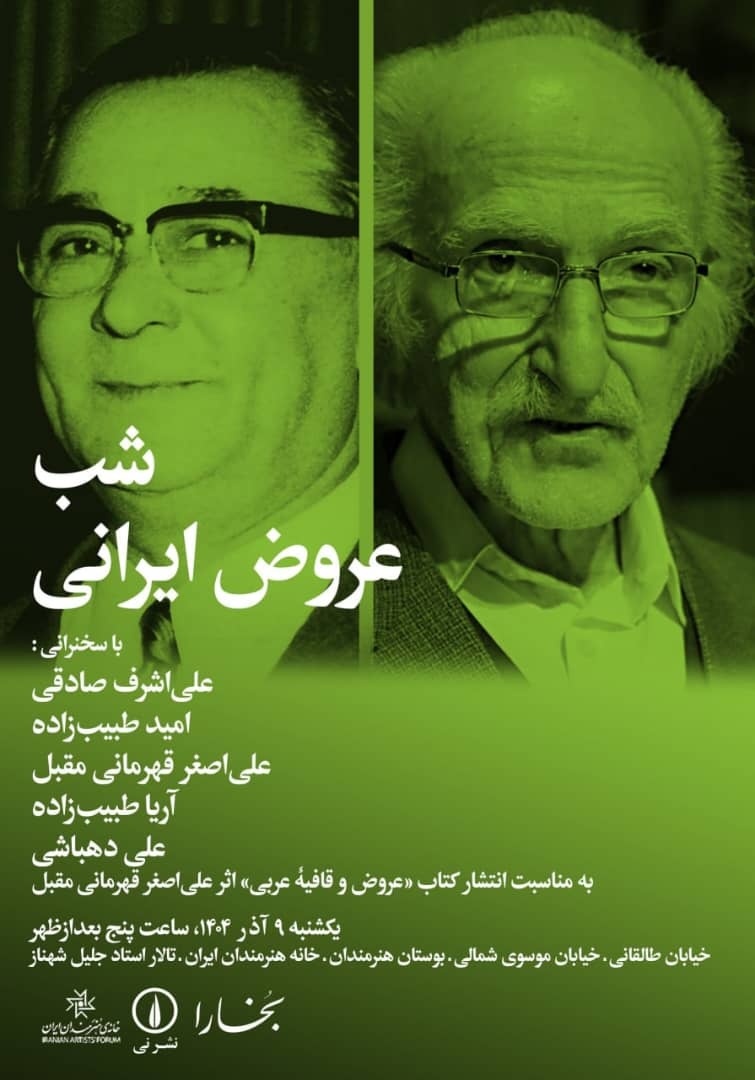
According to the Iran Book News Agency (IBNA), this session will be held at 5 PM on Sunday, November 30, 2025, with speeches by Ali Ashraf Sadeghi, Omid Tabibzadeh, Ali Asghar Ghahramani Mogbel, Arya Tabibzadeh, and Ali Dehbashi at the Artists’ House of Iran, Master Jalil Shahnaz Hall.
Even if Khalil Ahmad Farahidi was not of Iranian origin, he was certainly influenced by the Iranian tradition in elucidating the rules of Arabic prosody, establishing a foundation for this science in the second century AH that remains valid and effective to this day. For this reason, Arabic prosody can and indeed should be placed under Iranian prosody. From the beginning of Persian poetry in the third and fourth centuries AH, Iranians were so influenced by Khalil Ahmad’s prosody that instead of explaining the specific rules of Persian prosody, they imposed Khalil’s prosodic rules on Persian poetry. This situation, which lasted for centuries, finally ended with the efforts of masters such as Parviz Natel Khanlari and especially his worthy student, Master Abolhassan Najafi, and Persian prosody gradually acquired its own specific rules. The Iranian Prosody Night seeks to discuss the history of Persian poetic meter before Islam, the new achievements of Iranian prosodists, and Khalil Ahmad’s legacy in Arabic poetry.
The book ‘Arabic Prosody and Rhyme’ by Ali Asghar Ghahramani Mogbel is the most comprehensive book on Arabic prosody and rhyme written in Persian since the establishment of Khalil ibn Ahmad’s prosody. This book is in fact a much more detailed version of another book that Ghahramani Mogbel had previously written, which was the only existing reference on Arabic prosody and rhyme in Persian. In this book, the author not only fully describes the rules of Khalil’s prosody, introduces Khalil’s prosody with a new and scientific approach, and in addition to all the details of Khalil’s prosody, also discusses some traditions, forms, and features outside of Khalil’s prosody in Arabic poetry, as well as the meter of contemporary Arabic poetry. The comprehensiveness and scientific method of the book have made it not only an outstanding work in Persian but also one whose merits cannot be matched by any work even in Arabic.
This session will be held at Talaghani Street, North Mousavi Street, Artists’ Park, Artists’ House of Iran, Master Jalil Shahnaz Hall.





