Unveiling of ‘Toopkhaneh Square, Naseri Darulkhilafeh’/ How did a square with a military nature become an important public space in the city?
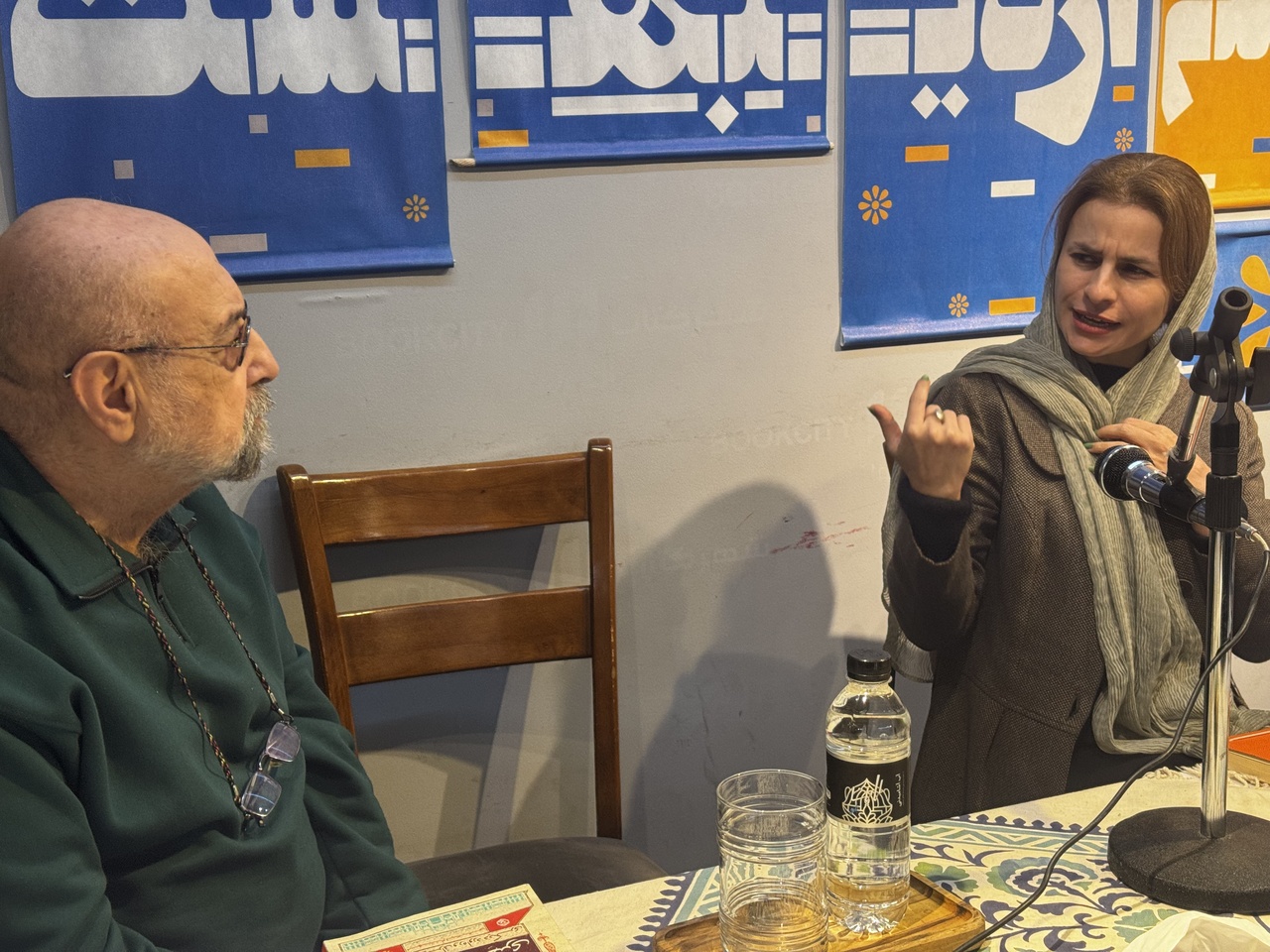
According to the correspondent of the Iran Book News Agency (IBNA) in Isfahan, Aridibesht Book City of Isfahan hosted the unveiling ceremony of the published book ‘Toopkhaneh Square, Naseri Darulkhilafeh’. The session was held with the presence of enthusiasts in the field of architecture, urban history, and publishing, and hosted by Ali Khodaei, a writer and book critic. Mahnam Najafi, architect and author of the book, spoke in detail about the reason for writing the work, the research process, and the importance of Toopkhaneh Square in the history of Tehran.
At the beginning of the meeting, Najafi referred to her entry into the master’s program in Iranian architectural studies in 2006 (1385 SH), recalling: This program, from the outset, was a cohesive and purposeful collection of influential professors in the field of architecture and cultural heritage. The experience of these three years was very valuable for me and full of scientific achievements. She explained that a group of professors such as the late Bagher Ayatollahzadeh Shirazi, Seyyed Mohammad Beheshti Shirazi, Zahra Ahari, and Mehrdad Ghayoumi had extensive experience and concerns in this field, and this motivation and academic environment provided a suitable research ground for the formation of the present work.
She added: My main problem during this research was examining one of the most important public spaces in Tehran during the Qajar period; a space that has a military body but at the same time was considered a completely public and lively arena for citizens.
The author explained: This central research question was formed from the very beginning: how could a square with a military nature simultaneously become the most important public space in the city and create interaction between people and the urban space?
History of Research and Motivation for Writing the Book ‘Toopkhaneh Square, Naseri Darulkhilafeh’
Najafi described the formation path of the book, saying: This work is actually the result of my master’s thesis, and the research began with a simple question; imagine an open square with a collection of cannons ready to fire, how can it be a public and lively space for people?
She continued: Naseri Toopkhaneh Square not only had a defensive role but was also a place for social, commercial, and cultural events. This very contradiction and coexistence of two contrasting qualities became the main axis of my research.
The author of the book ‘Toopkhaneh Square, Naseri Darulkhilafeh’ added: Studying multiple historical sources, European and Iranian travelogues, Qajar era maps, and existing visual documents were among the primary research sources. She recalled that evidence indicates Naseri Toopkhaneh Square, with the deployment of cannons and artillerists in the lower chambers and numerous public activities, was considered a unique example in the urban history of Tehran.
Najafi pointed out: During the research, she found that cannons in Iranian urban culture, besides their military role, had symbolic and cultural functions and gradually achieved a kind of sanctity and social status.
She noted: Cannons became symbols of power and blessing among people. This characteristic, in addition to its historical value, gave Naseri Toopkhaneh Square a cultural dimension.
Naseri Toopkhaneh Square, a Military and Public Arena
The architect explained by describing the physical body of the square: There is a pool in the middle of the square, and cannons are stationed on its four sides. Around the square were chambers where the cannons were placed, and artillerists were stationed on the upper floors. This spatial organization provided the possibility of actual military utilization.
She added: Her research shows that six major city streets branched off from this square, and this urban connectivity increased the square’s importance as a center for social, commercial, and cultural activities in the capital.
Najafi emphasized: While this square had defensive tools, it was considered one of the busiest and most vibrant public spaces in Tehran.
She continued: Field and historical study shows that people’s interaction with the cannons indicates a complex coexistence that, contrary to today’s perception, was not incompatible. This issue was particularly attractive to me as an architectural and urban history researcher and is considered the main motivation for writing the book.
Najafi went on to refer to the role of cannons in various urban events and said: Cannons were fired during celebrations, religious holidays, New Year’s Day, and governmental ceremonies, and this act not only had military significance but also helped evoke joy, blessing, and social security.
She added: These findings show that cannons had a presence in people’s daily lives in symbolic, cultural, and functional ways.
Unveiling of the Book ‘Toopkhaneh Square, Naseri Darulkhilafeh’ and Audience Reaction
In the concluding part of the session, Ali Khodaei, as the host, pointed to the importance of the book, saying: Najafi’s work is a combination of historical research, physical analysis, and examination of social interaction with urban space, and it can be a suitable model for future research in the field of squares and public spaces in Iranian cities.
In response to audience questions about the book writing process, Najafi explained: Studying historical sources, travelogues, and Qajar era maps, and analyzing the physical structure of the square constituted the bulk of the research. I tried to present historical data and observations in an understandable and attractive way for the audience.
She added: In this research, in addition to technical and architectural analysis, the cultural and social aspects of the square have also been addressed. According to her, this book can provide a fresh perspective on people’s interaction with historical urban spaces and show how a military square can become a public and active arena.
At the end of the ceremony, the audience reviewed the book and spoke with the author, expressing their positive feedback on the research and writing value of the work. Many audience members emphasized that the book is considered an interesting and informative study not only for history and architecture researchers but also for those interested in knowing historical Tehran.
Najafi concluded the session by saying: My goal in writing this book was to re-examine the role of Toopkhaneh Square in the history of Tehran and analyze its interaction with people’s social lives. I hope this work can help increase the attention of researchers and enthusiasts to public spaces in Iranian cities.
Given the content value of the research, the book ‘Toopkhaneh Square, Naseri Darulkhilafeh’ has now become one of the reliable sources in urban history and architectural studies in Iran and can be a suitable model for future research in this area.
The book has been published by Rozaneh Publishing and is available to researchers, students, and enthusiasts. Among the distinct features of the work is its simultaneous attention to the physical body, history, and urban culture, which transforms Toopkhaneh Square from a mere military arena into a social and lively space.
The unveiling ceremony in Isfahan Book City, attended by a group of experts, enthusiasts in architecture and publishing, and urban history researchers, showed that this book has managed to attract the attention of a wide range of specialized and general audiences and initiate new discussions about the interaction between the city, the square, and the people.





