American anthropologist and the study of Qom Seminary as the center of the revolution / Iran: Philosophical-religious roots of conflict with Pahlavi / Decoding the Iranian Revolution
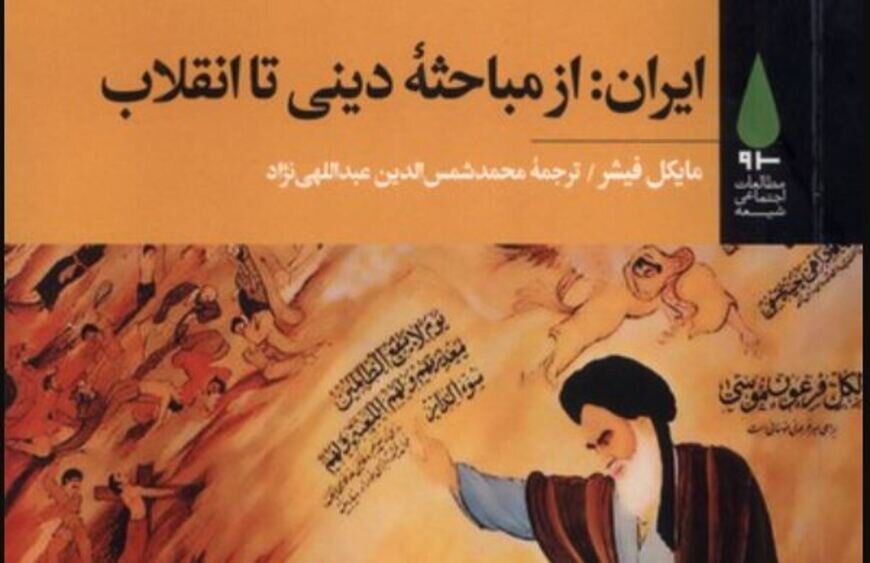
The following is a brief overview of Michael Fischer’s book, “Iran: From Religious Dispute to Revolution,” translated by Mohammad Shamseddin Abdollahi Nejad, and published on the website of the Documentation Center of the Islamic Revolution in Qom. In this book, Fischer emphasizes that understanding the Islamic Revolution in Iran is impossible without examining the practical implications on the deep cultural, social, and religious structures of society, especially in the city of Qom and its seminaries. This book is one of the first and most profound anthropological studies of the Revolution, based on extensive fieldwork in Qom and interaction with clerics and students (first published in 1980). Fischer’s book demonstrates how “common sense” and religious beliefs (especially the Karbala model and Muharram mourning rituals) permeated society’s layers, and how religious institutions (seminaries) were structured to eventually become an arena of confrontation with the Pahlavi technocratic government.
From a structural content perspective, the book, in six chapters, examines the fundamental concepts of Shia culture and history, specifically addressing the history, structure, and function of Qom’s seminaries (as an “open university”), the confrontation between the clergy and the government in Qom (such as the events of June 5, 1963), and how Shia discourse transformed into an ideological revolutionary movement in the years 1977-1979 (1356-1358 SH). The importance and credibility of this work stem from its documentary nature and multi-layered analysis of the deep socio-religious roots of the revolution, making it known as a “key to understanding the revolution and the entire society of Iran,” and it continues to be a fundamental source in Iranian studies. This short report is presented for your consideration:
Note
The following article is dedicated to introducing the book “Iran: From Religious Dispute to Revolution,” written by Michael Fischer. This introduction is based on the English version. The specifications of the original English and Persian translation of the book are as follows:
- Michael Fischer, Iran: From Religious Dispute to Revolution, 1980
- Michael Fischer, Iran: From Religious Dispute to Revolution, translated by Mohammad Shamseddin Abdollahi Nejad, Arma Publishing, 2025 (1404 SH).
Dr. Michael Fischer
About the Author:
Michael M. J. Fischer (born 1946) is an American anthropologist and professor at the School of Anthropology and Social Sciences at MIT. He completed his education at the London School of Economics, Johns Hopkins University, and the University of Chicago, receiving his doctorate in 1973 with a dissertation on the sociology of Zoroastrians in Yazd. Throughout his academic career, Fischer has conducted extensive studies and research on Iranian society, traveling to Iran multiple times for fieldwork.
His areas of expertise include economic anthropology, sociology of religion, and humanities and social science studies. Among his prominent works is this very book, “Iran: From Religious Dispute to Revolution” (first published in 1980 by Harvard University, second edition in 2003 with a new introduction by the University of Wisconsin). Fischer has also written other books on Iranian culture and literature; for example, a collection of essays on contemporary Iranian poetry (illustrated “Silent Nightmares and Blind Owls”) and studies on Zoroastrians and religious rituals in Iran.
About the Book:
“Iran: From Religious Dispute to Revolution” is one of the first and most profound anthropological and sociological studies of the Islamic Revolution of Iran and the role of religion within it. Fischer wrote this work based on extensive fieldwork in the holy city of Qom; in Qom, he interacted with clerics and students and closely observed the religious and daily life of the people.
The book’s approach is analytical and multi-layered; instead of merely addressing the political events of the revolutionary years, the author delves into the deep cultural, social, and religious structures of Iranian society. Fischer’s goal is to show how religious beliefs and “common sense” played a role in various layers of Iranian society and how religious institutions (especially seminary schools) were formed and transformed in the pre-revolutionary period.
The original version of the book was published in 1980 (Harvard University Press) and reissued in 2003 with a new introduction by the University of Wisconsin Press. In the new introduction and addition, Fischer also discusses post-revolutionary Iran and the changes in the early years of the Islamic Republic. By meticulously examining the history and social realities of Iran, this book presents a dynamic picture of the changing society of that time, which remains fundamentally important for understanding Iranian society in the 21st century.
The book’s content is extensive and well-documented. Unlike many quick and superficial analyses of the revolution published in 1978 (1357 SH), Fischer compiled a systematic and coherent collection of fieldwork, interviews, and observations to explain the deep socio-religious structures of Iran. The book consists of six main chapters, a concluding chapter (related to Muharram 1979/1358 SH), several explanatory appendices, and detailed subject indexes and references.
In different chapters, in addition to analyzing historical events, it addresses points such as the religious worldview of the people, the role of mourning ceremonies and Shia rituals in shaping collective beliefs, the structure of Qom’s seminaries, and the ideological conflicts between the authoritarian Pahlavi government and the clergy.
Critiques and Feedback:
Upon its publication, this book received widespread attention from experts and critics and garnered positive feedback. For instance, Peter Chelkowski (Professor at Harvard University and editor of Asia journal) described the work as “a key to understanding the recent revolution and the entire society of Iran.”
Furthermore, reputable publications such as “California Academic Press” evaluated it as a comprehensive and brilliant introduction to the lesser-known dimensions of Iran’s religious history. This reception indicates that Fischer’s comprehensive view of pre-revolutionary and revolutionary Iran continues to be of interest to Iranologists.
Table of Contents and Chapter Explanations
The book is organized into six main chapters and a concluding section, which sequentially examine the following topics:
Chapter One: “Culture, History, and Politics”
This chapter begins by explaining fundamental concepts. Fischer first attempts to identify Iranian “culture” and the symbolic structures that play a role in public consciousness. He describes the role of “common sense” and religious beliefs in people’s daily lives. He then examines the history of interaction between religion and power, showing how religious beliefs became involved in Iranian history’s transformations (from the Safavid to the Pahlavi eras). Overall, Chapter One defines the conceptual framework of the research and emphasizes that cultural and historical assumptions are key to understanding the revolution and its aftermath.
Chapter Two: “The Rise and Fall of the Seminary School”
This chapter outlines the history of Shia Islam and the formation of the religious education system (“Seminary School”) in Iran. The first part of the chapter is dedicated to the intellectual foundations of Shia Islam: the author explains the “Karbala model,” which includes the memory of the Ashura event and the status of the Prophet’s household, demonstrating its importance in the collective spirit of Iranian Shias.
It also examines the process of the officialization of the Shia religion in Iran (since the Safavids) and how the sacred texts of Shiism were compiled and established. Subsequently, Fischer compares the “classic form of the seminary school” with examples of Jewish and Christian religious schools to clarify how this educational tradition works and what its characteristics are. At the end of the chapter, the reasons for the relative decline of this traditional structure are discussed; for example, the impact of the Pahlavi government’s educational reform programs and social developments on reducing the influence of the old religious education system are analyzed.
Chapter Three: “The Seminary School: Style and Content”
This chapter specifically focuses on the nature and function of Qom’s seminaries. Fischer first describes the seminary as an “open university”; meaning that almost anyone can study there without cost, and classes are held with their particular independence. He then elucidates the internal structure of this institution, discussing the number of students and professors, educational innovations, and internal problems and challenges.
In the next section, he introduces the “ruling elite” of the seminary; those who hold the role of religious authority (Marja’ al-Taqlid) and are the main jurisprudential decision-makers. In contrast, he also pays attention to the “intellectual elite,” namely religious preachers and speakers, who play an important role in transmitting religious messages to the people. In this chapter, Fischer shows how the structure of power and knowledge in the seminaries is organized and how relationships between high-ranking clerics and preachers have formed.
Chapter Four: “Qom: The Arena of Confrontation”
This chapter analyzes the city of Qom as the site of confrontation between the Shia clergy and the Pahlavi government. The author first outlines the historical process of Qom’s formation as a religious “pilgrimage city” and reviews its relationship with royal power (both during the Qajar and Pahlavi periods). He then shows how the central government’s efforts to expand the administrative and national system (especially during the Pahlavi era) conflicted with traditional clerical institutions. This chapter also addresses important events such as the June 5, 1963 uprising (protests related to Imam Khomeini’s movement). Fischer examines important events that occurred in Qom and acted as sparks for public opposition against the Shah. Finally, he describes the confrontation between two “governance styles”: the technocratic-modern governance of the Pahlavis and the governance style based on religious thought and teachings, and examines the outcome of this struggle in the political atmosphere of pre-revolutionary Iran.
Chapter Five: “Discourse and Imitation: Shiism in Everyday Life”
In this chapter, Fischer analyzes how Shia beliefs permeated the daily lives of Iranians. He first delves into the inner and mystical dimensions of Shia religion: he speaks of the influence of mysticism and the pursuit of self-purification among religious groups, explaining the specific language and speaking style of the educated class and clerics.
He then addresses the social utopia envisioned by the scholars; meaning how believers seek political and economic justice within the framework of religious teachings (such as the conduct of Imam Ali (AS) and Imam Hussein (AS)) and what place individual moral behavior holds. Fischer argues that a set of beliefs and ideas influences people’s economic life (such as economic justice in Islam) and daily ethics.
The final section of the chapter is dedicated to religious rituals and public ceremonies: the author shows how rituals like Ta’ziyeh, Muharram mourning, and other religious dramatic manifestations act as “religious dramas” in the lives of the masses, transmitting their religious meaning.
Chapter Six: “The Revolutionary Movement of 1977–1979 (1356–1358 SH)”
This chapter is divided into six main topics. The first section (“Social Drama: Political Liberation”) narrates the final events leading to the revolution. Fischer begins with an “Introduction” and then categorizes the important events: Muharram 1977 (June 5, 1977, the start of a new wave of protests), Ramadan and Black Friday 1978 (bloody protests of September 8), and martial law and Muharram 1978 (bloody uprisings in Isfahan and Tehran). He also explains the victory of the revolution in 1978 and the problems thereafter.
In the second section (“Ideological Revolution”), Fischer examines the role of religious ideology in shaping the revolution: how the Karbala model transformed into “active fervor” and explains the principle of “governance in the school of [Imam] Ali (AS) and [Prophet] Muhammad (PBUH).” Finally, the chapter refers to the “New Era”; meaning how Iran entered an atmosphere dominated by the slogans and intellectual structures of the Islamic Revolution. Overall, this chapter analyzes the revolution of 1978-1979 as both a socio-political event and an ideological phenomenon.
End of the Book: “Muharram 1979 (1358 SH)”
After Chapter Six, the book concludes with a dedicated final chapter on the events of the first Muharram after the revolution. In this section, Fischer examines how the “Muharram spectacle” (rituals and mourning processions after the victory of the revolution) reflected the revolutionary atmosphere and new ideals.
He pays special attention to the role of the younger generation in these processes, showing how revolutionary students and adolescents entered the arena of slogans and religious ceremonies. In addition, ongoing discussions about the future of the revolution and subsequent social transformations (from the perspective of “continuing discussions”) are contemplated. In summary, this section is the author’s final statement, tracing the religious-social situation of Iran during the transitional period after the fall of the Shah and the beginning of the Islamic Republic.
The book concludes with several detailed appendices and a glossary. The appendices include a list of seminary courses, a list of Shia Marja’ al-Taqlid, statistical charts for Qom, a timeline of religious and governmental developments, and financial information on religious institutions. Likewise, extensive lists of names and sources are provided at the end of the book to easily follow the referenced discussions.
Conclusion:
Pre-revolutionary Iran was influenced by a deep religious heritage and historical social traditions. Fischer’s book, with documented and analytical language, proves that understanding the Islamic Revolution is impossible without addressing these cultural roots. This work, combining history, sociology, and ethnography, provides a multifaceted picture of Iranian society during that period. The book’s content continues to hold validity among researchers and enthusiasts of contemporary Iranian history and is recognized as a key source in studies of the Islamic Revolution and the sociology of religion.