The aggression of the Zionist regime showed their hatred towards the Islamic world
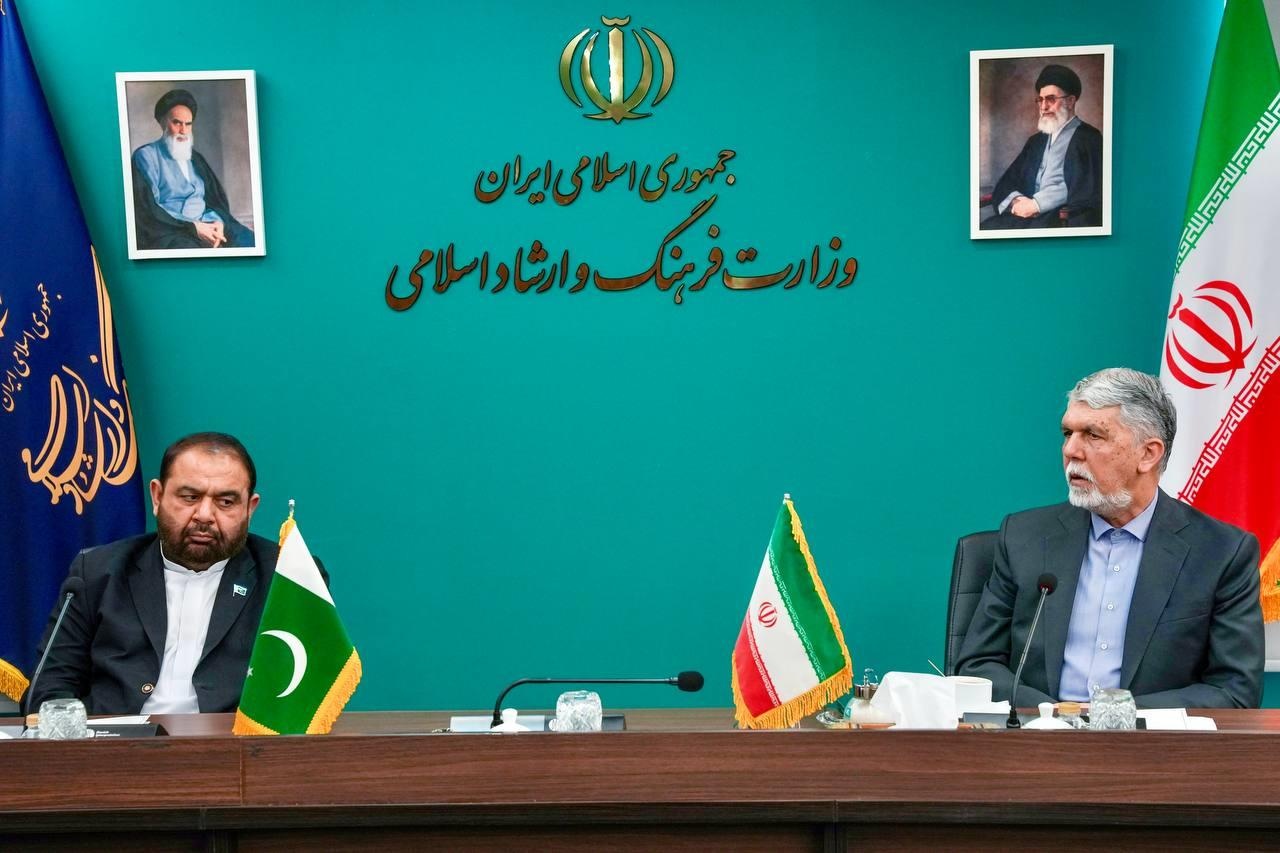
According to Iran Book News Agency (IBNA), quoting the Public Relations and Information Center of the Ministry of Culture and Islamic Guidance, Seyed Abbas Salehi, the Minister of Culture and Islamic Guidance, stated in this meeting, in response to the remarks of Pakistan’s Minister of Culture and National Heritage regarding the Zionist regime’s aggression against Iran: “The 12-day war was not merely a confrontation between two nuclear powers against Iran; rather, it demonstrated the Zionist regime’s hatred towards the Islamic world, and we were one of the targets of this hatred.”
He stated: “What sustained us during these 12 days was the wise leadership of the Supreme Leader, the resilience of the Iranian nation, and the solidarity of Muslim nations worldwide, especially the government and people of Pakistan.”
The Minister of Culture and Islamic Guidance further said: “I thank you for accepting Iran’s invitation for the Fajr International Film Festival.”
He added: “During the Iranian President’s visit to Pakistan, a cultural exchange program between the two countries was signed, creating a valuable opportunity to operationalize these programs.”
Salehi continued: “I propose that a joint working group be formed by the two countries to implement the agreement and to follow up on the operationalization process of the program signed by the Presidents of Iran and Pakistan.”
The Minister of Culture and Islamic Guidance said: “Recently, in the Public Culture Council of the country, due to the Iranian nation’s interest in Allama Iqbal Lahori, Iqbal Day was included in Iran’s official calendar.”
He stated that individuals whose names are officially placed on Iran’s calendar must undergo specific procedures, adding: “Allama Iqbal Lahori is the only non-Iranian personality to have entered Iran’s calendar; this event can be a turning point for the cultural relations between the two countries.”
Salehi added: “Fortunately, we had already taken steps, and an agreement for filmmaking on the subject of Iqbal Lahori was signed between the Cinematic Organization of Iran and Pakistan. We must bring that project to fruition as soon as possible and produce a high-quality feature film about Iqbal Lahori.”
The Minister of Culture and Islamic Guidance, stating that Iqbal Lahori’s name can be considered a common symbol of cultural relations between Iran and Pakistan, said: “Activities can also be carried out on other topics under the title of Iqbal Lahori, such as the ‘Iqbal Lahori Literary Award’ as a joint award between Iran and Pakistan.”
He further added: “Cinema is one of the notable areas for communication between the two countries, and we are pleased that you accepted our official invitation to participate in the Fajr International Film Festival and traveled to Iran for this purpose.”
Salehi, stating that during your stay in Iran you will become more familiar with the capabilities of Iranian cinema, emphasized: “Iranian cinema is one of the most reputable cinemas globally and regionally, and through this path, we can establish more connections with each other.”
The Minister of Culture and Islamic Guidance said: “In this regard, various ideas can be considered, including joint productions, joint visits, cinematic events, using cinematic locations in both countries, and many other aspects.”
Referring to the Pakistani Culture Minister’s proposal for Pakistani cinema students to study in Iran, Salehi stated: “We welcome this, as it will certainly help the cinematic relations between the two countries.”
The Minister of Culture and Islamic Guidance also spoke about the Persian language and manuscripts, saying: “The Persian language is not merely the language of the Iranian people; rather, for a long time, it has been a connecting link between us and others, especially in relation to Pakistan.”
He stated that when we speak of the Persian language, we are in fact talking about a shared heritage between the two nations, adding: “A figure like Allama Iqbal composed a significant portion of his poetry in Persian, and for us, he is considered a national poet.”
Salehi, while thanking the various Pakistani governments for the opportunities they have provided for the Persian language, emphasized: “The Pakistani government has taken the view that attention to the Persian language is not attention to a foreign language, but rather attention to a language rooted in Pakistan’s history.”
The Minister of Culture and Islamic Guidance said: “Therefore, greater familiarity and proficiency with the Persian language in Pakistan is considered attention to the shared heritage of the two countries.”
He stated that fortunately, Iran’s cultural centers and universities in Pakistan provide an opportunity for the expansion of the Persian language, adding: “Considering that the economic languages of the world have changed, perhaps there is less perceived need for Persian compared to some economic languages.”
Salehi continued: “Since the Pakistani government also considers Persian as its heritage language, we must jointly strive to ensure that interest in the Persian language continues among the Pakistani nation.”
The Minister of Culture and Islamic Guidance then outlined some proposals for better achieving these goals, saying: “Pakistani universities should at least offer Persian language as an optional course for students, or provide scholarships to Persian learners to foster their interest. In this area, we can also have joint discussions on how to ensure the Persian language continues in Pakistan.”
Salehi added: “In this regard, we are ready to consider the proposals of the Pakistani government to pursue joint projects.”
The Minister of Culture and Islamic Guidance said: “Persian manuscripts are a part of our history, heritage, and identity in Pakistan, and a significant part of the connection between the two nations. Perhaps a prominent part of the relationship between Iran and Pakistan is based on this feeling, and we can undertake serious joint work in this area as well.”
Salehi, stating that various Pakistani museums are rich in resources important to us and contain significant manuscripts, emphasized: “Cooperation between the Ministry of Culture and the National Library of Iran with active organizations in Pakistan is important.”
The Minister of Culture and Islamic Guidance said: “On the sidelines of a previous meeting I had with you, I mentioned that at the meeting of the Foreign Ministers of Islamic countries, it was decided that Muslim nations would commemorate this year (the lunar year) as the 1500th anniversary of the birth of Prophet Muhammad (PBUH) in a special way.”
He added: “The interest of the Muslim nations of both countries in the Prophet of Islam (PBUH) provides an opportunity for us to undertake joint bilateral actions under the umbrella of this great event.”
Salehi said: “Over these 15 centuries, the nations of both countries have shown their affection and love for the Great Prophet of Islam (PBUH) in various literary, artistic, and social forms. This love has also manifested in contemporary art forms in the modern era, and on the occasion of this grand event, joint programs can be designed between the two countries.”
The Minister of Culture and Islamic Guidance continued: “Numerous measures are underway in Iran in this regard, and a committee has been formed for this purpose, with various sub-committees. One of these is the Committee for Communications and International Relations on this topic, chaired by the Ministry of Foreign Affairs of the Islamic Republic, with its secretariat located in the Islamic Culture and Relations Organization.”
You resisted like a rock in the 12-day war
Aurangzeb Khan Khechi, Pakistan’s Minister of Culture and National Heritage, also said in this meeting: “On behalf of the Pakistani nation, I congratulate you; Israel’s attack on Iran was an attack on all Muslims, and you resisted like a rock.”
Pakistan’s Minister of Culture and National Heritage said: “As a result of the efforts of cultural officials of both countries during the Iranian President’s visit to Pakistan, documents were signed by both parties, which indicates our forward movement. In this regard, I agree with your proposal to form a joint working group between the two countries, and it should be on the agenda.”
He added: “I thank you for registering Allama Iqbal’s birthday in Iran’s national calendar and call for more activities centered around Iqbal’s personality.”
Pakistan’s Minister of Culture and National Heritage said: “The proposal for a joint Iqbal award is also a good one, and we are with you on this path. We must work jointly on Allama Iqbal Lahori’s personality, as he was a great leader for Pakistan, and with his guidance, we were able to establish Pakistan. In this regard, I commend your perspective on Allama Iqbal.”
He added: “Iran has extensive experience in film and television series, and we are keen to utilize this experience. It is possible to establish a joint working group to achieve this goal.”
He added: “The Persian language is considered one of the elements of Pakistani Muslims’ identity, and it is one of the factors by which every Pakistani recognizes themselves, and our history has been written in Persian.”
Pakistan’s Minister of Culture and National Heritage said: “When I was a student, Persian language was offered as an optional course, and I took it. We can help improve the status of the Persian language in Pakistan.”
He stated that the issue of scholarships will be put on the agenda, adding: “Valuable Persian manuscripts are preserved in galleries in Pakistani museums. We will strive to revive the status of the Persian language in Pakistan.”
Pakistan’s Minister of Culture and National Heritage said: “We consider love for Prophet Muhammad (PBUH) as one of the pillars of faith. We propose that Iran hold an art exhibition in Pakistan, and we will also hold an exhibition in Iran, displaying works related to love for the Noble Prophet of Islam (PBUH).”