How From Plow to Instagram Shape Our Thoughts? / Left Economics, Right History; The Secret to Human Success in Joint Cooperation
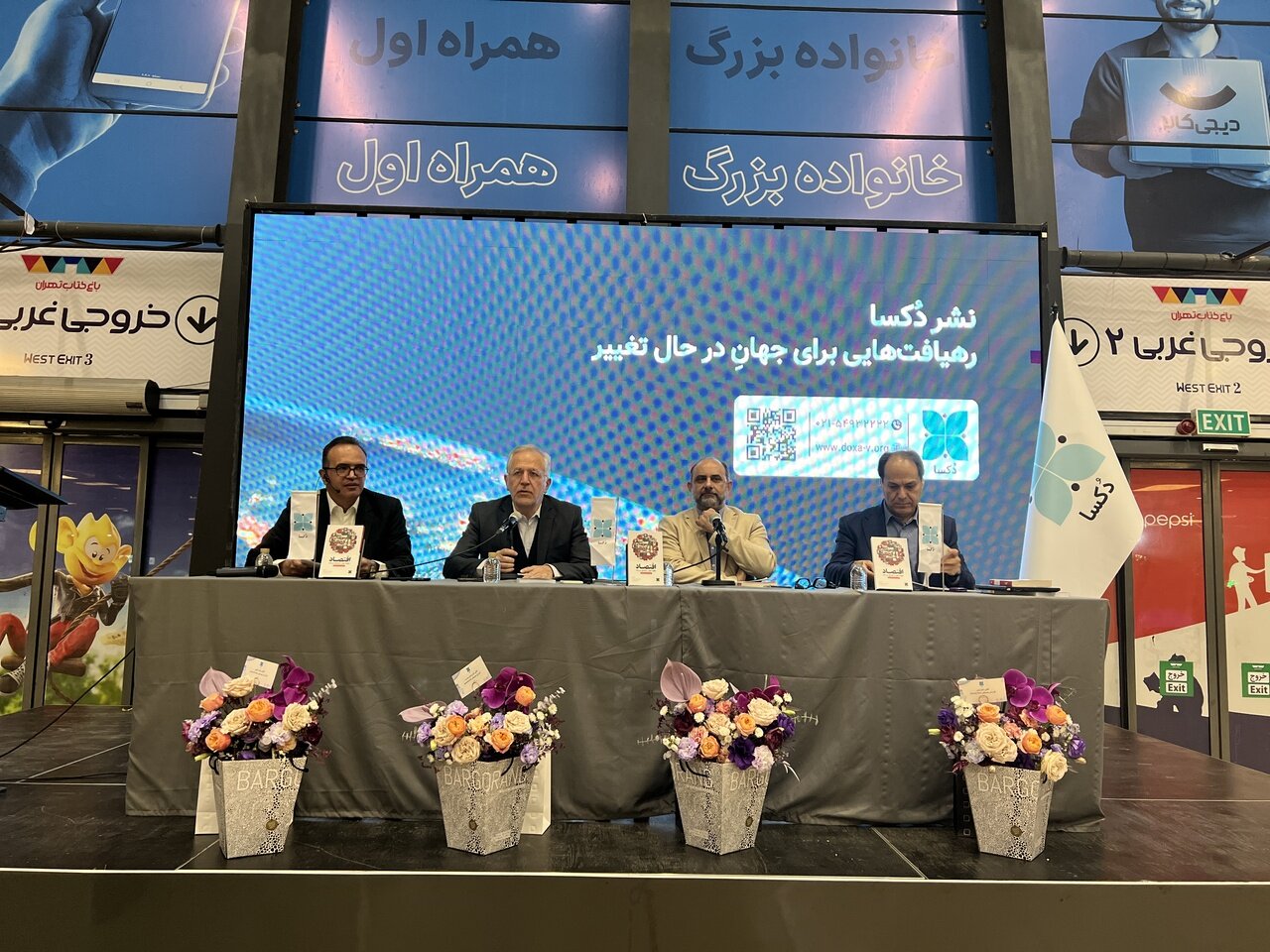
According to Khabaronline News Agency, Sobhan Kiani wrote in IBNA’s Religion and Thought service: The book ‘Economics How the World Explains’ was unveiled by Dexa Publishing on November 23rd at 6 PM at Tehran Book Garden. This book is written by Andrew Leigh, translated by Vahid Mousavidaver, and published with an introduction by Farhad Nili. In this session, economist Farhad Nili, archaeologist Hamed Vahdatinasab, psychiatrist Azarakhsh Mokri, and philosophy researcher Mohammad Ali Niazi delivered speeches and offered points about the book, its author, and its good translation. The session was met with wide interest from enthusiasts, but due to some issues, it was not possible for all registrants to attend.
The Transformation of Economics from Moderation to Economy
At the beginning, Mohammad Ali Niazi, while welcoming the attendees and speakers, made some points about the book and said: Tonight, in this gathering, we will examine this book from three perspectives—a book that explores human behavior, its messages, decisions, and the meaning of its choices from the angles of economics, paleoanthropology, and psychology. Contrary to our perception, economics is not merely a science dealing with numbers, figures, and decimals; it is a broad philosophical concept.
I conducted a search on the word ‘eqtesad’ (economics) in the Persian language to understand its original meaning. In ancient Persian literature, ‘eqtesad’ meant moderation, borrowed from the Arabic word ‘qasd’. For instance, when it is said: ‘If you have taken me into your work, look upon me, for without moderation, a country cannot be organized.’ Here, ‘eqtesad’ means the same moderation I mentioned earlier. As we move forward, we witness the evolution of this word during the Qajar era and before the Constitutional Revolution in some writings of Mirza Malkam Khan Nazem-al-doleh, who in a treatise in the Office of Regulations and also in his own newspaper, Qanun, states that economics is the basis of the country’s progress.
Also, Talebof, an intellectual of the Naserian era, says: Human economy results from knowledge, industry, and division of labor, and any nation that falls short in these three remains poor and needy. Talebof is one of the first to use ‘eqtesad’ in its modern sense, close to ‘economy’.
Farhad Nili
Left Economics, Right History
The next speaker, Farhad Nili, presented his points and said: The approach of history to economics and economics to history is new, for which I offer two signs: First, in 1993, Douglass North won the Nobel Prize in Economics for the first time for his work in history, and the awarding of this prize was so novel to someone who looked at economics through the lens of history that Joel Mokyr, who won this year’s Nobel Prize in Economics, says, ‘When I heard Douglass North received the Nobel Prize, my eyes filled with tears, thinking, finally, they gave us a Nobel Peace Prize.’
Recent Nobel laureates in Economics from 2024 to 2025 have had a historical approach to economics. Joel Mokyr teaches in two departments, History and Economics, at Northwestern University, and as he puts it, ‘I am left economics and right history.’
He continued: Therefore, today’s topic is a new discussion about whether we should use economic knowledge to explain history or use historical insights to elaborate on economics. In my opinion, the subject of this book is to explain possible changes in human life. History, in my view, is our greatest teacher, giving us two lessons: first, where change is possible, and we should resolve to change; second, where change is impossible within the existing technology and institutions, and we should try to prepare the means for change.
This book is full of changes that have occurred throughout three hundred thousand years of human history in small increments, and more frequently in the last ten thousand years. But the feature that captivated me about this book is its shift from the question ‘what’ to the word ‘why’ – why these changes have happened. Our inquisitive mind, whenever it encounters a change that has altered the unchangeable form of human life, must ask ‘why’.
There are many examples. For instance, why did feudalism last for ten centuries? What were the differences between Western, Russian, Chinese, and Japanese feudalism? Why did the Industrial Revolution occur in 18th century England? Why didn’t it happen before then or somewhere else? History provides us with enough raw material for social scientists to extract the ‘whys’. History shows us where we should accept impossible changes and where we should resolve to bring about possible changes.
Hamed Vahdatinasab
The Secret to Longevity in Joint Cooperation
Next, Hamed Vahdatinasab shared his points from the perspective of paleoanthropology and said: When Nili invited me to participate in this session, I was very surprised because I am very weak in economics. It wasn’t until I received the book that I understood why I had been honored with this invitation. I have a habit of finding flaws in books, but this book was a masterpiece, and I could only find one instance, even with strict scrutiny, where a plow was mentioned for ten thousand years ago, when iron had not yet been discovered.
Apart from this, I could find nothing else, and the translation is very readable and fluent. On page eighteen of the book, it is stated that economics deals with people’s behavior as individuals and how we cooperate with each other in families and companies. If we want to go back three to four hundred thousand years and then quickly return to the present, the most important key is how we cooperate with each other.
This was the most significant change that occurred in human evolution, leading to us being here today, while Neanderthals, Homo erectus, Homo floresiensis, or any other human species—who were successful in their own right, like Homo erectus, which lived on Earth for two million years with minimal resources—are no longer present, and today, nine billion intelligent humans populate the Earth.
None of the humans who lived before us even came close to this number. For example, a specific calculation shows that forty thousand Neanderthals lived on the continent of Europe, which was at the peak of Neanderthal flourishing. What happened that we became so successful?
He continued: The secret lies in joint cooperation. What provided this joint cooperation? A very complex brain that was not only larger in size than previous ones but also much more complex and thought in complex ways.
It could think about things it had never seen, which we call anticipation. It became possible for humans to think, ‘Where have I come from? Where am I? Where am I going?’ Humans could even produce fictional stories that everyone believed; this means having both the ability to produce abstract stories and the ability to understand them. Intelligent humans have produced many of these stories for us, such as economics, money, and many other things, all of which are shared narratives.
You cannot promise an animal something for tomorrow or the day after. Now, because we have the ability to understand this issue, we invest in things that are not currently tangible and do not yet exist but are intended to exist, or stories that were created to establish bonds. The story narrated in this book is how this joint work is formed among humans and what leap has occurred.
Ninety-nine percent of human history, meaning from the time we can easily call Homo erectus, one of our ancestors from two million years ago, human, no complex economic work was done. However, from ten thousand years ago, our ancestors entered a phase called food production. When food production increased, the population grew. Somewhere in the book, it is stated that when food production increased, humans became very happy, which is my criticism of the book’s author: did humans really become happier?
Azarakhsh Mokri
Tools That Shape Our Thoughts
The last speaker, Azarakhsh Mokri, referred to the psychological dimensions of economics and ancient humans, and made points about the book, saying: It is a very valuable and readable book, and what makes it attractive is the lightheartedness and logic that the author pursues in it. He has not made exaggerated claims and has tried to err on the side of caution, presenting it as a possibility. The deeper we go, the more we see the tremendous impact of economics, economic relations, wealth, and production on our psyche. I believe Andrew Leigh is not the first to raise this issue, as it has been discussed much more profoundly before him, but he has beautifully summarized the matter.
Our thoughts are created by intellectuals and thinkers, spread to others, and grow in society. Movements are formed through new ideas and thoughts; we have heroes who write books, enlighten, and I am not denying that, but what this book adds is that all these matters are not so simple. We have the perception that some people emerge to advocate for gender equality, but there’s an interesting aspect to this that we are unaware of.
He provides several examples, one of which is about the plow or ox-drawn plow. He says: In the past, for agriculture, a stick was inserted into the ground, and seeds were planted, but with the advent of the plow, people push it, and cultivated land increases, and production multiplies. Now, one point: pushing a plow requires a strong upper body, and this strong upper body is influenced by testosterone in men, which led to an advantage for men over women. The author mentions a civilization in the book where, because the use of the plow was less common, gender equality was also greater.
He also said: The tools we use, without us realizing it, strangely affect our psyche. He gives another example of the discovery of the mirror, stating that with the availability of mirrors, the concept of narcissism was transformed. There is a book that refers to matters before this and the discovery of the bow and arrow, which, because it somewhat reduced the role of brute force, also made the rights of women and people more equal, and that masterpiece sentence in this book says: God created men and women, and Samuel Colt made them equal.
Without criticizing philosophers and thinkers, it can be said that a large part of our intellectual domain has been shaped by the tools around us. At one time, humans said, ‘I don’t have what others have,’ but with the production of cheap goods and abundance, this problem was solved, and humans realized, ‘I can also have what others have,’ and it was during this period that 20th-century psychology was born.