Akbar Zanjanpour: Hadi Marzban suffered so much that I don’t know if it was good or bad that he left / Iraj Rad: The banning of ‘Tango of the Hot Egg’ caused his stroke
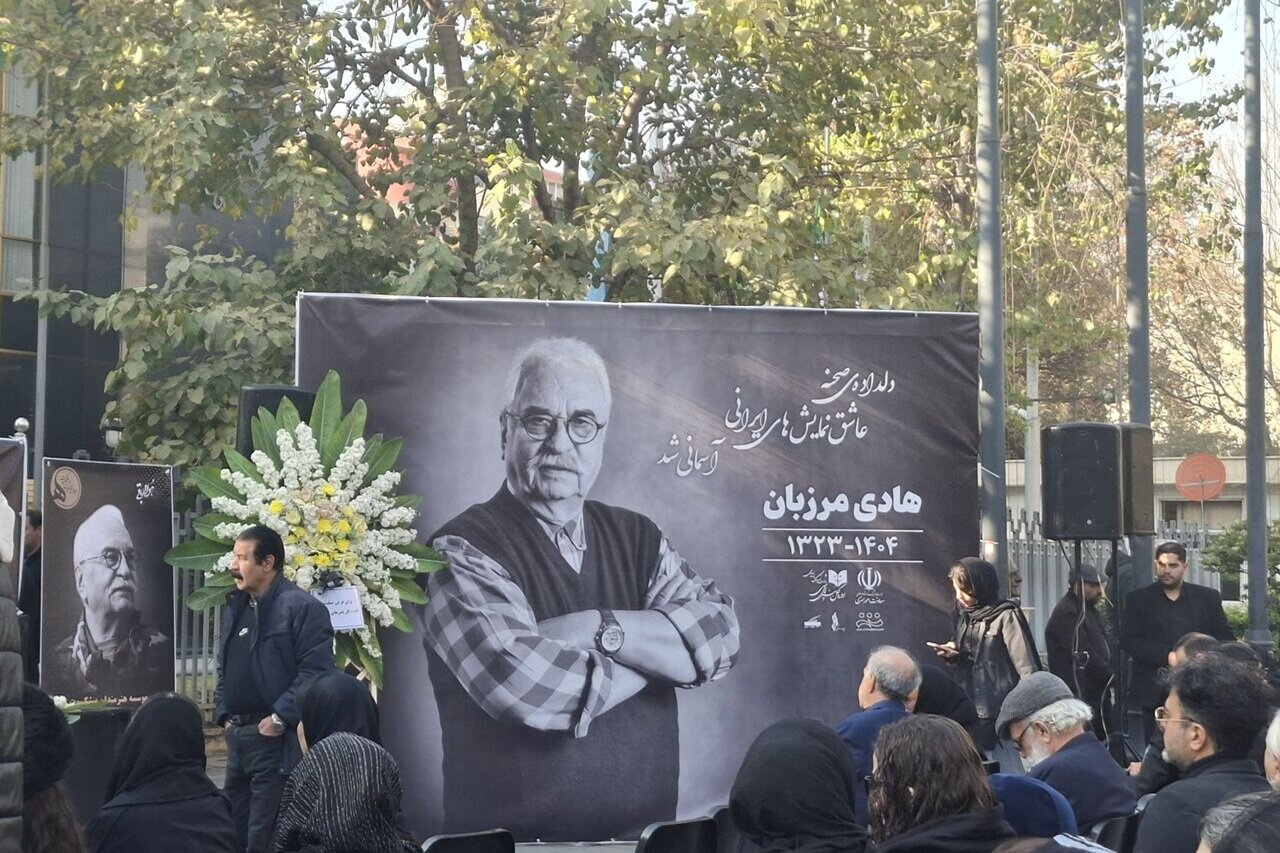
According to KhabarOnline news agency, citing ISNA, the funeral and burial ceremony for Hadi Marzban, veteran theater director and actor, began this morning, Tuesday, November 25th, in Rudaki Esplanade, opposite Vahdat Hall. A gathering of friends, artists, and colleagues attended the ceremony to bid farewell to him and escort his body to the artists’ section of Behesht-e Zahra cemetery.
Attendees of the ceremony included Majid Mozaffari, Akbar Rahmati, Akbar Zanjanpour, Shahram Karami, Farhad Sharifi, Parisa Moghtadi, Iraj Rad, Mehdi Ahmadi (Head of the Artistic Deputy), Niknam Hosseinipour, Morteza Kazemi (Former Deputy of Artistic Affairs), Atabak Naderi, Saeed Asadi, Reza Mardani (Director General of Dramatic Arts), Ayoub Aghakhani, Farhad Ayish, Maedeh Tahmasbi, Mehdi Shafiei (Former Director General of Dramatic Arts), Ra’ed Faridzadeh (Head of the Cinema Organization), Reza Fayazi, and others.
After the recitation of the Quran, Fereydoun Mehrabi, the program’s host, began the event by reading a poem by Shamloo.
Then Ali Nassirian offered condolences to the theater community and the people of Iran on the passing of Hadi Marzban as an active theater artist, adding: “One of Marzban’s characteristics was his activeness. Before the revolution, he was dispatched to cities as a theater expert because theater is a living art where humans express social issues to other humans, and it’s a kind of internal human surgery, very effective in society. Mr. Marzban served the youth greatly during that era. After the revolution, he turned to directing and staged most of Akbar Radi’s plays, in one of which I also acted, right here in Vahdat Hall.”
Nassirian, recalling a memory of his collaboration with Marzban in the play “Tango of the Hot Egg,” pointed out the banning of this play after 30 performances and reminded: “In a play, language expresses the characters’ personalities.”
He spoke of Marzban as a renowned artist who performed brilliantly, and people participated in his farewell ceremony out of respect for him.
Subsequently, Iraj Rad, another theater artist who had multiple collaborations with Marzban, as the second speaker of the program, offered condolences for the passing of Hadi Marzban and recounted the beginning of his acquaintance with him, saying: “I met him in 1968 at the Faculty of Fine Arts. For years, he was engaged in teaching theater in the northern cities of the country, and then, returning to Tehran, he knew that theater work was impossible without a group, so he formed a group with young friends, including both youth and veterans. From the very beginning, he was interested in Iranian theater and chose the works of the great Akbar Radi, who is one of our most prominent playwrights capable of being global. Hadi Marzban, like Radi, cared about people’s issues and social problems. He staged 10 plays by Radi, and I collaborated with him on about 8 of those plays, and I had the honor of serving people who, despite all difficulties, kept the light of theater alive with their presence.”
He thanked the people who had come to Marzban’s funeral despite the air pollution.
Rad referred to the banning of the play “Tango of the Hot Egg,” which caused Marzban’s stroke, and said: “Despite the harm he endured, he was always thinking about theater, and in the last days of his life, he was thinking about staging his new play ‘Parizad,’ which I hope will be performed.”
Akbar Zanjanpour, another veteran artist, also offered condolences to the attendees, saying: “It has become a custom that when one of us is lost, we consider it a misfortune, but let us remember that the country’s artists suffer greatly. Hadi Marzban spoke of his pains in the last days of his life. He suffered a lot, and I don’t know if it was good or bad that he left. None of us are doing well. He was freed and relieved from all this suffering. Where is well-being? Our state should be good, but it is not, and Hadi Marzban was freed from these pains.”
Farhad Ayish, another theater artist, as the next speaker, offered condolences on Marzban’s passing and added: “I’m not supposed to give a speech. They asked me to speak, I think because we were friends. He was always in love and had a passion for his work, art, and friends. He always had a smile on his face, even when his eyes flickered with worry. His love for theater was evident to all of us. Last night, when I came out of rehearsal, I saw a picture of him with candles and flowers on the table. It saddens one to see a friend’s picture in this situation. We will all miss him.”
In the next part of the program, a piece of music composed by Saeed Zehni for the play “Melody of the Rainy City” was played, and attendees applauded Akbar Radi and Hadi Marzban, the writer and director of the play, out of respect.
Then Mehdi Ahmadi, Head of the Artistic Deputy, conveyed the condolences of the Minister of Culture and Islamic Guidance and Aref, the First Vice President, and said: “What I have learned from this artist’s lifestyle, I have documented and will present here.”
In this writing, Ahmadi spoke of Marzban as a thoughtful and identity-driven artist who considered theater a way of life and an opportunity to present Iranian identity.
In another part of this writing, he recalled Marzban’s popular appeal and his immense love for Iran, describing him as a respected, good-natured, humble, ethical, hardworking, and disciplined artist who remained faithful to his theatrical commitment until the last days of his life and was preoccupied with Iranian theater.
He referred to Marzban’s activities in acting and writing and spoke of him as an influential artist who not only performed plays but also shaped the path of the work.
Then Farzaneh Kaboli, a theater artist and Marzban’s wife, thanked those who had been by his side during his illness.
She said: “You all know everything about dear Hadi; he was passionately devoted to theater and thought about his work late into the nights.”
Kaboli recounted a memory from the play “The Turn of Madness,” for which she had done the movement design, and this play was about Shams and Rumi. She said: “I always told him, ‘You want to save the country’s theater,’ and he would follow up with all managers and officials to secure a suitable venue for his work. Now his last work is almost ready, and I hope it will be staged with the support of officials because it must be. We have always loved this land and never wanted to emigrate. I hope this land recognizes the worth of its great figures and children.”
Addressing Marzban, she said, “Dear Hadi, I know you are here, but I have lost you.”
Then prayers were offered over the artist’s body. Throughout the ceremony, pieces of music composed by Saeed Zehni, a theater composer who had many collaborations with Marzban, were played.
Hadi Marzban, who had repeatedly negotiated with Vahdat Hall for the performance of his last play “Parizad” but had not reached a conclusion, was brought to this hall for the last time this morning to mark his final presence in it.
Then, Hadi Marzban’s body was escorted on the shoulders of artists and figures such as Farzin Mohaddes, Vahid Aghapour, Sirous Hemmati, and others towards Behesht-e Zahra.
At the artist’s burial ceremony in the artists’ section of Behesht-e Zahra, Reza Fayazi, an actor who had several collaborations with Marzban, recounted a memory from the performance of the play “Hamlet with Seasonal Salad,” during which Behrouz Baghaei suffered a stroke, and Marzban, out of respect for the audience, did not stop the performance but went on stage himself in his place.
Also, Alireza Gilouri, CEO of the House of Theater, considered Marzban an artist who had chosen theater not as a profession but as a way of living. He recalled Marzban’s efforts in training young students and emphasized: “Mr. Marzban’s name will remain in the history of the country’s theater, and wherever there is talk of love for theater, he is present in that place.”
Gilouri, on behalf of the House of Theater, offered condolences on the passing of this artist.
Continuing the ceremony, Asman Ebadati, Hadi Marzban’s granddaughter, on behalf of the artist’s family, thanked the attendees and said, “I wish I could have spoken with you alongside Grandpa Hadi. Thank you all for being with us on this polluted day. My grandfather will never be forgotten, and his love for Iranian theater will always be remembered by everyone.”
Hadi Marzban’s body was buried next to Mehran Zeinatbakhsh, a documentary filmmaker, and above Masoud Rashidi.
Also, it was announced: The memorial service for Hadi Marzban, veteran theater director and actor, will be held on Saturday, November 29th, from 3:00 PM to 4:30 PM at Jame Mosque of Shahrak-e Gharb.





