The Contradictory Role of Celebrities!
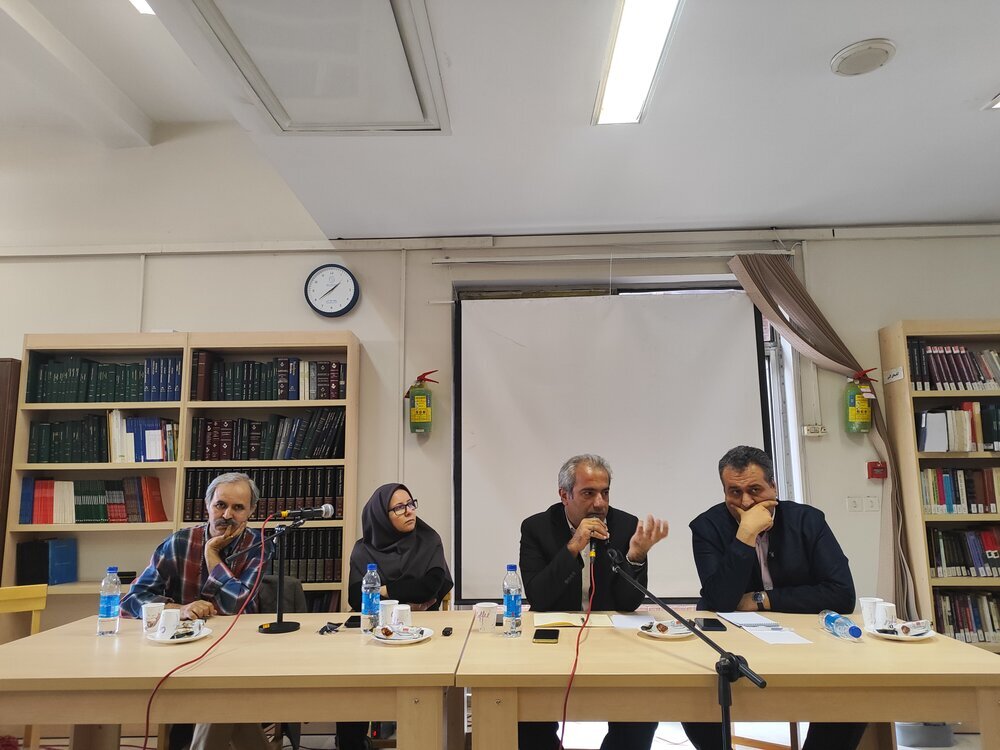
According to ISNA, the ‘Reading or Show’ session, attended by Pedram Alvandi (Ph.D. in Communication Sciences), Ali-Asghar Seyedabadi (writer and journalist), Morteza Kardar (publisher), and moderated by Lida Kavoosi with executive secretariat by Baharak Mahmoudi, was dedicated to examining various aspects of the presence of well-known figures in the publishing industry and their impact on promoting reading and the economy of the book market.
This session was held on November 17th, coinciding with Book Week, at the Faculty of Communication Sciences of Allameh Tabataba’i University, organized by the Research Vice-Chancellor and in collaboration with the Association of Communication Studies.
The Dual and Contradictory Role of Celebrities in Book Introduction
At the beginning of the session, Lida Kavoosi, referring to the global presence of celebrities in the culture industry, stated that the topic of ‘celebrity’ has a prominent and sometimes problematic presence in all fields.
'Whether we like it or not, a part of book promotion passes through these famous figures, and as an audience, we must learn to have a logical encounter. This phenomenon is contradictory for me; sometimes it works, and sometimes its negative aspects are more visible.'
Attention Economy; The Link Between Fame and Book Promotion
Pedram Alvandi, referring to the experience of the ‘Aknoon’ program and the incorrect attribution of a poem to Rumi, which caused controversy, explained that ‘promotion’ and ‘facilitation’ in reading today are influenced by the attention economy.
'In social networks, attention is the most important capital. It is natural that book promotion in this space also moves towards stars and producers of highly viewed content. The publishing industry, in the meantime, is forced to respond to a mechanism that retains the audience.'
From Crowded Book Launches to Surging Sales
Subsequently, speakers presented examples of the impact of famous figures on book sales; from the launch of Mojdeh Lavasani’s book to the sale of hundreds of thousands of copies of ‘Savushun’ after the unveiling of the film adaptation of Simin Daneshvar’s novel.
However, Alvandi and other program guests emphasized that ‘high sales are not always synonymous with quality’ and that one should not overlook ‘triviality,’ ‘comparison-centricity,’ and ’emotional markets’ in some introductions.
Concern About the Growth of Popular Books and Hidden Illiteracy
Morteza Kardar asked in his speech:
'When we talk about books, which books are we talking about? If the result of celebrities’ presence is an increase in attention to yellow and popular books, there is a danger that the audience will remain within that limited scope.'
He added:
'Today we are facing a new form of illiteracy that is outwardly hidden. Some novels have had dozens of print runs without having high literary value.'
Kardar also gave an example of publishing responsibility:
'We did not reprint Dariush Mehrjui’s translation of ‘The Holographic Universe’ at Hermes Publishing due to its pseudoscientific nature. Our duty is to separate our path from low-quality trends.'
Seyedabadi: The Issue is Not Just Books; It’s a Crisis of Authority
Ali-Asghar Seyedabadi, with a more historical perspective, considered the discussion beyond books and explained that triviality and fame-centricity are not exclusive to the publishing sector. Referring to bestsellers of past decades, he said:
'In the 70s, many novels, like Fahimeh Rahimi’s books, were read because of the author’s familiar name or style. This trend has intensified today, but its form has changed. Now, a politician, sociologist, or someone without an academic record also wants to become a celebrity.'
Regarding the crisis of authority in social networks, he added:
'Today, someone becomes a historical source by repeating a sentence in multiple interviews. This is dangerous. In contrast, someone who criticizes is less seen because criticism does not have economic benefits.'
Seyedabadi also emphasized the necessity of forming a ‘public dialogue about books’:
'If students, writers, and ordinary readers write and talk about books, authority will be redistributed among the people.'
The Issue of Transparency in Book Promotion
Seyedabadi continued the discussion by addressing ‘transparency’ and said the main problem is not the presence of celebrities, but the lack of clarity regarding motivations:
'A volunteer book promoter differs from someone who advertises due to a contract. The problem is that the audience doesn’t understand whether this book introduction is out of genuine interest or advertising.'
The Gap Between Expertise and Platforms
In another part of the session, speakers referred to ‘the widening gap between expertise and authority.’
'In today’s specialized world, the possibility of dialogue between people has been lost, and literature is one of the few fields that can create a thread of cohesion among different domains.'
At the end of the session, Pedram Alvandi concluded by saying:
'Platforms have delegitimized everything. Today, people search for answers on Instagram for everything from buying a washing machine to choosing a book, trusting the number of likes and comments, not the expert in the field.'
He added:
'One must distinguish between book promotion, production, and sales. Drivers outside the publishing industry, such as Soroush Sehat, can be the engine of publishing movement, but if they offer a mediocre or weak book, it must be approached with a critical view.'