In the Service of Light: A Narrative of the Life of Lady Fatimah Zahra’s Close Companion.
Mehr News Agency, Culture and Literature Group, Zahra Eskandari: This time, we are to hear the story of the Lady of the Two Worlds from the perspective of her servant, someone who never imagined such a fortunate destiny. We are going to recount the story of a woman who entered this household from the very beginning and accompanied Lady Fatimah Zahra (PBUH) until her martyrdom. She witnessed the joys and sorrows of this house, and her life underwent a transformation.
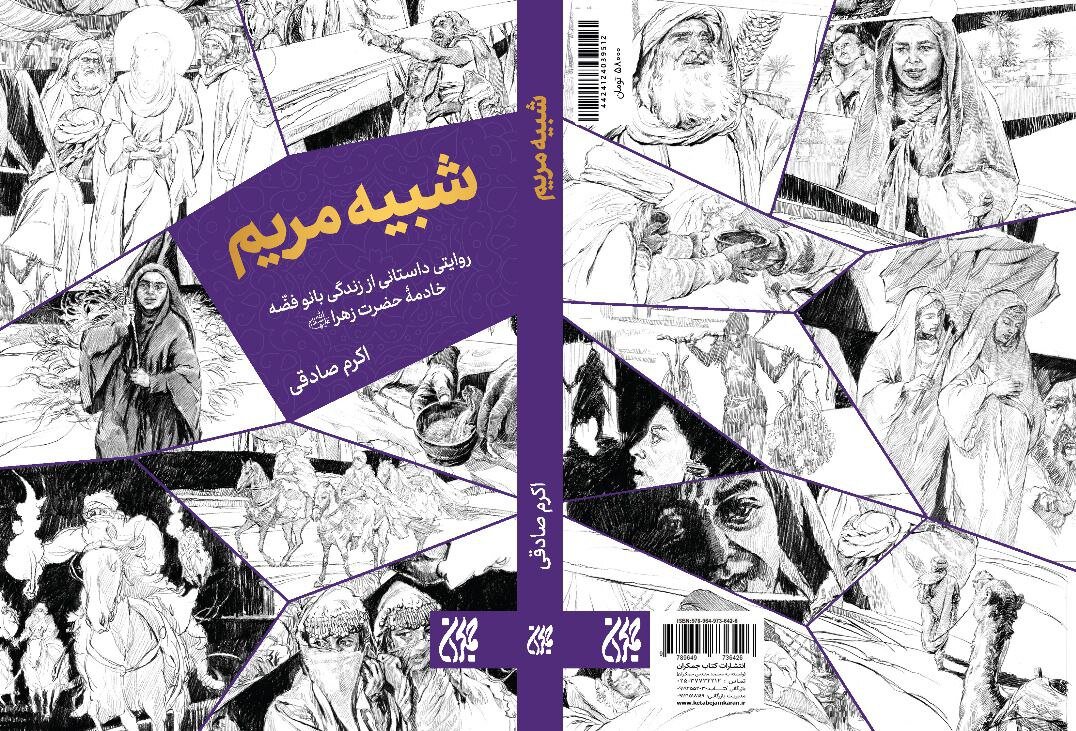
This woman’s name is “Fiddah,” and she is known in history as a lady who spoke only with the language of the Quran for twenty years. “Shabih-e Maryam” (Like Mary) is a work written by Akram Sadeghi, published by Jamkaran Publications, which has recreated a part of early Islamic history in the form of Fiddah’s life, in a narrative and understandable way.
The book’s story begins with an unexpected encounter. A man named Abul-Qasim Qushayri meets an old woman on the road who answers every question with a verse from the Quran. From the very beginning, a sign of this woman’s inner secret becomes apparent; the man realizes that she is close to the Prophet and his family, or certainly had a connection with this family. When he brings the old woman to the caravan, he discovers the truth: she is “Fiddah,” the servant of Lady Fatimah Zahra (PBUH), who for twenty years has spoken only the words of the Quran. From this point, the narrative returns to the past to recount the eventful journey of this woman’s life from childhood until her arrival in Medina.
Returning to the past, a young girl named Maryam is introduced; a Christian girl living with her father in a small village. Her father named her Maryam in honor of Saint Mary (PBUH). Their lives pass under the shadow of fear and threat. Repeated attacks on the village led the father and daughter to build a secret refuge under their house. They rarely leave their home, awaiting a peaceful day, but a new attack changes their destiny. A stranger, learning of the large number of young people in the village, attacks them with the greed of enslavement. In this attack, Maryam’s father is killed, their home burns, and many girls and boys are taken captive. Maryam is among them.
The captives move through the scorching desert heat to reach a caravan destined for the slave market. An Abyssinian merchant buys twenty young people, sending the girls to Abyssinia and the boys to Syria. Among them, siblings are separated, and human ties are broken. Along the arduous sea and sand journey, Maryam uses the medical knowledge she learned from her father to treat her companions. She gives the meager food distributed among the slaves to the sick and protests against injustice. This protest leads to the slaves being whipped; but a young Christian, who is in charge of the ship, comes to her aid. He cleans her wounds and ensures that the captives receive enough food. This humane behavior affects Maryam deeply; she realizes that even in captivity, freedom can be kept alive.
Upon the ship’s arrival in Abyssinia, a new destiny awaits her. Maryam becomes known by the new name “Maymounah,” because upon arrival, she saves the life of the infant daughter of the King of Abyssinia, and thus is named Maymounah, meaning “blessed.” The King, from the Najashi dynasty, makes her the infant’s special maidservant and accepts her into the palace. Life in the palace brings her both apparent calm and inner anxiety. She still yearns for freedom, but her friend Anna, now named Houriyeh, is content with her position and asks her to accept palace life. The King’s son also falls in love with Houriyeh, relieving her from the suffering of slavery. But Maymounah’s restless soul is still searching for a truth that she cannot find peace in the palace.
The arrival of Ja’far ibn Abi Talib and his wife Asma to Najashi’s palace marks a new point in the story. The King of Abyssinia welcomes them with great respect. Asma breastfeeds the King’s child and her own, and a friendly relationship forms between the two families. Maymounah closely witnesses Ja’far and Asma’s faith and serenity and feels a new question arise in her heart. But this quiet transformation is met with jealousy from those around her. Jilan, the head of the palace maids, by speaking ill of Maymounah, causes her to be restricted. Until one day, the King of Abyssinia decides to send a group of new Muslims along with Ja’far ibn Abi Talib to Medina, and to send gifts to the Prophet of Islam. Among the gifts are Maymounah and Houriyeh.
The journey to Medina is the beginning of a new chapter in Maymounah’s life. She expects harsh treatment, but Ja’far ibn Abi Talib’s caravan treats them kindly. One night, the sound of the caravan’s prayers and invocations calms her heart. The same sounds that free her weary soul from fear. Nevertheless, the desire to escape is still alive within her. One night, she and Houriyeh escape, but they are soon found. To their great surprise, they are not only not punished but are treated with respect and forgiveness. This different treatment is the first spark of faith in her heart. For the Prophet and Imam Ali (PBUH) had repeatedly told their companions about the status and position of women. They did not even speak with anger to their slaves and maidservants.
Upon arriving in Medina, the Prophet of Islam (PBUH) bestows Maymounah upon his daughter and names her “Fiddah,” a name meaning silver. From this point onwards, the Christian Maryam becomes Fiddah, the servant of Lady Fatimah Zahra (PBUH). On the way to the house, Salman al-Farsi, who was once a freed captive and slave himself, tells her about the Prophet and his daughter. Fiddah realizes that the Prophet her father had promised for years was the one now living in Medina. For the first time, she finds peace in their gaze, recites the Shahadah, and becomes a Muslim.
Entering Lady Fatimah Zahra’s (PBUH) house is the beginning of a new understanding for Fiddah. The simplicity of the home, the kindness of its inhabitants, and Fatimah’s loving treatment of her are astonishing to her. Lady Fatimah divides the household chores with Fiddah; one day Fiddah does them, and the next day Lady Fatimah herself. There is no sign of dominance in any word, and Lady Fatimah calls her a servant, not a slave. This humane and generous behavior creates a transformation in Fiddah’s soul. One night, she sees Lady Fatimah praying, mentioning the names of her neighbors one by one, and finally praying for herself. Fiddah is astonished by this level of humility and kindness. From that night on, her heart becomes tied to the House of Revelation.
She hears from Umm Salama, the Prophet’s wife, about the past of the prophetic household; about the patience of Lady Khadijah, the Prophet’s hardships in Shi’b Abi Talib, the persecution by polytheists, and the childhood of Lady Fatimah (PBUH), who would brush dirt off her father’s head. Everything she hears and sees deepens her faith. She repeatedly witnesses that there is nothing to eat in the house, but Lady Fatimah Zahra (PBUH) asks nothing from Ali (PBUH), because her father had forbidden her from doing so. This demeanor and inner peace are a sign of Lady Fatimah Zahra’s (PBUH) spiritual status for Fiddah.
During her days in the House of Revelation, Fiddah learns the Quran from Imam Ali (PBUH) and Lady Fatimah Zahra (PBUH) and herself uses Quranic verses in her speech. Years later, her name becomes known as a woman who spoke only with the language of the Quran for two decades of her life; a woman who defined faith and knowledge alongside service.
The book “Shabih-e Maryam” narrates this long journey in a fluent and narrative language. The author, by utilizing historical sources and a humanistic perspective on Fiddah’s life, presents a tangible picture of the early days of Islam and the atmosphere of Lady Fatimah Zahra’s (PBUH) house. The narrative begins amidst tense adventures but culminates in the peace of Fatimah’s (PBUH) home; a path that symbolizes the inner journey of a human being from fear and bewilderment to faith and certainty.
The book’s illustrations, with historical details and in harmony with the text, add to the work’s appeal, making it a suitable option for indirect teaching of religious and historical concepts in the form of fictional literature.
Alongside its narrative appeal, the work reminds us of the status of women in early Islamic history; a woman who rose from the class of slaves but, under the shadow of faith and knowledge, reached a station where her words reflected divine speech.
In summary, “Shabih-e Maryam” is not just a story of captivity and freedom, but a narrative of the transformation of the human soul in the light of faith; the story of a woman who was freed from bondage, found her way to the House of Revelation, and became a mirror reflecting the Fatimid light in history.
In a part of the book we read:
Umm Ayman knew from the Prophet’s early childhood that he would one day become a prophet. She told Fiddah about the conspiracies of the Jews, who had known for years about his appearance and migration to Yathrib, now called Madinat al-Nabi, and had settled there for years, but gradually deviated from their intentions and became involved in trade and usury. Fiddah recalled the words of the people of Medina. She had often heard amidst their discussions in the streets and markets that they considered the Jews to be the cause of seditions and family and tribal wars among them. The Jews had deliberately remained in Medina during the Battle of the Trench to attack the Prophet and his companions from behind.
The book “Shabih-e Maryam” by Akram Sadeghi, 251 pages, priced at 250,000 Tomans, has been published by Jamkaran Publications.