Kanoon Has Done Something Different by Publishing ‘A Footnote’
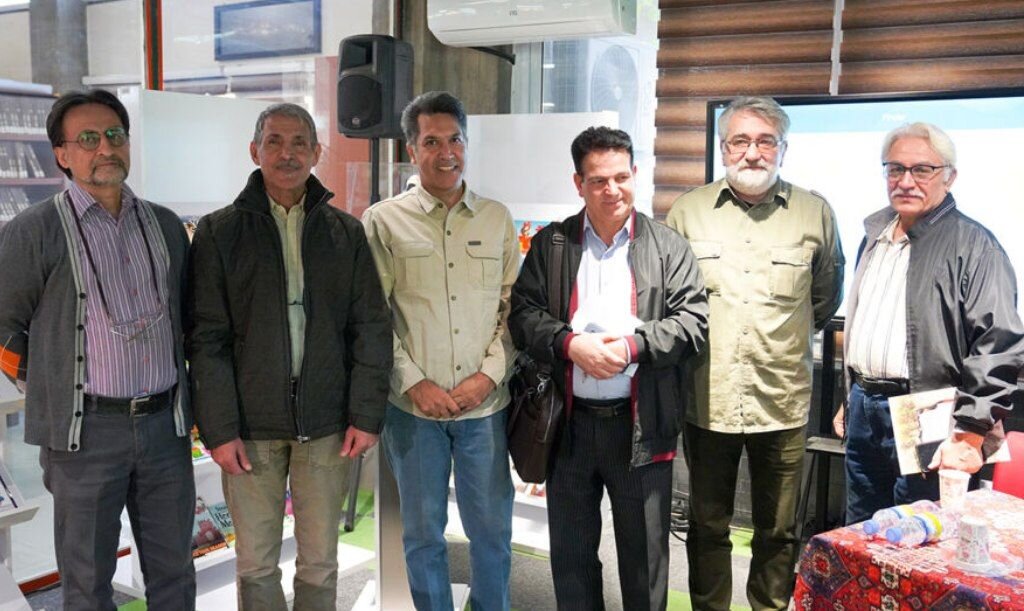
According to Mehr News Agency, the review session for the five-volume collection ‘A Footnote’, stories derived from Ferdowsi’s Shahnameh by Mohammad Goodarzidehrizi and Amirhossein Zanjanbar, was held on Wednesday, November 4th, with the presence of Hamed Alamati, CEO of Kanoon, the authors, and Mohammadreza Yousefi, Kouroush Parsanejad, and Bahram Jalalipour as critics of the work, at the Ahmadreza Ahmadi Hall of the Institute for the Intellectual Development of Children and Young Adults Reference Library.
“A Footnote” Offers a Postmodern Perspective on Shahnameh
Mohammad Goodarzidehrizi, author and psychologist, stated that serious discussions are needed in the field of adaptive literature, saying: “In recent decades, strange scientific developments have occurred in the field of adaptation. According to new views on adaptation, it means repetition without copying. Thus, fidelity to the text is no longer the criterion for adaptation.”
The author added, pointing out that in the new adaptation theory, being old does not mean being original and valuable: “According to this theory, we do not have primary and secondary texts, and instead of the word ‘original’ or ‘mother’, we use ‘prior’.”
In “A Footnote”, We Sought to Create a New World
He continued: “In the collection ‘A Footnote’, with Mr. Zanjanbar’s help, we approached Shahnameh with a postmodern perspective. In this collection, we encounter two stories: one at the top of the page, which is Ferdowsi’s story, and a story in black in the footnote. Gradually, the text at the top diminishes, and the text at the bottom increases.”
Goodarzidehrizi, stating that they sought to create a new world in ‘A Footnote’, said: “We gave the book to some teenagers. They narrated neither the top text nor the footnote, but rather a mixture of the two texts. This was precisely the goal Mr. Zanjanbar and I had in mind.”
According to New Adaptation Theories, Even the Original Text Is Not Authentic
Subsequently, Amirhossein Zanjanbar, author and university lecturer, said: “In the discussion of adaptation, we have a continuum, one end of which is recreation and the other end is rewriting. Will Hutchins, a cinema actor, believes that to keep a text alive, you must allow recreation. Genres produced in adaptation, especially in cinema, are mostly recreation.”
He added, referring to the fact that in the introduction to the ‘Footnote’ collection, they drew a line over the words ‘original story’: “When something is turned into text, it becomes a representation of reality and is different from reality itself. Therefore, according to new adaptation theories, even the original text is not authentic.”
Kanoon Has Acted as a True Recreator
Another speaker at this session, Mohammadreza Yousefi, believing that no text is sacred, said: “A recreator must show their will and creativity, which is why the recreator’s responsibility is very heavy. I am glad that Kanoon has acted as a true recreator, because many works are published under the name of recreation but are not truly recreations.”
He considered Ferdowsi a powerful recreator and added: “No text is a mere rewriting. In Shahnameh, we have a filicide by Goshtasb. He instigated the war between Rostam and Sohrab. In the Avestan text, we have a Goshtasb who accompanies Zoroaster and is not comparable to the Goshtasb of Shahnameh at all.”
Kanoon Has Done a Courageous Work by Publishing “A Footnote”
This author continued: “Our professors repeatedly said that Ferdowsi was a text editor and a rewriting adherent, but I don’t think so. We don’t have sacred texts. Many books are influenced by other books; for example, many books are influenced by The Iliad and The Odyssey.”
Yousefi said about ‘A Footnote’ collection: “The fact that Kanoon dared to question a text is very good and sufficient. Recreation is a very difficult task and is actually the work of an artist, whereas a rewriter is not an artist.”
Ferdowsi Knew World Literature in His Time
He continued: “Mr. Mehrizi Yazdi was not an artist, because he simplified a series of texts. Whereas Bahram Beyzaie is a successful recreator. A recreator must know folklore, anthropology, sociology, psychology, and concepts related to Shahnameh very well.”
This children’s and young adult author, stating that Ferdowsi knew drama and world literature in his time, said: “The basis of drama is conflict. Drama writing is very difficult, and Ferdowsi wrote drama.”
Today, Fidelity Has No Place in Adaptation
Subsequently, Bahram Jalalipour, referring to the fact that Kanoon played an active and strategic role in his childhood, said: “If it weren’t for Kanoon, I wouldn’t be here today. I will not forget Kanoon’s films and books. I hope Kanoon continues its active role.”
Jalalipour, stating that theorists believe fidelity has no place in adaptation today, continued: “Translation is also a type of recreation. Nothing is truly original. In adaptation, especially for the children and young adult age group, we must pay attention to the context, era, place, audience, and medium. When the target audience is children and young adults, our primary duty is to introduce the work and then to offer an innovative perspective.”
Kanoon Has Shown Good Initiative by Publishing “A Footnote”
He said, referring to Kanoon’s good initiative in publishing ‘A Footnote’: “The authors tried to introduce the audience to both the story and another possible world. Kanoon has previously published works adapted from Shahnameh. We rarely see a critical perspective in these adaptations.”
This critic, posing the question of what defamiliarization has occurred in the story, added: “In the first step, an ideological engagement with the work is necessary. How acceptable is this content today? Another aspect is the narratological dimension of the work. It seems that in ‘A Footnote’, the authors’ critique has been more on the narrative aspect than the content.”
The Idea Behind “A Footnote” Collection Is Attractive
Jalalipour said: “I saw a work related to Little Red Riding Hood from 2012 where the relationship between Little Red Riding Hood, Snow White, and the Three Little Pigs with today’s life was clear. This issue has not occurred in the ‘Footnote’ collection. Moreover, we see violence and taboos in this collection, whereas it needs to be softened for children and young adults.”
He considered the idea of ‘A Footnote’ collection attractive and added: “Considering the defamiliarization approach, the top of the page should have the story and its corresponding image, and the bottom of the page should also have the story and its corresponding image, so that the reader does not lose the thread of the narrative.”
Kanoon Has Done a Different Work by Publishing “A Footnote”
Another speaker at this session, Kouroush Parsanejad, noting that he took over the responsibility of Kanoon’s graphic unit in 2008, said: “Kanoon used to publish one or two books by Ahmadreza Ahmadi each year. Due to the characteristics of his texts, I thought it was possible to have new ideas in designing his books. I tried to create a collection where, when the reader turns the page, they encounter three interpretations: the author, the illustrator, and the graphic designer.”
“A Footnote” is a New Event for Kanoon
He continued: “Last year, Mr. Goodarzidehrizi and Mr. Zanjanbar approached me, and I became acquainted with ‘A Footnote’ collection. I was thrilled and felt that this was a new event for Kanoon. Kanoon is a place that should publish new books outside of conventional clichés and be a pioneer. In fact, Kanoon should do things that other places do not have the courage to do.”
Parsanejad added: “In ‘A Footnote’ collection, the posterior text replaces the prior text and becomes the main text itself. The letters also gradually enlarge in the book. These are the attractions of the work. This collection is different from other works by Kanoon. ‘A Footnote’ collection has an extraordinarily attractive idea.”
Kanoon Must Do Different Works in Terms of Thought, Innovation, and Creativity
This graphic designer, referring to a time when Kanoon was a pioneer in children’s and young adult books, said: “Today there are many children’s and young adult publishers, and Kanoon should do different works in terms of thought, innovation, and creativity without entering into competition…”
He continued: “What emanates from women in various forms is identifiable to artists. For example, women’s poetry and handwriting are identifiable from men’s. The subject of ‘A Footnote’ is Shahnameh, whose main characteristic is its epic nature. Therefore, it would have been better to choose male illustrators for this collection. The volume illustrated by Morteza Yazdani is different from the other volumes.”
“A Footnote” Collection Has the Potential to Become a Ten-Volume Series
Parsanejad stated that the illustrations of ‘A Footnote’ should have gradually become different, modern, and contemporary in line with the text, saying: “I liken the book’s introductory pages, meaning the title pages, ‘Bismillah’ (In the Name of God), and imprint, to a film’s opening credits, which are very impactful. In my opinion, these pages in ‘A Footnote’ should have been given more attention.”
This illustrator added: “The ‘A Footnote’ collection has the potential to reach at least ten volumes. In subsequent printings, recreation in illustration and graphic design, and coordination in font style and size on the cover and text, are necessary.”
The ‘A Footnote’ collection, published by Kanoon-e Parvaresh Fekri Publications, includes five volumes with the titles ‘Rostam’s Seven Labors’, ‘Arash the Archer’, ‘Gordafarid’, ‘Zal’, and ‘Zahhak’. The first volume of this collection, ‘Rostam’s Seven Labors’, is illustrated by Atefeh Ghanbarian; the second volume, ‘Arash the Archer’, by Negar Orang; the third and fourth volumes, ‘Gordafarid’ and ‘Zal’, by Mahshid Darabi; and the fifth volume, ‘Zahhak’, is adorned with illustrations by Morteza Yazdani.





