Malekian’s critique of Imam Muhammad Ghazali’s views / Imam Muhammad Ghazali; Critic or Defender of Philosophy
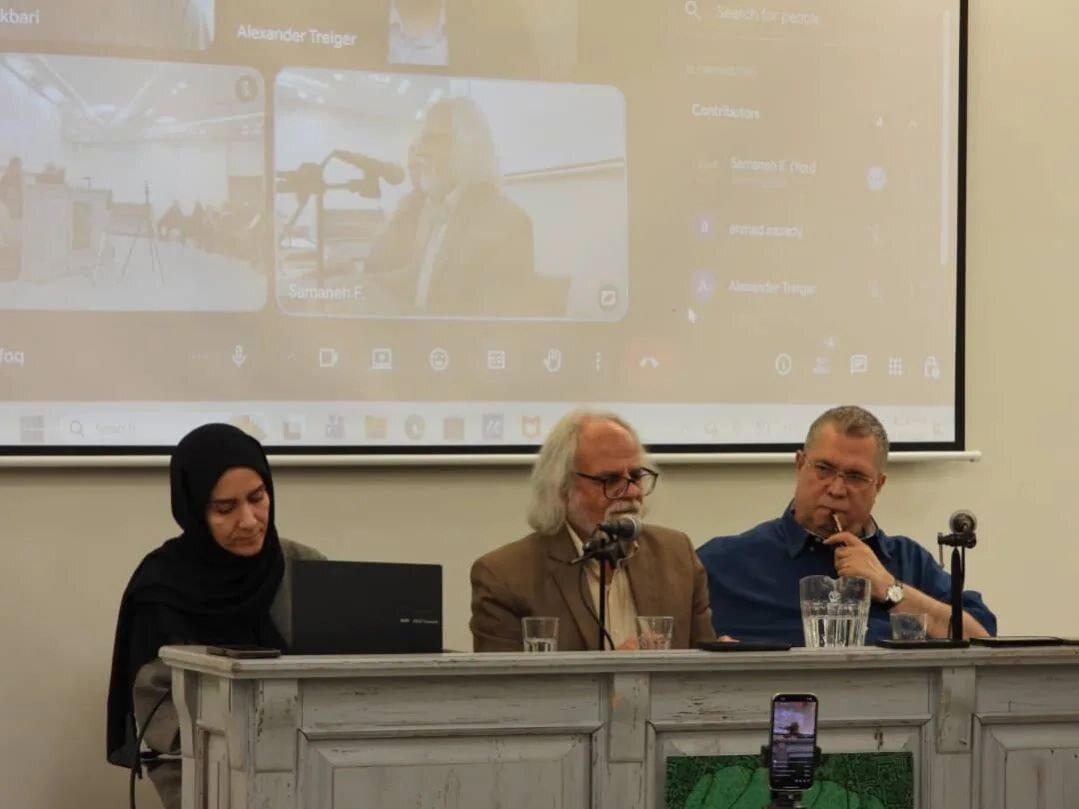
According to Khabaronline News Agency, Sobhan Kiani reported on the eighth night of Bokhara Nights, dedicated to commemorating Ghazali, on Ibna’s religion and thought service. To mark the publication of “Ghazali the Philosopher” by Alexander Treiger, translated by Samaneh Feizi and Ahmad Izadi (published by Qoqnoos Publishing House), the 928th night of Bokhara Nights was dedicated to honoring Ghazali. The event was held on Thursday, December 11, 2025, with speeches by Mostafa Malekian, Mitra Poorsina, Samaneh Feizi, Ali Dehbashi, and a video message from Alexander Treiger, at the Qoqnoos Publishing House headquarters in the Discussion Hall.
Mitra Poorsina: Ghazali, Contradictor of His Own Words
Mitra Poorsina, a professor at Shahid Beheshti University, opened the session by saying: The background of this session, in a way, goes back twenty-five years ago when I consulted with Professor Malekian about my PhD thesis. We ultimately decided to work on a fresh topic in philosophy and epistemology that lacked academic history: the influence of sin on knowledge. In researching this topic, which prioritized problem-solving, we needed to complete philosophical work by relying on thinkers who accepted this influence. We decided to use two early thinkers: Saint Augustine and Imam Muhammad Ghazali. During my trip to Canada to access sources on Augustine, which were used for this research, I encountered a very wide field on this subject. I suggested to Professor Malekian that Ghazali seemed very shallow and empty compared to Augustine for this research, and it was decided to only use Augustine.
She continued: After defending my PhD thesis, I thought I must examine the other side of the story, otherwise, Ghazali would not be given his due. I spent twelve years working on Ghazali, and two books were published under this title: “The Influence of Sin on Knowledge,” the first focusing on the views of Saint Augustine, and the second on Imam Muhammad Ghazali. When I started working on Ghazali’s works, I didn’t have a very positive view of him because I thought Ghazali didn’t get along much with philosophers. However, the further I went, the more I realized I didn’t know him.
She said: Working on Ghazali is difficult because every sentence he says, he contradicts afterward. We are unfamiliar with the concept of intellect in Ghazali, and there is a strange incompatibility. The intellect, in its highest form of manifestation according to Ghazali, becomes one with the heart. So I moved away from the common view about Ghazali based on the book “The Incoherence of the Philosophers.” Subsequently, I encountered new Ghazali scholars, including Treiger and Abrahamov. Abrahamov proves in his article that the superior method for knowing God from Ghazali’s perspective is the philosophical method. We suffer from a lack of awareness in our country that new Ghazali scholars are raising new issues about Ghazali.
Alexander Treiger: May God Protect Your Beautiful Country
Alexander Treiger, the author of the book, was another speaker at the event, attending online. He first said: It is very valuable to me that the people of Iran consider my research on Ghazali to be useful and important. I want to declare my support for the people of Iran following this summer’s events and that aggressive attack. I say this clearly: May God protect your beautiful country. Extensive research on philosophy and Islamic studies has been conducted in Iran’s academic community, which is commendable. Iran has a rich philosophical tradition that includes figures like Suhrawardi, Mulla Sadra, and Imam Muhammad Ghazali.
He continued in English: The discussions about Ghazali, labeling him anti-philosophy, are not the main point but merely one possible view. It may seem strange, but Ghazali takes many of the beliefs he rejects in one place as his principles elsewhere. Our evidence for these statements comes from many of Ghazali’s own books.
He said: In Ghazali’s time, we can find evidence that his enemies in Nishapur attacked him, and they even brought their critique against him to the Seljuq Shah in Sanjar, Khurasan, refuting his philosophical beliefs. You can see the most important of these doctrines, which Ghazali himself believed in, in correspondence collected by his students in Persian. If we pay attention to the words of his opponents, we will see that Ghazali did not follow beliefs that a Muslim should adhere to, and followed the works of philosophers and atheists. Ghazali was condemned for philosophizing in his time.
Treiger said: I mention two examples from Ibn Rushd and Ibn Tufail, two philosophers who clearly expressed their knowledge derived from Ghazali. Ibn Rushd did not take away from Ghazali that he was anti-philosophy; rather, he believed Ghazali expanded philosophical knowledge in the Islamic world. Ibn Rushd believed Ghazali expressed truths to the public that he should not have. Ibn Tufail, however, is not a critic of Ghazali but is very interested in his ideas. According to Ibn Tufail, Ghazali considered some ideas as heresy and used them himself.
It seems that contrary to what he claims, he does not believe in bodily resurrection but, like philosophers, believes in spiritual resurrection, which is evident in “The Alchemy of Happiness.” Ghazali does not consider the body a part of our truth and identity. What he says about death refers to leaving the body behind and continuing life with the spirit. Ghazali’s interpretation of heaven and hell deviates from classical thought, defining what he calls observing the beauty of servitude.
He concluded: My logic in this book is that Ghazali followed the path of philosophers. “The Incoherence” cannot express Ghazali’s authentic views. Ghazali, like any other philosopher, has his own philosophical system and pursued Sufi inclinations.
Samaneh Feizi: The Tradition of Revisionism
Samaneh Feizi, a philosophy researcher and one of the book’s translators, was another speaker. She began by saying: I will present my remarks in three parts: first, what is happening in the book “Ghazali the Philosopher”? Second, why is the book important? Third, what was our experience as translators dealing with this book?
She continued: Our general image of Ghazali is that he is a critic of philosophy, but this book presents a completely unprecedented image of Ghazali. Ghazali demonstrates a completely philosophical face in epistemology and eschatology. First and foremost, it shows that the interaction between philosophy and mysticism within the Islamic tradition is much more complex than we think, and these two have a dynamic interaction with each other. The book shows that Ghazali’s idea about the authority of mystical knowledge was not formed in a vacuum.
Feizi continued: The author’s question is how Ghazali theorizes mystical knowledge and how his understanding of mystical knowledge took shape. Treiger pursues this in Ibn Sina’s philosophy. The importance of the issue lies in clarifying these connecting links. Perhaps it can be said that Ghazali is the one who introduced philosophical thinking into fields like ethics, mysticism, and education.
She added: Introducing the element of philosophy into these areas should be considered a form of conceptual continuity. We should understand the history of thought as a chain of contact and transmission in which linear boundaries between different disciplines are broken, and what is happening in this book belongs to this category and topic.
Feizi said: The importance of the book also lies in the tradition of revisionism. In this tradition, the author or researcher reviews established narratives, which gives us a new perspective. There are many references in this book, which indicates it is an analytical rather than purely descriptive book. This book logically examines Ghazali’s core concepts by extracting and reviewing concepts shared with Ibn Sina’s perspective.
In another part of her speech, she said: In the study of terminology, the issue raised in this book is the word “tahafut” as the factor shaping our image of Ghazali as anti-philosophy. The author, referencing works by Ibn Maimon, defines this word to mean “haste.” If we approach the book through this lens, our view of Ghazali will also change.
Feizi concluded: This book was easy and impossible for us. Easy in that the author had provided the Persian and Arabic terms wherever a specific philosophical or mystical term was intended. However, the impossible part returned to the general difficulties of translation, and all our efforts were to maintain the text’s fluency and the author’s meaning.
Mostafa Malekian: If You Cannot Speak About Something, Pass It by in Silence
Mostafa Malekian, a philosophy and ethics researcher, was the last speaker at the session. He said: In my opinion, Treiger has four purposes in this book:
The first intention is to explain the theory of inspired knowledge, or the theory of mystical knowledge, from Ghazali’s viewpoint, which contains many novel points, and to show how Ghazali intended to justify it.
Second, that Ghazali is not only a theologian but also ranks among philosophers.
The third point is that Ghazali should be considered a proponent of a type of theology interpreted as philosophical theology or rational theology. Treiger aims to introduce Ghazali as a philosophical theologian.
The fourth point is that something expressed in this book is that Ghazali’s intellectual developments should not be considered merely changes in belief, because those who study his works encounter a certain incompatibility. Before Treiger, some believed Ghazali had intellectual developments, which caused his seemingly inconsistent remarks. Treiger states that this was not the case; rather, he spoke differently in response to each sect and current. That is, he wanted to tell his audience that their position could be refuted or completed.
Malekian then began criticizing Ghazali and said: In my opinion, when someone reads the book, besides Treiger’s four main claims, they arrive at a series of things that the author did not explicitly state. Ghazali, at least in three aspects, did not observe the ethics of belief. Using a quote while simultaneously criticizing it is contrary to the ethics of belief and discourse. One cannot use words one rejects as premises for one’s claim, which is a double standard. Citing a statement as if it is one’s own invention is called source documentation denial, and these words are taken from other philosophers. A large part of Ghazali’s works are not his own words, and just as wind brings, wind takes away, Mulla Sadra did exactly the same thing with Ghazali’s works. A large part of Mulla Sadra Shirazi’s work is taken from Ghazali.
He said: The next issue is the writing method, that we should not inflict unnecessary pain and suffering on the audience in writing and speaking. If our topic is presented clearly without ambiguity, the audience understands the subject without needing excessive effort or becoming hopeless. Treiger himself has a comment in this book about Ghazali having unstable terms, where the word and meaning are used differently each time and place. In Ghazali’s Ihya’ Ulum al-Din, you can also see that he uses twelve different words for one concept. The author also says Ghazali’s words are seemingly imprecise and contradictory.
Malekian concluded: Also, the issue of unopened secrets, which I believe is a disaster founded by Ghazali in the Islamic world. Whenever a topic reaches a sensitive point, they say: here there are things that must be discovered through spiritual insight, and an illumination reached my heart, and nothing else should be said. As Wittgenstein said, “Whereof one cannot speak, thereof one must be silent.”
216216





