Review of the book “My Life Story” by Abdullah Mostofi
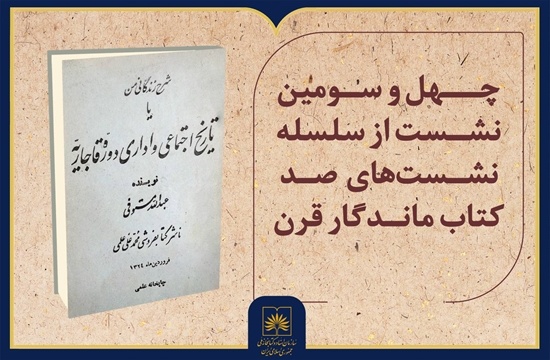
According to Iran Book News Agency (IBNA), the 43rd session of the “One Hundred Lasting Books of the Century” program series will be held on Sunday, December 14, at the National Archives and Library of Iran, dedicated to reviewing the book “My Life Story” by Abdullah Mostofi.
In this session, Gholamali Haddad Adel, head of the Academy of Persian Language and Literature and Saadi Foundation, and Fatemeh Ghaziha, a historical text researcher, will present their views on the documentary value and position of this work in Iran’s social historiography. The program will be chaired by Mahboubeh Shamshirgarha, a faculty member of the National Archives and Library of Iran.
“My Life Story” is one of the most prominent works of memoir writing and social history in Iran; a three-volume work that, in addition to recounting Abdullah Mostofi’s life, provides a vivid picture of Iran’s administrative, economic, cultural structure, and social relations in the late Qajar period and early Pahlavi era. The narrative of this book, while linear, is accompanied by intertextual analyses and historical flashbacks, which elevates it beyond a simple biography and turns it into a historical text.
Mostofi, who was born on December 3, 1876 (3 Azar 1255) in Tehran into a courtly family descended from the Qajar Mostofis, became familiar with the mechanism of power and the country’s administrative system from childhood and served for years in the Ministry of Finance and the administrative apparatus of Qajar and then the Pahlavi government. This long experience formed the basis for his precise observations about administrative corruption, financial disarray, class relations, and social transformations in Iran; observations recorded in “My Life Story” with a smooth, analytical, and straightforward prose.
The first volume of this work deals with the history of the Mostofi family and the old court structure; the second volume is dedicated to the author’s entry into the administrative apparatus and his experiences in the Ministry of Finance; and the third volume deals with the collapse of the old Qajar order and the beginning of the Pahlavi period. This collection, from the perspective of recording daily life, customs and traditions, clothing, education, the market, government-people relations, and the tax system, is considered one of the most authoritative examples of socio-historical autobiography in Iran.
Researchers have described “My Life Story” as a unique document of Iran’s social history; a text that establishes a link between official history and people’s lived experience and provides a clear picture of Iranian society on the verge of major transformations. Therefore, this book is an inspiring and educational work for both historians and sociologists, as well as for readers interested in Iranian culture and life.
Abdullah Mostofi died on December 15, 1950 (24 Azar 1329) and was buried in the courtyard of Hazrat Abdolazim Hasani in Rey. He was an author who narrated Iran’s history not from official tables, but from the heart of people’s lives, giving depth and authenticity to the country’s social memory.
The “One Hundred Lasting Books of the Century” meeting series is held by the National Archives and Library of Iran with the aim of reviewing and analyzing prominent contemporary Persian literary and research works, and so far, forty-two outstanding works have been reviewed within this framework.
The book review session for “My Life Story” will be held on Sunday, December 14, 1404, from 10:00 AM to 12:00 PM in the Culture Hall of the International Conference Center of the National Archives and Library of Iran.





