The Spiritual World is More Real Than the Material World / A Philosophy that, by Integrating with Mysticism, Presents an Image of the Afterlife
The book “Afterlife, a Celestial Journey with a Guide and its Wonders” by Emanuel Swedenborg, translated by Seyed Mohammad Naghib, has been published by Philosophy and Culture Publications.
The book (Afterlife), a summary of Emanuel Swedenborg’s “Heaven and Hell,” the great Swedish scientist and mystic, was made available to those interested in religious, mystical, and supernatural topics by the Swedenborg Foundation, by omitting some parts of the original text and including exact phrases from other parts of the book.
The original book was written in Latin by Swedenborg and was first translated into English in England in the 18th century, specifically in 1778. Three years after its English translation, a volume of it was taken to America and widely welcomed by American immigrants. It should also be added that this book has been translated into most of the world’s languages, and the current translation is the most updated version, produced by the Swedenborg Foundation in 2002.
The original translation of the book is 700 pages long. To attract readers, versions were also made available in a portable 400-page format. Furthermore, for broader public access and study, an essence of it, without alteration of content, was printed under the aforementioned title, roughly half the size of the portable book, by omitting less important sections and placing the ‘World of Spirits’ or ‘Purgatory’ section in the first chapter, which Swedenborg had placed in the last chapter of the original book.
Emanuel Swedenborg
It can be stated that “Heaven and Hell” is one of the most important and controversial works of Emanuel Swedenborg, the 18th-century Swedish philosopher, theologian, and mystic; who, after years of scientific activity in the fields of engineering, anatomy, and physics, entered a period of deep spiritual experiences and claimed to have the ability to visit the spiritual world and communicate with angels and spirits.
This book, published in 1758, is a detailed report of his observations and experiences of three spiritual realms: Heaven, Hell, and the “World of Spirits.” In this work, Swedenborg attempts not only to provide an objective and structured description of that world but also to present a different understanding of the afterlife that fundamentally differed from the prevalent notions of his time.
At the beginning of the book, Swedenborg explains that the spiritual world is more real than the material world, and after death, humans continue their lives not as abstract and intangible beings, but as entities with complete identity, clear feelings, and active experiences. He emphasizes that death is not an end but a natural continuation of life; as if humans merely separate from their physical shell and enter their true essence.
In his view, humans enter the other world with all their inner characteristics—beliefs, emotions, desires, and moral inclinations—and these determine their spiritual status, not merely external actions that might have been accompanied by hypocrisy or social pressures in the earthly world.
Heaven: The Realm of Harmony and Divine Love
One of the book’s main themes is Swedenborg’s detailed description of Heaven. He does not consider Heaven a place where humans receive worldly rewards but rather a spiritual structure composed of various levels, each corresponding to the degree of a human’s love for good and truth. According to Swedenborg, Heaven is a collection of harmonious communities of angels, with each community formed based on the dominant type of love among its members; a love that must be inherently “altruistic” and “God-centered.”
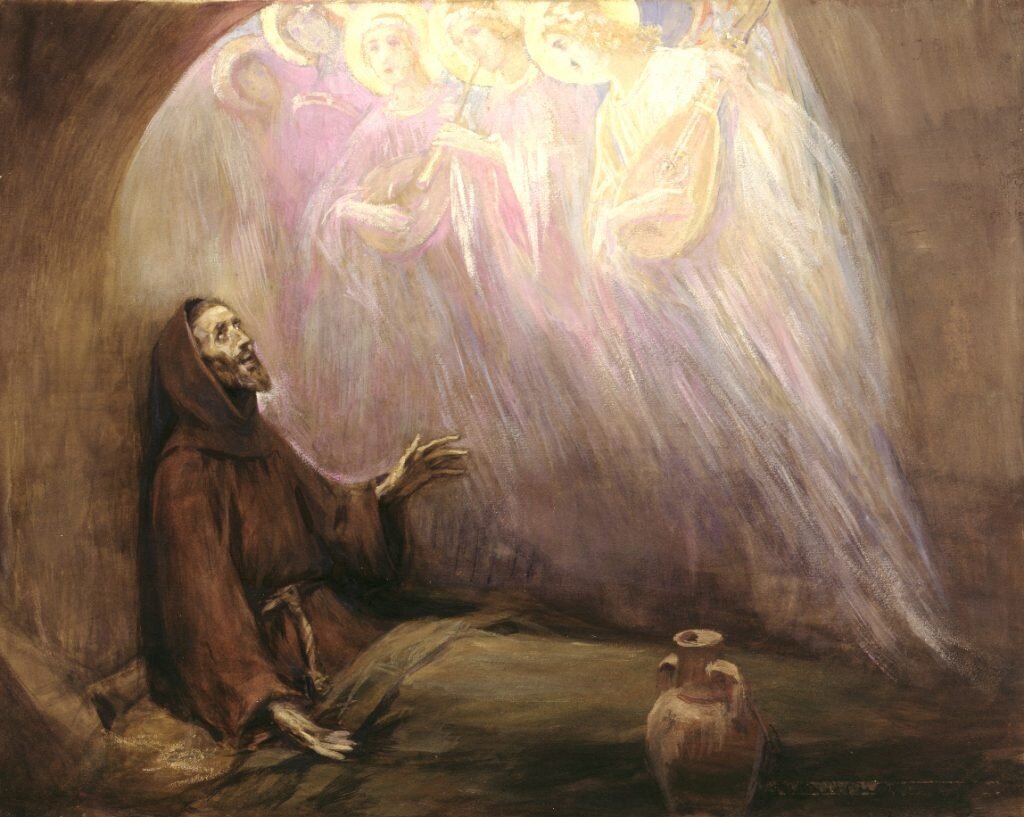
He believes that heavenly joy stems from this alignment with goodness, not from physical pleasures. Swedenborg tries to explain the existential nature of angels in an understandable language. He says that angels are the same humans who lived in the world and entered Heaven after death; therefore, angels are not abstract beings or different from humans. They still retain their individual characteristics, but these characteristics are in complete harmony with good and truth.
He emphasizes that angels do not speak of seeing God in the sense of seeing a luminous body or a separate person; rather, they experience God’s presence within the love and truth that permeate everywhere. According to Swedenborg, Heaven functions like a large and dynamic society. Individuals are placed in appropriate positions based on their inner quality, and no one is forced or externally commanded into a specific rank. This internal and automatic order transforms Heaven into a realm of complete harmony—a realm where true freedom is linked with divine love.
Hell: The Natural Consequence of Separation from Good
In the section on Hell, Swedenborg presents a different picture from traditional Christian conceptions. He does not see Hell as a place where God “punishes” humans; rather, it is the natural outcome of human selfish and egoistic tendencies. In his view, infernal beings are those who were indifferent or even hostile to good and truth in the world, and whose innermost pleasure lay in pursuing instincts such as dominance, lust, deceit, violence, and hatred. Such humans are drawn to Hell after death because the heavenly environment—a place of love and harmony—is “unpleasant” and unbearable for them.
Hell, in his view, is endless chaos based on the conflict between selfish wills. Infernal spirits organize into dark societies, each reflecting their negative motivations. In these societies, individuals are constantly engaged in competition, deceit, or harming one another; because self-love and superiority form the basis of their relationships. Swedenborg emphasizes that this pain and suffering are not an external punishment but the natural experience of spirits aligned with their own nature.
The World of Spirits or Purgatory: The Transitional Stage Between the World and the Hereafter
One of the unique sections of the book is the description of the World of Spirits; a realm between Heaven and Hell that humans enter first after death. According to Swedenborg, this stage is one of the most important spiritual processes because it reveals the true nature of humans. In the material world, individuals can appear better and more moral than they are through pretense, habits, or social pressures, but in the World of Spirits, everything gradually becomes clear according to the person’s inner being.
In this stage, external masks fall away, and the spirit reveals its true existence. According to Swedenborg, some spirits are drawn towards heavenly communities after a short period, while others—whose inner selves are incompatible with good—gradually incline towards Hell. This transition is neither forced nor sudden but is the natural result of the law of spiritual attraction; a law by which each spirit goes to an environment that is more compatible with its inner tendencies.
Human Relationship with the Spiritual World
In other parts of the book, Swedenborg also discusses the nature of human connection with the spiritual world during life. He believes that humans are constantly influenced by communities of angels and spirits, but these influences operate in a hidden and unconscious manner. In his view, the thoughts that cross the mind and the motivations that encourage humans to act originate from spiritual currents; with the difference that humans ultimately have free will and can choose the direction of these influences. It was this freedom, in Swedenborg’s view, that made humans responsible for their spiritual destiny.
He also explains that God always strives to guide humans towards good, but without compulsion; because true love only grows in freedom. Therefore, the entire structure of Heaven and Hell is based on the principle of freedom and individual responsibility.
The Importance of the Book and its Impact
“Heaven and Hell” was not only an important work in its time but also influenced thinkers, artists, and various spiritual movements in subsequent centuries. Swedenborg’s view of the afterlife, with its emphasis on personal experiences, the structured nature of the spiritual world, and human freedom, has been attractive and inspiring to many. His works influenced writers such as Balzac, Emerson, and Yeats, and “Swedenborgianism” spread as a school of thought in Europe and America.
The importance of this book lies in its view of the afterlife not as a distant mystery, but as an understandable and orderly truth. Swedenborg strives to bridge the gap between science, philosophy, and mysticism, presenting an image of the spiritual world that, while mysterious, appears logical and lawful. The book’s simple language and organized structure have ensured its continued readership and made it inspiring in various spiritual traditions.