‘Goodbye, My Doll’; A Conceptual Shift from Female Symbol to Human Alienation in the Form of Indigenous and Contemporary Theater
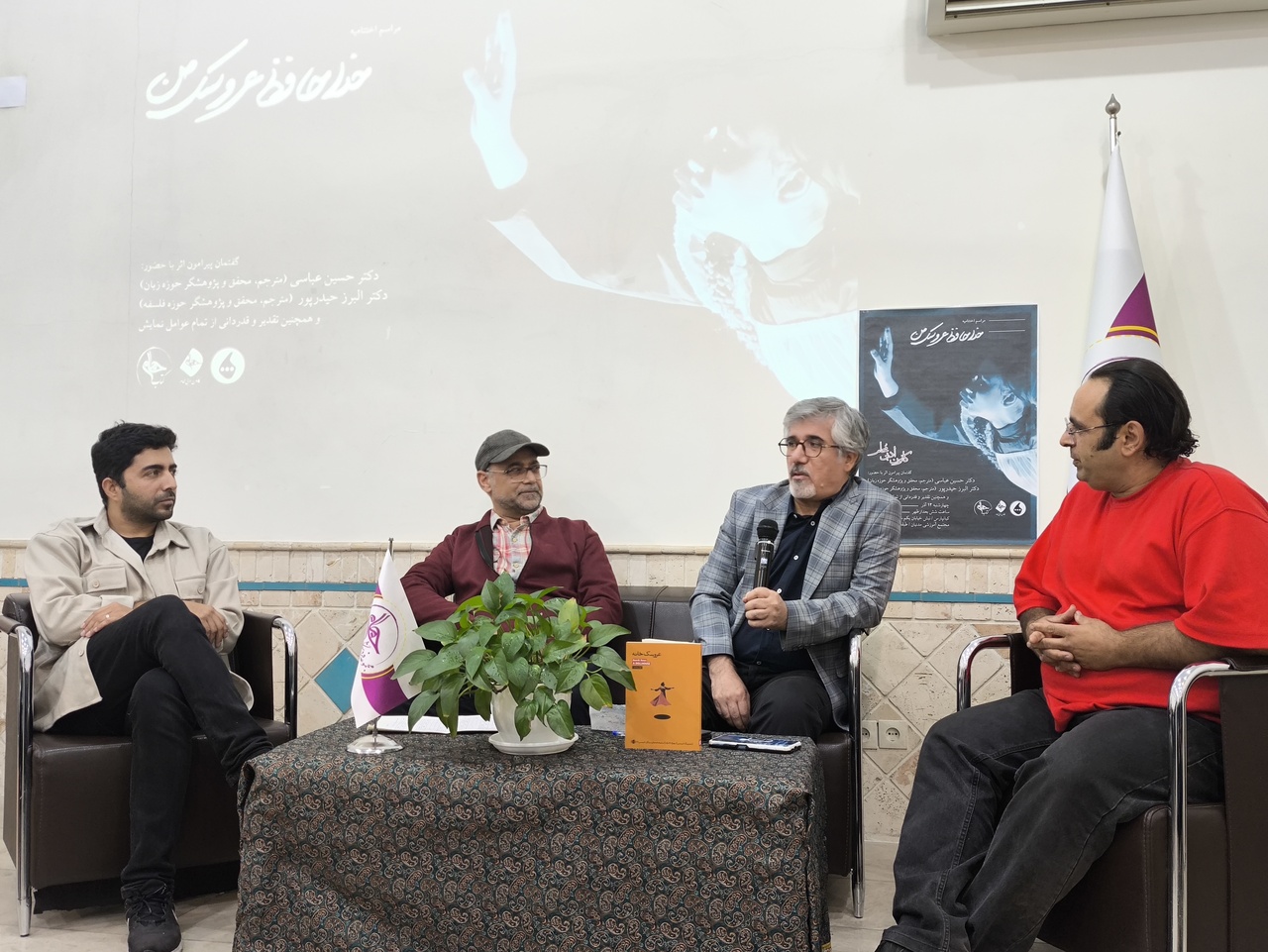
According to the correspondent of Iran Book News Agency (IBNA) in Ahvaz, Abbas Saeedi, on Wednesday evening at the closing ceremony of the play ‘Goodbye, My Doll’ at Maham Bookstore in Ahvaz, stated that ‘Goodbye, My Doll’ is an adaptation of Henrik Ibsen’s play ‘A Doll’s House’, translated by Behzad Ghaderi; he said: This play is a work that, with a fresh perspective on Ibsen’s classic play, attempts to redefine modern concepts of female identity, power, and patriarchy within an indigenous and contemporary context.
He added: I tried, by choosing the title ‘Goodbye, My Doll’, not only to remain faithful to the original drama but also, with a conceptual shift, to transform the doll into a social object for depicting the manipulation of humans.
Saeedi explained: In this adaptation, the doll is no longer just a symbol of women, but represents a human being alienated from themselves in patriarchal and power-oriented systems. At the underlying layer of ‘Goodbye, My Doll’ is the story of a woman’s self-discovery in a patriarchal society. A woman who, to reach her true self, is compelled to break internal and external structures, and this play is a kind of social and philosophical critique of the status of women in traditional authoritarian systems, where, in Foucault’s terms, power is exercised through body and language.
Saeedi said: The play ‘Goodbye, My Doll’ is an effort to create theater from the heart of society that, using the language of metaphor and sign, re-examines the issues of identity, power, and liberation. This work, seeking a theatrical statement, is in search of a woman free from being a doll.
He stated that theater is like fresh fuel for him and his colleagues; he added: Nevertheless, we always tried to keep our appointments with the audience. Theater is our only consolation, the only place where we feel useful and can do something for the culture and art of this land.
Emphasizing the role of theater as a collective and influential art, he noted: Our goal was not just to perform a play, but to show that theater can survive even in the toughest conditions and convey its message to the people. We believe that theater must remain for the enrichment of the culture and poetry of this land.
Alborz Heydarpoor, a researcher in the field of philosophy, also remarked on the precise and rich writing of the play ‘Goodbye, My Doll’, stating: In this work, emotional moments and borderline situations of life are depicted so profoundly that the audience is compelled to endure them. This play is full of moments that instantly shatter one’s world, from ennui and anxiety to a woman’s struggle to begin a new life within a larger structure.
He continued: From a philosophical perspective, every human being, on one hand, and relationships, turn into a struggle between subjects. When someone enters another’s life, they want to impose their viewpoint on them, and this is the beginning of conflict. In fact, ‘the other is hell’, and the text of this play is rich from this perspective.
Heydarpoor referred to the process of captivating women within the bonds of marriage and said: ‘My Doll’ outwardly has a childish discourse, but when we accept living within the framework defined by others, we fall into the trap of subjugation, which indicates that the conflict between husband and wife is never resolved, and 30 years of their shared life might collapse in an instant.
He continued: The play ‘Goodbye, My Doll’ deeply explores the realm of family and women’s issues. Therefore, in our view, an attempt is made to contain the conflict between husband and wife, but the problem becomes acute when the woman forgets her role.
Heydarpoor said: In marital life, no conditions should be imposed. On the other hand, sometimes women’s enemies are women themselves; one woman drags another into misery. We must observe this conflict in individual confrontation.
Hossein Abbasi, another researcher in the field of language, emphasized in this session, analyzing four types of capital – economic, social, human, and psychological: Nesa in this play symbolizes a woman who bids farewell to all her capitals and ultimately is reduced solely to her female gender, a woman sacrificed for motherhood and wifehood, losing her status without a husband.
Abbasi, referring to the traditional maternal role Nesa abandons and her relationship with her daughter Shadi, whom her father doesn’t recognize, said: The dialogues in this play are ‘squabbles’, as if two mutes are talking to each other, where resilience, as the most important psychological aspect of the relationship, has been lost in this play.
Emphasizing the importance of the element of place in the play, he clarified: Nesa is a victim of the erosion of the urban family system, where emotional equality is absent in this spectacular play. Parental and maternal contracts and commitments are ignored.
This researcher in women’s studies said: Today, we have separated from extended families and moved to the city to form nuclear families, but we arrive at premature beginnings, and children seek refuge in mobile phones. The play ‘Goodbye, My Doll’ confronts us with the social anomalies of the urban family.