A Poet Who, If You Ask Him Why He Acted in Films or Sang, Says: I Wanted To! / Shams Langroudi Turns 76
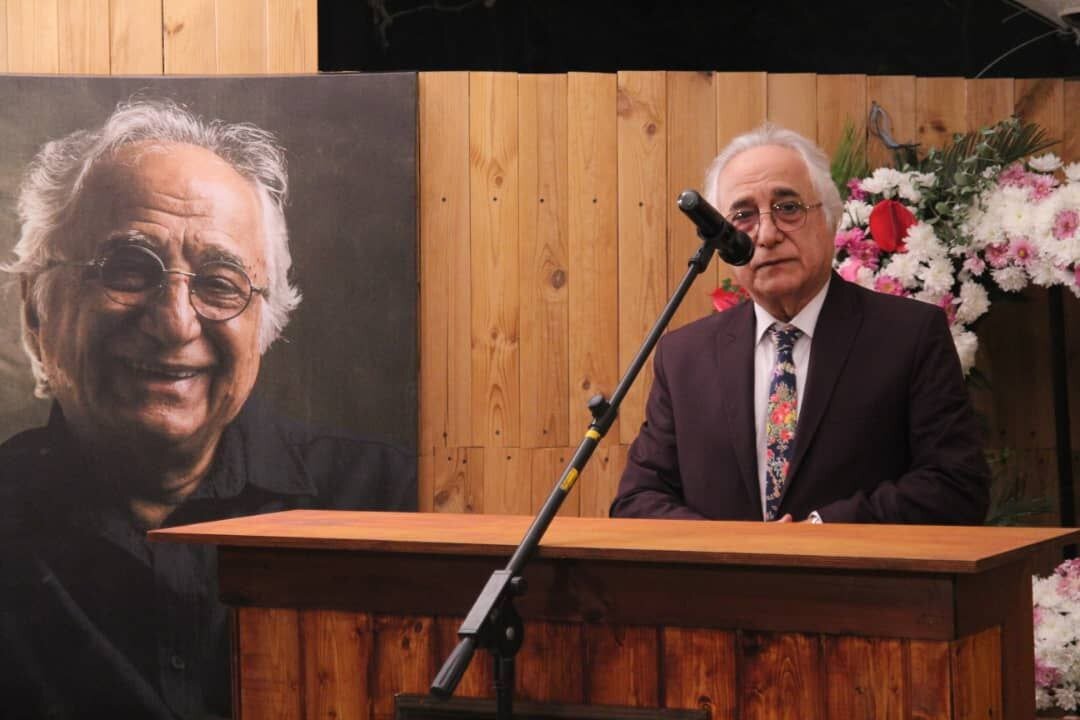
According to Khabaronline News Agency, quoting the event’s public relations, a commemorative ceremony for the poet and artist Shams Langroudi was held on Monday, Aban 26 (approximately November 17), at Sufi Art House, coinciding with his 76th birthday, with the presence of poets, writers, artists, and admirers of his works.
Shams Langroudi, at the beginning of his speech, while thanking all those who contributed to his memorial ceremony, said: “Art is one of the least immediately rewarding professions in the world. Someone who is an employee or has an administrative job works for specific hours during the month and receives their salary at the end of the month, but artistic work is full-time, and perhaps years pass without any return for the individual.”
He added: “When I am in such gatherings, I am most happy to be among people who are empathetic with each other. In my opinion, the best outcome of artistic work is finding individuals who are empathetic. These empathies are very valuable, because one cannot create art or write poetry in a vacuum. It is you who listen to poets’ poems and inspire them with your empathy.”
Shams Langroudi continued his speech by thanking all those who empathized with his poetry and recited several poems for those present at the ceremony.
Ahmad Poori: Shams’s Poetry is Highly Popular
Ahmad Poori, a writer and translator who has been friends with Shams Langroudi for 50 years, said: “Shams Langroudi is one of the most popular poets of recent decades in Iran, whose free verse poetry has been warmly welcomed by various groups of literature enthusiasts.”
He added: “If you ask enthusiasts of Iranian poetry, culture, and art to name five of their favorite poets, you will undoubtedly arrive at a five-person list which includes Shams Langroudi.”
This translator, referring to Shams Langroudi’s efforts in the field of culture and art, said: “In these 50 years, I have truly witnessed how sincerely Shams has strived in the realm of poetry and art, and it is because of these sincere actions and efforts that many today love him, his poetry, and his art.”
Poori continued: “Without exaggeration, I must say that Shams Langroudi is a prolific reader, and in these 50 years, every time I have wanted to translate a book, I have consulted him and always benefited from his opinions. Each time I thought I was translating the poetry of an unknown poet and discussed it with Shams, he would suddenly say, yes, I know this poet, and a book by this poet was published in such-and-such issue of a journal in such-and-such year by such-and-such publisher.”
According to Ahmad Poori, Shams Langroudi is very confident, and if you ask him why he acted in films or sang, he explicitly says: I wanted to, and I know I did a good job. Poori continued: “He trusts himself, and this is very valuable. He has done whatever he liked throughout his life.”
Poori further, referring to Shams Langroudi’s humor, said: “He is a very humorous person and poet, and this spirit has had a prominent manifestation in his life and art. Shams is very meticulous in choosing words, and this meticulousness makes his poetry beautiful.”
Poori continued: “Shams is a tireless person and believes that if someone is to do something, they must do it in the best possible way. When he was busy writing the book ‘Analytical History of Modern Poetry,’ I truly witnessed his efforts firsthand, and he found many of his sources from under rocks to write this research work. I remember once he called me and asked, ‘Do you know anyone in Tabriz? I want a few book titles that are available in a library in Tabriz; I want to see these books up close.’ I said, ‘Yes, I do.’ At that time, technology had not yet advanced to the point where one could take photos of book pages in a few minutes and send them to another person via phone. He had to visit in person.”
He added: “I was still thinking about how to help Shams access these books when my phone rang, and Shams said that he had gone to Tabriz himself to see and study these books. This is how Shams wrote the book ‘Analytical History of Modern Poetry,’ and his work is truly valuable.”
Poori then read several poems from the collection “Gardener of Hell” for the attendees.
Davood Heidari: The Main Theme of Shams’s Works is Love
Davood Heidari, who was responsible for conducting the program, said in his speech: “Langarud is one of the cities in Iran that has been written about in many foreign travelogues; in this small city, many great poets and writers have been born and raised, among whom Shams Langroudi and Mahmoud Payandeh are prominent cultural figures of this region.”
He added: “The love for poetry, culture, and art has taken root in Shams Langroudi’s soul since childhood, and in his works, it can be clearly seen that he is searching for something lost to guide him to his ultimate destination.”
Heidari added: “The main theme of Shams’s poems is love, and his poems are among the best of our contemporary poetry, and how wonderful it is that we have all gathered to appreciate a poet who, throughout his life, has enriched the ancient tree of culture and art of this land with his works.”
Sardar Sarmast was among the artists who performed music at the ceremony, and in his speech about how he became acquainted with Shams Langroudi and his poetry, he said: “I have had a friend for years who always invites me to his house to watch movies together, but from the moment the movie starts, he talks so much that we don’t understand anything about the film, and coincidentally, his conversations have nothing to do with the movie. However, through him, I have become familiar with many films and later sat down and watched them.”
He added: “Once, we watched one of the films in which Shams Langroudi had acted. I asked him who he was, and he said he was Shams Langroudi, a poet. This was the only thing he said that was related to the film, and through this film, I became acquainted with Shams Langroudi. I regret getting to know this poet so late, and I truly envy those who have been familiar with Shams’s poetry for years.”
Bahaeddin Morshedi also said in a brief speech: “25 years have passed since my acquaintance and friendship with Shams Langroudi, and I am very proud of this friendship. Shams Langroudi is one of our top-tier poets, and I have learned a great deal from him in life and professional work.”
He added: “He is a fair and gentle person and always believes that if you are going to do something, you must do it correctly. I remember once one of his poetry books had sold 7,100 copies in pre-sale, and he spent a full day signing all these books for his audience and did not feel tired at all, because each and every one of his readers was important to him.”
According to Reza Razqandi, who is curating this event and the exhibition “Shams at Sufi House”; an exhibition will also be inaugurated on Friday, Aban 30 (approximately November 21), at Sufi Art House, to commemorate Shams Langroudi’s 77th birthday, with Shams Langroudi in attendance.
This exhibition will showcase works by Linda Azad, Sara Azmoodeh, Fariba Aghayan, Hossein Esmaeili, Anahita Aboutorabi, Asef Ebrahimi, Sepideh Ashrafi, Sara Eskandari, Ebrahim Brafrazi, Hooman Bayat, Alireza Bidari, Saeed Panahzadeh, Sayeh Saghafi, Fatemeh Haghdar, Mohsen Hejazi, Davood Heidari, Alireza Rouholamin, Reza Razqandi, Mojtaba Rostami, Maryam Zahmatkesh, Abbas Seifabadi, Amirhossein Sharifian, Ali Sufi, Marjan Askari, Katayoun Asaliyan, Mohsen Farahani, Azarmidokht Fattahi, Golnaz Gaeini, Ali Gorji, Eliana Shams, Mahdis Mehrjou, Nasrin Hadian, Hoorieh Hashemi, and Shahrouz Yar-Ahmad. The exhibition will continue until Azar 12 (approximately December 3).
The memorial ceremony for Shams Langroudi was held by Reza Razqandi and Sufi Art House, and several music groups performed at this ceremony. Sufi Art House is located at No. 2, Khorsand Alley, Razi Street, Neauphle-le-Château Street.