Get to Know ‘Mahdinegaran’ from the First Five Centuries After the Prophetic Mission / From Sulaym ibn Qays al-Hilali to Muhammad ibn Ali al-Farsi
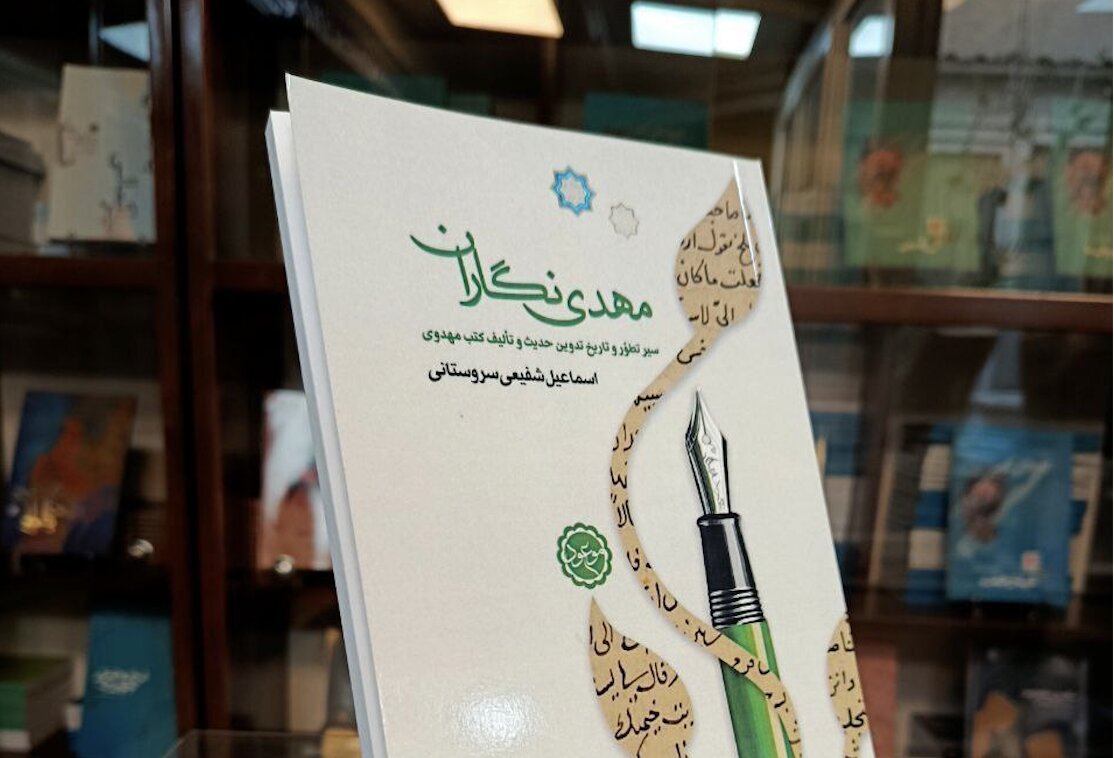
According to the Mobligh Thought and Culture website, citing the public relations of the Maw’ud Asr (AJ) Cultural and Artistic Institute, ‘Mahdinegaran’ is a novel lexical compound recently coined by Esmaeil Shafiei Sarvestani to describe the struggle and efforts of authors who dedicated their lives to writing and compiling works about the blessed existence of Hazrat Baqiyatullah al-A’zam, Qa’em al-Montazar, Hujjat ibn al-Hasan, Mahdi al-Maw’ud (may Allah hasten his honorable reappearance). These are authors who spent their entire lives preserving, recording, and writing down narrations issued by the Infallible Imams, transmitted through one or more intermediaries, and then documented and written by these authors.
The book ‘Mahdinegaran: The Evolution and History of Hadith Compilation and the Authorship of Mahdavi Books’ was written by Esmaeil Shafiei Sarvestani, and Maw’ud Asr (AJ) Publications has released this book in one hundred copies and 172 pages.
The author writes in the opening pages of this book: This collection was initially chosen as an introduction to the ‘Encyclopedia of Mahdavi Authors and Narrators,’ but we regretted that the story of many faithful believers and Mahdavi researchers, who with great endeavor passed down collections of hadiths, narrations, and written works through all the arduous ups and downs and from the dark hands of rulers and blind bigots to the present day, should be forgotten by the ravages of time.
This book includes topics such as the evolution and history of Hadith compilation, the narrative of transmission and fabrication of Prophetic Hadith, the hardships faced by Imami scholars and authors, the mission of conveying Mahdism at the peak of Islamic history, and the evolution of Mahdavi books and authors. The author, by expressing the concept of waiting as inherent to human existence, refers to Imam Mahdi (AJ) as the heart of the world of possibility and the perfect human being.
A section of the book mentions: In recent years, the book ‘Mu’jam Mahdism in Exegetical Narrations’ by the esteemed researcher Morteza Abdi Charli has been published. In this extensive three-volume collection, researchers, by referring to exegetical narrations, have cited 363 verses (related to Mahdism) and declared the number of related surahs to be 91. In this collection, regarding the reason for the expansion of Quranic discussions on the topic of Mahdism, it states: ‘If not all discussions of Mahdism, at least a major part of them, since they are instances of the unseen and hidden, cannot be explained and discovered except with the aid of the Quran and Sunnah. The best helper for those interested in understanding true Mahdism, far from subtleties and distortions, are those exegetical narrations that have emerged from a specific combination of the Quran and Hadith and are full of pure subtleties and nuances that should be the source of correct Mahdavi thought.’ (Page 50)
The author divides the evolution and history of Hadith compilation into two periods: the presence of the Infallible Imams and the period of occultation. He discusses the Hadith heritage of Amir al-Mu’minin Ali (AS) and Hazrat Siddiqah Tahir Fatimah Zahra (SA), and further examines the eras of Imam Hasan Mojtaba (AS), Imam Husayn (AS), Imam Zayn al-Abidin Sajjad (AS), and the Sadiqayn. He also briefly refers to the period from Imam Kadhim (AS) to the father of the Master of the Standard, Hazrat Imam Hasan Askari (AS), noting that 1,695 books by 603 individuals have been recorded as statistics for the companions of the Infallibles.
In another section, we read: From the very early days of Hadith collection, narrators and authors grappled with the problems of their time. Sulaym ibn Qays was one of the earliest Mahdavi authors, who was imprisoned by Ibn Ziyad during the uprising of Imam Husayn (AS). He fled Iraq in the year 75 AH when Hajjaj ibn Yusuf came to power, as Hajjaj sought him out due to his clear friendship and history with the Household of the Holy Prophet (PBUH). During this forced exile, at the age of 77, Sulaym came to Iran, reaching a city called Nowbandjan near Shiraz in the Fars region, where he passed away and was buried. (Page 157)