“Parsijan” Award Reached Chavoshi, Bozorgi, and Azharianfar in Aban
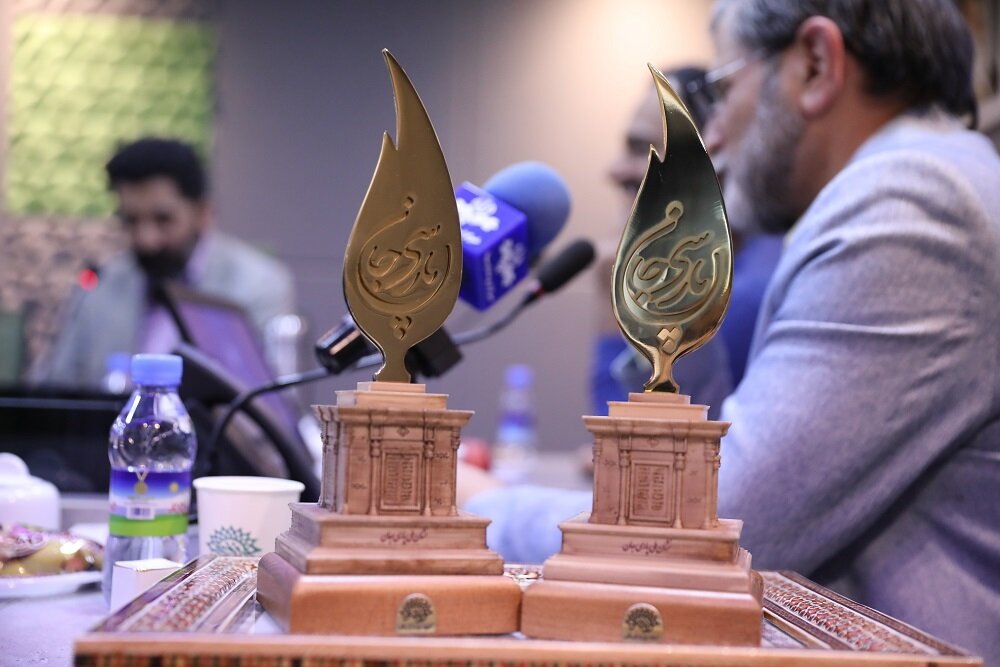
According to Mehr reporter, the Parsijan Award ceremony (special for Aban 1404 / November 2025) was held at the Tahereh Saffarzadeh Hall of the Art Bureau, introducing three honorees. In this ceremony, attended by Nasser Faiz, Milad Erfanpour, Mahmoud Tavasolian, and Fariba Yousefi, Shahriar Azharianfar (for the game Amirza), Ali Bozorgi (pilot), and Mohsen Chavoshi (singer) were honored.
At the beginning of the ceremony, Mahmoud Tavasolian, a member of the Office for the Preservation of the Persian Language, welcomed the attendees and said: “Since its establishment, the Office for the Preservation of the Persian Language has always strived to expand this beautiful and magnificent language among the people in every possible way within its capacity. One of the main concerns of this office from the beginning has been that although the Persian language has always flourished among Persian speakers, thank God, what has been lacking is planning and purposefulness to further transfer this language to various segments of society.”
He added: “In this regard, as a first step, we established the Parsijan School in previous years, and I believe many friends, both within and outside the Art Bureau, are now aware of its activities. Throughout the week, and sometimes every day, we hold two workshops or two meetings whose main focus is the study and analysis of ancient texts; because, in fact, these texts form the foundations of our identity. But what has brought us together today is the awarding of the ‘Parsijan’ emblem. As friends are aware, we initially started with a focus on cinema and awarded this prize for two periods to filmmakers and screenwriters. Then last Shahrivar (August/September), we also had this emblem and two commendations.”
He continued: “The main approach in awarding this emblem is to honor any individual, group, or event that takes a step, however gradual, in the public sphere towards safeguarding and preserving the Persian language. In other words, our main goal is not to celebrate those whose inherent and defined activities are within the field of Persian language and literature.”
In another part of his speech, Tavasolian referred to the selection process for this award: “We formed a consultative council of 100 people from the fields of language and literature, artistic guilds, and various segments of the public. By collecting the votes of these esteemed individuals and summarizing their opinions, the results are provided to a nine-member scientific council. The members of the scientific council are Ms. Fariba Yousefi, Reza Daneshgar, Alireza Qazveh, Mohammad-Mehdi Sayyar, Vahid Yaminpour, Hadi Moghadamdoost, Milad Erfanpour, Nasser Faiz, and Hamidreza Shoeiri. This scientific council meets monthly and, after reviewing the results from the 100-member consultative council, ultimately selects one to three final honorees.”
Why Parsijan?
The second speaker was Milad Erfanpour. He said: “For us, after realizing the importance of the Persian language and its identity and cultural value, the question arose: how can we preserve this language, prevent its erosion, and protect this valuable heritage, and consequently, safeguard our own identity and culture? Naturally, there might be different opinions and approaches in this regard. In our view, the more the issue of the Persian language is presented to the public and innovative measures for its preservation and protection originate from within society, the more sustainable its impact will be. Preserving the Persian language should not necessarily be confined to formal policymaking or limited to governmental institutions. This language is a precious gem that all our people—each one—should feel obligated, with concern and love, to contribute to its preservation in whatever profession, position, and status they hold.”
He added: “Our students should commit themselves to protecting this language through correct reading, precise learning, proper writing, and pure speech. Our teachers, our employees, our department heads and managers, and activists in various fields—each in their own way—as well as thinkers and innovators in media—each in their own method—should be the guardians of this unique gem.”
The director of the Literary Creations Center of the Art Bureau continued: “Based on this, with the formation of an appropriate scientific and consultative council, it was decided to make this approach more public, beyond previous actions, and to advance the movement with broader participation. On this basis, each month we honor three individuals, three events, or three topics that have, in some way, through innovation, voluntary action, and significant effort, carried out important, attractive, and innovative work in line with preserving the Persian language.”
He concluded his speech by saying: “The process is such that each month, with the opinion of the scientific council and an approximately one-hundred-member consultative council—whose esteemed members provide their opinions—nominees that come to mind are introduced. As mentioned, this nominee could be a restaurant that strives to preserve the Persian language, a literature teacher who innovatively teaches language and literature, a pilot who values the Persian language and poetry in their profession, a virtual space tool that pays attention to the Persian language, or a singer who, in their works, emphasizes the language and the strength and maturity of the poetry they perform. After this process, each month, with the final selection by the council, three honorees are chosen. Today, our first monthly honorees—related to Aban 1404 (November 2025)—will be celebrated and honored at the Office for the Preservation of the Persian Language of the Art Bureau and will receive the Parsijan emblem and a certificate of appreciation.”
Focusing on Persian Language, Outside Formal Duties and Usual Expectations
Nasser Faiz then thanked the attendees and said: “In selecting individuals or organizations to receive this emblem, we have mainly focused on whether attention to the Persian language is among the main concerns of that person, organization, or institution. Of course, many others claim to pay attention to the Persian language and perform their duties in this area. But what is important to us is that this issue has become a serious concern in the individual’s life, even if their job is not directly related to this field. Someone whose inherent duty it is must perform it and be accountable for the tasks they have not done.”
He continued: “In other words, those individuals who are not primarily active in the field of Persian language and literature but show creativity through personal initiative, in my opinion, are considered among the most valuable people for this organization. Beyond mere attention to the Persian language, what is important is that this issue becomes a serious concern for them, in a way that in their profession and activity—to their own extent—they can also attract and make others aware of this language and our identity. The creativity an individual demonstrates and the action they take outside the framework of formal duties and usual expectations are, in our view, extremely valuable. Such individuals should even be highlighted and introduced.”
Faiz, referring to two features of the Persian language: its ancientness (one of the four ancient and living languages of the world) and having very ancient written sources that can still be read and understood, added: “We hope this event can draw public attention more than ever to the importance of the Persian language, especially those whose inherent duties include this responsibility and who are expected to act with greater seriousness than in the past in this regard.”
Amirza, and a Team That Has Always Focused on Iran in Game Creation
Following the screening of a film about the founders of the Amirza game, Shahriar Azharianfar, representing the group, began his speech and said: “We started our activity in game production in 2004, and interestingly, these games have always been based on Iranian history. Our first work was the story of Nader Shah Afshar’s life titled ‘Nader’s Sword,’ Lotfali Khan Zand’s ‘Night Watchman’ game, and then the ‘Arrow of Time’ game. Since 2013, we have also offered the word game ‘Baghali’ and subsequently the ‘Amirza’ game.”
He added: “Throughout this journey, no governmental support or budget was allocated to us, with the exception of one award that was supposed to be given by the Scientific Vice-Presidency—which they never gave; it was just a promise of an award!”
He continued: “Unfortunately, the Persian language is in a situation where—as the masters are aware—despite the holding of poetry gatherings, there is no spiritual or even material support behind the scenes in this regard. If individuals or institutions want to introduce Iranian literature to the world through games—which is a very creative industry—unfortunately, the necessary infrastructure or support is not available. Even in the field of cinema, no worthy works have been produced so far; for example, we have never had a series about Cyrus the Great, which is truly regrettable, or even a well-known work centered around the Shahnameh that has become globally widespread has not yet been created.”
Azharianfar continued: “For example, there are Korean cinematic films, and diverse Korean games are produced, supported by very large budgets. In contrast, the entire budget available to, for instance, the National Foundation of Computer Games is merely limited to employee salaries, and unfortunately, there is no major planning in this area. This is despite the fact that the global gaming industry has high revenue generation, and extensive investments are made in it. As an example, Saudi Arabia has invested several trillion dollars just in games, while our share is almost zero.”
He added: “For instance, when we started our work, it is unlikely that Turkey or Saudi Arabia even knew where games were heading or what a game fundamentally meant; but today, with huge investments, they have taken over this entire industry. Out of the ten largest American developers, three are from Turkey, and we are still grappling with issues and problems like taxes, social security, and municipalities, facing major challenges.”
The young game developer concluded his speech by saying: “I hope that the current trends, with the cooperation of masters and experts, can at least convey our voice to high-ranking officials and demonstrate how much this industry can bring in foreign currency, create jobs, prevent emigration, and increase productivity. Given the population of approximately 32 million gamers in the country—which is not a small number—if there is proper policy support, many goals can be achieved, and great strides can be made.”
The Enthusiastic Pilot Who Recites Poetry Before Flight Announcements
Ali Bozorgi (passenger airplane pilot), another recipient of this award, then explained the reasons for his selection and said: “The idea of using Persian poetry and literature in messages presented to passengers originated from the initial goal of attracting passengers’ attention and creating effective listening. What could be better than the Persian language and literature, which connects us all, and perhaps this method is the best way; because the only means of communication at that moment is sound, and there are no visual elements.”
He continued: “Most airplanes in our beloved country are not equipped with displays for broadcasting entertainment content, so the minutes when the pilot speaks to passengers can be very important and create a better experience for them, especially if they are stressed or anxious. This approach will certainly also impact the improvement of passengers’ mood; and what could be better than starting this communication with Persian poetry and then conveying essential travel information to dear passengers.”
This enthusiastic pilot concluded by referring to passenger messages: “The messages received have always been numerous and high-quality, sustaining this valuable cycle—motivation, action, feedback reception, and renewed motivation—for me. A clear example was one of the esteemed passengers from our proud Sistan and Baluchestan compatriots, who, with admirable taste, improvised a poem inside the airplane in praise of myself. Studying this work was very pleasant and a source of joy for me, that I have been able to provide a small spark to the taste and creativity of my fellow citizens and awaken that inner motivation in them; it truly has great value for me.”





