Publication of audio versions of two audiobooks ‘Unfinished Fever’ and ‘Khanoum Mah’ featuring prominent voice actors
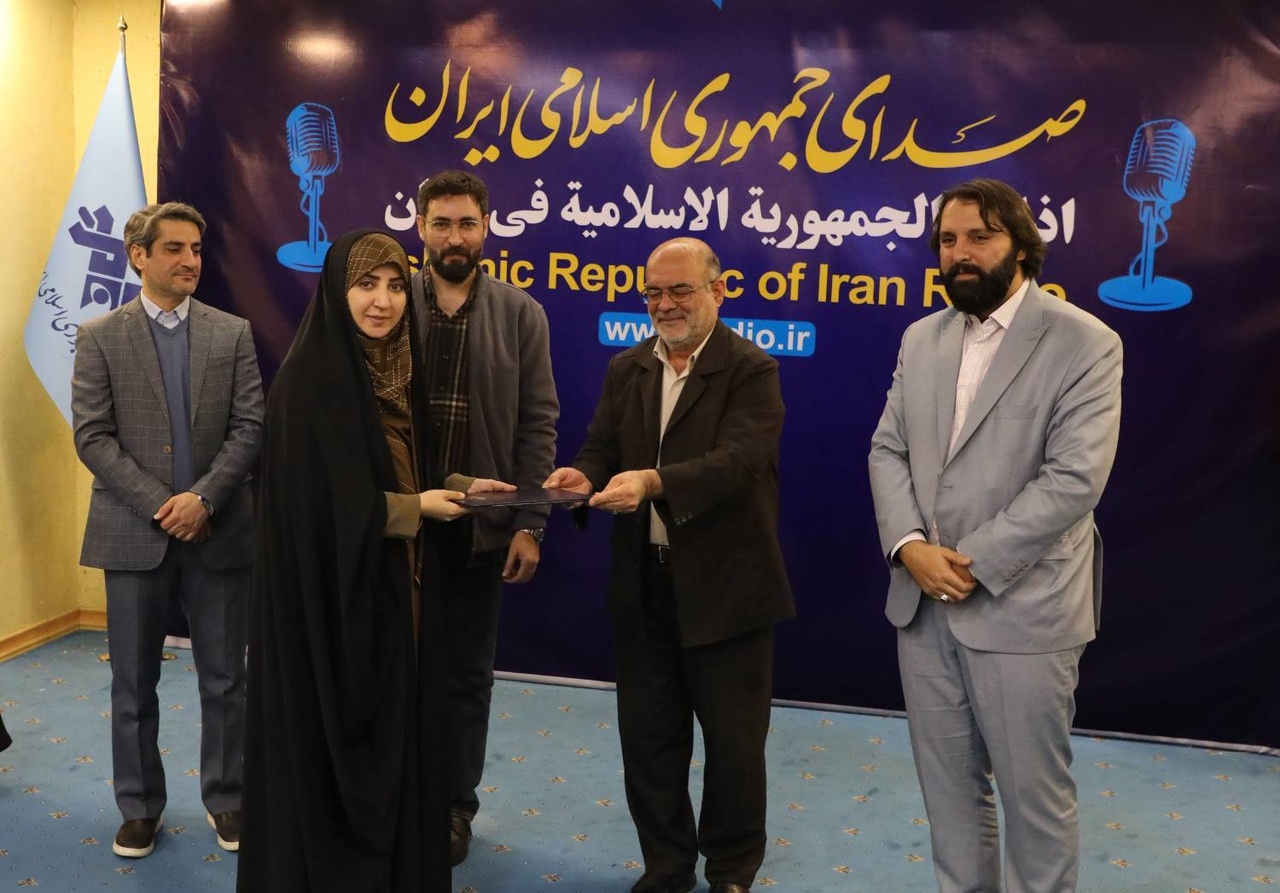
According to the Iran Book News Agency (IBNA), quoting Iran Seda public relations, a ceremony was held at the Radio Martyrs building with the presence of the Deputy Voice of National Media, Director General of Iran Seda, a group of artists, publishers, authors, media personnel, and esteemed martyr families. The audio versions of two books, ‘Unfinished Fever’ and ‘Khanoum Mah’, which had recently been commended by the Supreme Leader, were unveiled, and the production team was honored.
First, following the recitation of the Holy Quran, Mehdi Shamloo spoke about the widespread reception of Iran Seda audiobooks, especially among youth. He mentioned that in recent years, the free production and distribution of audiobooks have led to the creation of over 9,000 audiobooks, with an average of 400,000 daily playbacks. He noted that the art in Iran Seda audiobooks enhances the appeal of the books and adds those who lack the time or inclination to read physical books to the circle of readers. He emphasized that these two works, written by fluid and engaging authors, used the skill of more than 15 voice actors to promote the culture of sacrifice and portray real narratives of women and mothers who played significant roles in the country’s contemporary history.
‘Unfinished Fever’: The Story of a Martyr’s Struggle
Ali Bakhshizadeh, Deputy Voice of National Media, emphasized that today’s prosperity and security are indebted to the blood of martyrs. At the unveiling ceremony for the audiobooks ‘Unfinished Fever’ and ‘Khanoum Mah’, he said: “Reading ‘Unfinished Fever’ confronted me with the deep oppression of martyr Dakhanchi; a martyr who was a veteran for 17 years and lived struggling, without his pains being seen. Also, ‘Khanoum Mah’ narrates the story of the oppressed martyr Shirali Soltani, familiarizing audiences with this martyr’s struggle.”
In impactful remarks, Bakhshizadeh spoke about the place of martyrs in the historical memory of the Islamic Revolution, saying: “If we live in security and peace today, we owe it to the men and women who sacrificed their lives and health. Martyrs do not belong only to the past; they hold a great claim over our present day.”
He continued by citing martyr Dakhanchi as a clear example of this truth, honestly and humanly narrated in the audiobook ‘Unfinished Fever’, produced by Iran Seda.
The Deputy Voice of National Media highlighted the presence of martyr Dakhanchi’s wife at the unveiling ceremony, stating: “It was a great honor for us to be alongside the wife of this great martyr. This presence elevated the book beyond a written narrative, transforming it into a living and profound experience.”
According to Bakhshizadeh, reading this book introduces the audience not only to the life of a martyr but also to the hidden sufferings of veterans; sufferings that have rarely been seen or heard.
He paused meaningfully during the ceremony and added: “Perhaps being a veteran sounds simple in words; but you do not know what being a veteran means. Being a veteran means continuous editing of body and soul; it means living in pain, without complaint.”
Sharing his personal experience of reading the book, Bakhshizadeh said: “I started reading ‘Unfinished Fever’ last night after mosque. I read some pages twice. I couldn’t stop myself from crying. This book is not just the narration of a life; it is a mirror that reflects the oppression of a mujahid.”
The Deputy Voice emphasized the concept of “martyr mujahid”, stating: “Martyr Dakhanchi was a mujahid martyr. Struggle is not limited to the battlefield; struggle continues in the years after injury, in the patience of the family, in the silence of pain. The reward of a martyr mujahid is very high, and we have a duty to narrate this truth.”
In conclusion, Bakhshizadeh praised the authors of ‘Unfinished Fever’ and ‘Khanoum Mah’, saying: “Bravo to the authors of these works for writing the book so beautifully. These books show how literature and media can be a bridge between today’s generation and a truth that will be forgotten if not narrated.”
He stressed that producing audiobooks and audio narratives about martyrs’ lives is a serious mission for the national media; a mission to keep the truth of struggle alive, not in slogans, but in honest human narration.
A Narrative of Patience and Loyalty in Martyr Dakhanchi’s Life
In another part of the ceremony, Azam Nikosohbat, the wife of martyr Hossein Dakhanchi, spoke about the moral and spiritual characteristics of this esteemed martyr. She humbly stated that speaking about martyrs is difficult because “neither is the truth fully conveyed, nor can a drop from the ocean of a martyr’s existence be described.” Nikosohbat referred to her husband’s 17 years of quiet struggle, during which only his neck and part of his right hand could move, and highlighted patience and loyalty to Velayat (Supreme Leadership) as his most prominent features, adding: “If a place says someone is the red line of loyalty to Velayat, this description precisely applies to him.”
This Book Is Not Just a Narrative of Suffering
Zahra Hosseini Mehrabadi, the author of the book, explained that ‘Unfinished Fever’ addresses one of the least narrated aspects of the war; a story not from the hard battlefield, but from a nine-meter room. It’s the heroic life of a mother who nursed her paraplegic son. She emphasized that the book is not just a narrative of suffering, but the story of a family that transformed the bitter incident of spinal cord injury into a staircase for growth, patience, and spiritual ascension. This book is essentially the life story and first-person narrative of this heroic woman, Mrs. Shahla Monzavi, mother of martyr Hossein Dakhanchi. The author concluded by saying: “The story of the martyr’s marriage to Mrs. Azam Nikosohbat is briefly narrated in the final parts of the book. God willing, I will soon write another book based on interviews with the martyr’s wife.”
‘Unfinished Fever’: A New Look at the Life of Paraplegic Veterans
Fadhah Hosseini, narrator and voice actor of the ‘Unfinished Fever’ audiobook, also said at the ceremony that participating in this project changed her view on the lives of paraplegic veterans. She called the martyr’s mother the main hero of the book and expressed hope that the narrative of the martyr’s wife, a small part of which is in the book, will soon be published as a separate work. It should be noted that Ms. Fadhah Sadat Hosseini holds a doctorate in law and is known to the public as a news anchor and host of the TV program ‘Molaazeman-e Haram’.
Publication of a Book with the Martyr’s Mother’s Narrative, Noted by the Leader
Akhavi, representative of “Hamaseh Yaran” publishers, referred to the Supreme Leader’s commendation of two works from this publisher as a sign of the correctness of their cultural path. He said ‘Unfinished Fever’ is the intimate narrative of a mother who stood by her veteran son for 17 years and overcame the most difficult days with patience and an epic outlook.
‘Unfinished Fever’: A Different Experience of Sacrificial Narrative
Seyed Ali Mirtalebi Pour, the audio producer of this book, said that before reading this work, he did not have an accurate understanding of the life of a paraplegic veteran, and this book opened a new window for him to understand the sacrifice of veteran families.
Narrative of Martyr Shirali’s Life: From Shiraz to the Holy Shrine of Imam Reza
In another part of the ceremony, the audiobook ‘Khanoum Mah’ concerning the life of martyr Shirali’s wife was unveiled. Simriz, production manager of Astan Quds Razavi publishers, emphasized that publishing this book in Mashhad has a meaningful link to the life of this esteemed martyr. Referring to the fact that martyr Shirali was from Shiraz but had a deep bond with Mashhad and Hazrat Reza (PBUH), he said: “A part of the book mentions that before his last trip, the martyr told his family that ‘This year we will go to Mashhad and we will not return.’ Finally, his pure body returned to Mashhad.” He considered the publication of this book by Astan Quds Razavi publishers a divine blessing and expressed hope that the memory and path of the martyrs will always inspire society.
‘Khanoum Mah’: Representation of the Model Woman of the Islamic Revolution
Sajedeh Taghizadeh, the author of this book, stated her main goal was to present a real image of the “model woman of the Islamic Revolution.” She said this book is the result of years of research and narrates the life of a woman who, through the suffering of three martyrs in her family, transformed into a model of resilience, management, and cultural role-playing. ‘Khanoum Mah’ is the life story of Khanom Naz Alinejad, wife of martyr Shirali Soltani, from Shiraz. This book is narrated in three separate chapters and talks about the life and choices of Khanom Naz. In the end, she thanked the artists, voice actors, and production staff of this audiobook, considering working in this field to be very effective for promoting and expanding book content.
A Spiritual Experience in Producing the Work
Mehrkh Afzali, the main voice actor and narrator of the audiobook ‘Khanoum Mah’, spoke about a spiritual experience full of feeling during the production of this work, stating that from the very first session she felt the martyrs were present and watching. She considered the public’s reception of the book and numerous requests for intercession from martyr Shirali as a sign of the deep connection between the audience and this narrative.
This Audiobook Production Was the Martyr’s Choice
Mehrnoush Mohtashami, the producer of the audiobook ‘Khanoum Mah’, also spoke about the different experience of this project, saying: “Although I have produced hundreds of audiobooks so far, this work had a different feel, and I believe it was the martyr’s own choice.” This audiobook was produced with a first-person narrative and features the voice acting of veteran actress Mehrkh Afzali in the role of Khanoum Mah, along with more than 12 other actors and voice artists. Mr. Seyed Ali Mirtalebi Pour plays the role of martyr Shirali and Khanoum Naz’s husband, while Roya Fallahi, Asieh Gorji, Server Rakhshani, Mahdiyeh Mahboobi, and Leila Madadi, along with Messrs. Mehdi Malekan, Alireza Kouhpeyma, Amir Hossein Hossein Tabar, Fariba Ghalibaklou, and Kourosh Ehsani play various character roles in the ‘Khanoum Mah’ audiobook. Hassan Homayi narrated the introduction and poems of the book.
Appreciation for Martyr Families and Emphasis on Their Enduring Role in Resistance
Server Rakhshani, representing the other voice actors of the ‘Khanoum Mah’ audiobook, also thanked the martyr families, saying: “Every step taken in the path of the martyrs is the martyr’s own choice.” She wished health for the martyr families and emphasized that society is always indebted to their sacrifice.
The ceremony concluded with the unveiling of the audio versions of ‘Unfinished Fever’ and ‘Khanoum Mah’ and honoring the creators of these valuable works.