Resurrection of words, return of narrative, and crisis of meaning
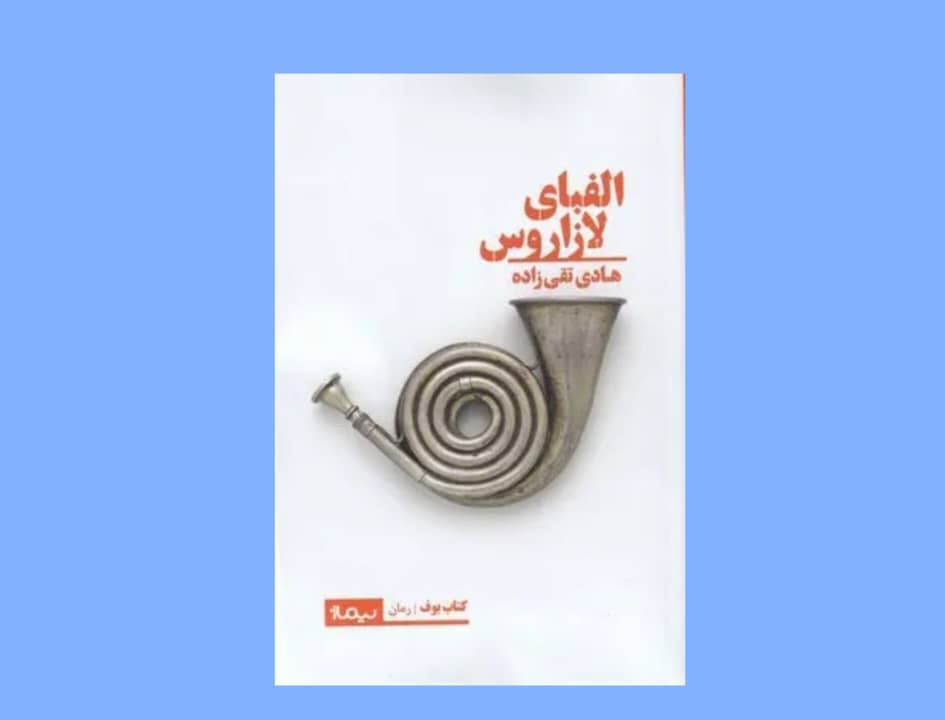
Literary service of Iran’s Book News Agency (IBNA) – Sameh Ebtehaj: In times of political turmoil, global environmental crises, and the collapse of collective meaning, literature once again becomes a refuge for thought. "Lazarus’ Alphabet," Hadi Taghizadeh’s latest work, emerges from this very place; from the void of meaning, from the ruins of language, and from the anxiety that contemporary man experiences when confronted with a world of images, violence, and ideology. This novel not only continues the author’s experimental path in works like "The Graph of the Cat" and "Water Pressure on Delko’s Strange World," but also offers a redefinition of narrative in the contemporary post-philosophical and post-idealistic world in form and content.
Taghizadeh is an author who blurs the line between history and imagination. In "The Graph of the Cat," he transformed the Chernobyl event into a contemporary myth by combining fairy tales and science; and in "Lazarus’ Alphabet," he turns the post-pandemic world into a mirror of civilizational and ideological collapse. During the same pandemic era, with the sharp insight of a historian-psychologist, he predicted the role of war profiteers and quasi-religious foundations in the birth of future violence. Therefore, while his novel is a product of imagination, it serves as a cultural and historical document of the anxiety of its time.
Language in this work is not a tool of narrative, but the subject of narrative itself. The alphabet here is not a semiotic system, but an ontological apparatus; words are like living corpses seeking the resurrection of meaning. Lazarus, the hero returned from death in Christian tradition, is here a metaphor for language itself; a language that has experienced death in the clamor of technology and consumption and now wishes to speak anew.
In the novel’s multilayered and puzzle-like structure, Taghizadeh draws on the tradition of nested, Thousand and One Nights-style narratives. Each story lives within another story, and the narrators, like broken mirrors, reflect fragments of reality. This structure can be analyzed through the lens of Gérard Genette and Paul Ricœur’s theories, where narrative simultaneously represents and reconstructs experience. Time in Taghizadeh’s work is not linear but circular; the past repeats in the future, and the future reflects in the past. This interplay with time and narrative is not a formal device, but an ontological statement: the world is no longer narrated linearly.
From a perspective of analytical psychology, the novel’s characters carry Jungian archetypes. "Tarf Pentible" follows a heroic journey, moving from the darkness of doubt and emptiness to the light of self-awareness; the same path described by Joseph Campbell in "The Hero with a Thousand Faces." In contrast, characters like "the Rainmaker Poet" or "the Prophetic Mechanic" reflect two contradictory facets of civilization: creativity and destruction. They are not only dramatic but also evolve into new myths on the level of the collective unconscious. Just as Jung said, every civilization recreates its own gods.
From a sociological perspective, "Lazarus’ Alphabet" stands on the ruins of the control society; a world where humans are not autonomous subjects but data points in a network of power, capital, and information. With Foucaultian precision, Taghizadeh narrates power relations within religious, military, and media layers.
War is not an external event, but an internal mechanism within the mind and language of contemporary man. He shows how violence is reproduced beneath the skin of faith and progress; as if Lazarus rises not only from the grave, but also from factories, markets, and altars.
From a philosophical standpoint, the novel focuses on the tension between faith and doubt, freedom and determinism, and death and rebirth. Lazarus here is the Nietzschean man who must find new meaning for existence. But with an existentialist tone reminiscent of Camus, Taghizadeh suggests that resurrection is ultimately not a return to faith, but a return to responsibility.
Aesthetically, the work can be considered a continuation of magical realism, but not in the Marquezian sense, rather in an Iranian and modern style; where magic originates from the human mind, and imagination is a reaction against the anxiety of reality. As André Gide said in "The Fruits of the Earth," literature has meaning when it arises from the collapse of meaning.
A notable point in "Lazarus’ Alphabet" is the connection between content and form. Taghizadeh has designed a structure that forces the reader to participate; the reader must connect scattered narratives and build truth from signs. This process is what Umberto Eco calls an "open text"; a text that suspends meaning so that the reader becomes a co-creator.
In this context, the potential for creative industries in the work is prominent. Its fictional world and metaphorical characters provide possibilities for adaptation into film, games, and performances. "Lazarus’ Alphabet," with its multi-media structure, can become a transmedia project that intertwines literature, cinema, images, and data; what we know in contemporary world literature as "transmedia storytelling."
Taghizadeh has in fact written a story that prophetically follows the logic of digital platforms: networked, fragmented, and participatory.
On an intercultural level, Taghizadeh’s novel echoes the atmosphere of works like Marquez’s "One Hundred Years of Solitude" and Murakami’s "Kafka on the Shore," with the difference that his world is more Iranian, darker, and more political. Behind this world stands the restless spirit of a civilization wounded simultaneously by faith and science, by myth and reason.
Taghizadeh’s language in "Lazarus’ Alphabet" is multifaceted: sometimes poetic and allegorical, sometimes philosophical and cold. He sculpts words like objects, giving them volume and dimension, to the point where language reaches self-awareness, and form and content become indistinguishable from each other.
Dramatically, the novel is built on fundamental oppositions: life/death, faith/doubt, language/silence, individual/collective. These contrasts are the main drivers of narrative tensions and lend tragic depth to the work. In this context, Lazarus is not only the hero, but also a mirror of contemporary man; a human who engages with language and time in search of lost meaning.
Ultimately, "Lazarus’ Alphabet" can be described as a work on the boundary between literature, philosophy, and humanities; a narrative of collapse and reconstruction, of the death of meaning and the resurrection of language. This novel, like a scroll of future and past, narrates human life in a world that no longer seeks salvation, but merely strives to understand itself.
In this work, Hadi Taghizadeh remains faithful to his long-standing concern—the connection between imagination, philosophy, and history—but his voice is now more mature, philosophical, and universal. "Lazarus’ Alphabet" is not just a novel about resurrection, but resurrection itself through language. In this work, we encounter the resurrection of Persian literature in an age of crisis; a novel that speaks of the death of meaning and, at the same moment, promises the possibility of its return.