An ‘open ending’ in a short story is often a sign of the author’s inability
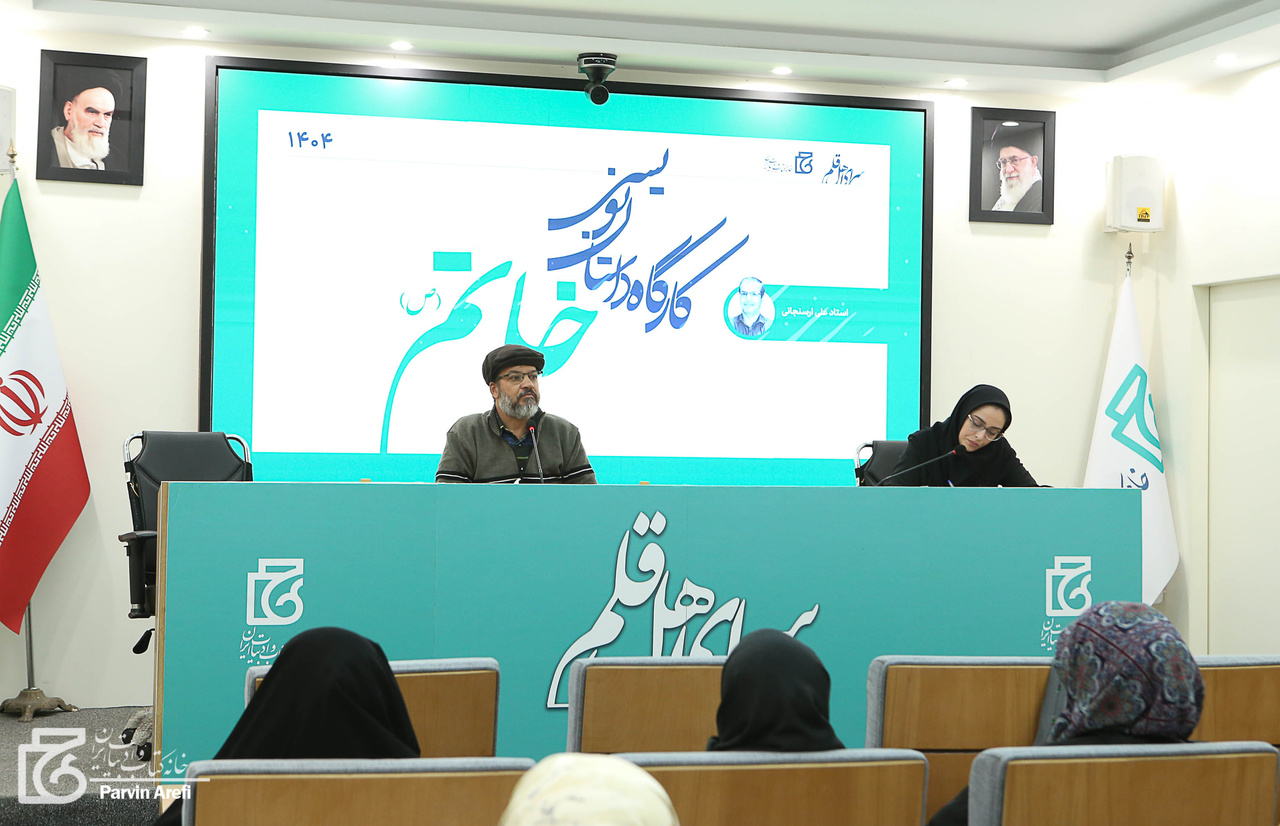
According to the Iran Book News Agency (IBNA), the fifth session of the Khatam (PBUH) short story workshop, in cooperation with the Office of Islamic Culture Publishing and the Iran Book and Literature House, was held on Saturday, December 13, 2025, with Ali Arsanajani as the instructor at the Saraye Ahle Ghalam (House of Writers) of the Iran Book and Literature House.
This session, dedicated to the critique and review of the story ‘H like Rahma’ written by Fazeleh Sarbandifarahaani (honored in the adult section of the fifth Khatam festival), covered topics such as plot analysis, characterization, main elements of the story, and the importance of rewriting.
The session began with an analysis of the plot of ‘H like Rahma’.
Arsanajani, differentiating between ‘narration method’ and ‘actual sequence of events,’ described plot as a driving force whose technical analysis requires rearranging all events, including flashbacks, according to the actual timeline.
He explained: An author might start the story from a climax for attraction, but when we want to extract the plot like a technical map, we have to see what happened first, what happened next, and where it ended. This analysis is the basic engineering of the story.
In response to a question about the rules of narrative order, this short story instructor emphasized the author’s creativity and courage and said: There are no absolute necessities in art. You can use any technique, provided you execute it correctly and convincingly, and the reader accepts it; art is the place to disrupt rigid dos and don’ts.
In response to another question about how to manage flashbacks in a novel without creating confusion, Arsanajani examined the answer through the ‘level of the audience’ and explained: A flashback disrupts the narrative unless the author is dealing with a very unfamiliar audience and takes great care to maintain coherence; like ancient narratives such as ‘A Thousand and One Nights’ and ‘Samak Eyyar’ which clarified the path for the reader by repeated references to the main story; but if your audience is professional, they will understand the world of the story even in narratives with stream of consciousness or complex time shifts. The key point is knowing the target community; you must ask yourself what level you are writing for. If you write for your own level or higher, it will be understood; but if you write for a level lower than yourself, they might not connect.
One of the main focuses of the fifth session of the Khatam (PBUH) short story workshop was the role of cause-and-effect relationships in advancing the story.
Arsanajani introduced this relationship as the basis for plot functionality and stated: If the chain of cause and effect in a story is broken, like dominoes where the distance between pieces is too large, the story stops at that point and does not progress.
The instructor of the Khatam (PBUH) workshop, pointing out a challenge in the story ‘H like Rahma,’ identified one of the common mistakes in short stories as choosing a ‘long timeframe’ and ‘too many characters’.
He explained: When an author wants to fit a long-term life story or complex characters into a short story format, they are forced to simply give information instead of ‘storytelling’ and showing. As a result, characterization remains superficial, the setting and beliefs lack depth, and the plot becomes unstable. A short story is not a field for massive character transformation, but only has the capacity to show one decision or one moment of change.
Endings; the art of connecting everything
Arsanajani described endings as one of the most difficult parts of a short story and, criticizing the common concept of an ‘open ending,’ said: An open ending does not mean abandoning the story, and a weak or abandoned ending is often not due to art, but due to the author’s inability. A skilled author knows how to bring all parts to a logical and convincing conclusion.
In another part of the workshop on story elements, this short story instructor said: The foundation of a story rests on two pillars: character and event. Adding other elements like ‘inciting incident,’ ‘turning point’ (where the story’s direction changes), and detailed atmosphere only makes the story more powerful.
Arsanajani emphasized the necessity of author’s patience and repeated rewriting and said: Writing a good story is like carving a delicate statue; it may require working on a story fifty times and rewriting it to achieve a brilliant result. Only with this meticulousness and precision can a universal and readable story be created that is attractive to every reader beyond the confines of a festival.
He also pointed out a subtle point in the language of the story ‘H like Rahma’ and criticized the common method of showing ‘stuttering’ in fictional texts: Some authors resort to drawing out words or using ellipses to show stuttering, which is often useless and even boring for the reader; the simpler and more effective way is to implicitly mention at the beginning or during dialogues that the character has a stutter. For example, a mother says that her son wants to speak again and repeats one word ten times; this is enough for credibility. The technique of direct showing in text is more suitable for screenplays.
The instructor of the Khatam (PBUH) workshop, in response to questions about the criteria for selecting stories in the Khatam (PBUH) festival and critiques leveled at the honored works, stated the educational approach of the workshop as follows: Our goal in these workshops is not judgment or giving prizes; here we are all authors and analyze selected stories as ‘educational materials’. If we propose fixed writing patterns, the result will be ‘mass production’ of similar stories; like some workshops where the master’s influence is repeated in all students’ works; this is not art. To prevent this stereotyping, we analyze the stories even with potential weaknesses so that you reach maturity through precise critique and repeated rewriting; so that after rewriting, those initial questions and ambiguities no longer arise for the reader.
Arsanajani concluded by discussing the influential nature of stories and said: Some ask, must a story always have a message? The reality is that an authentic and interesting story itself is a lasting and shaping work; we read stories to build our worldview and character; from childhood to now, our attitudes, ethics, and actions are a fabric of the same narratives we have heard; from bedtime stories from parents and teacher’s lessons, to pulpit speeches, books, and movies. What we are today is truly a manifestation of those stories.
The Khatam (PBUH) short story workshop is part of the Khatam festival’s program series, held with the aim of promoting Prophetic culture and character through the creation of authentic fictional works.





