Translation of Children’s Books is a Moral and Artistic Responsibility
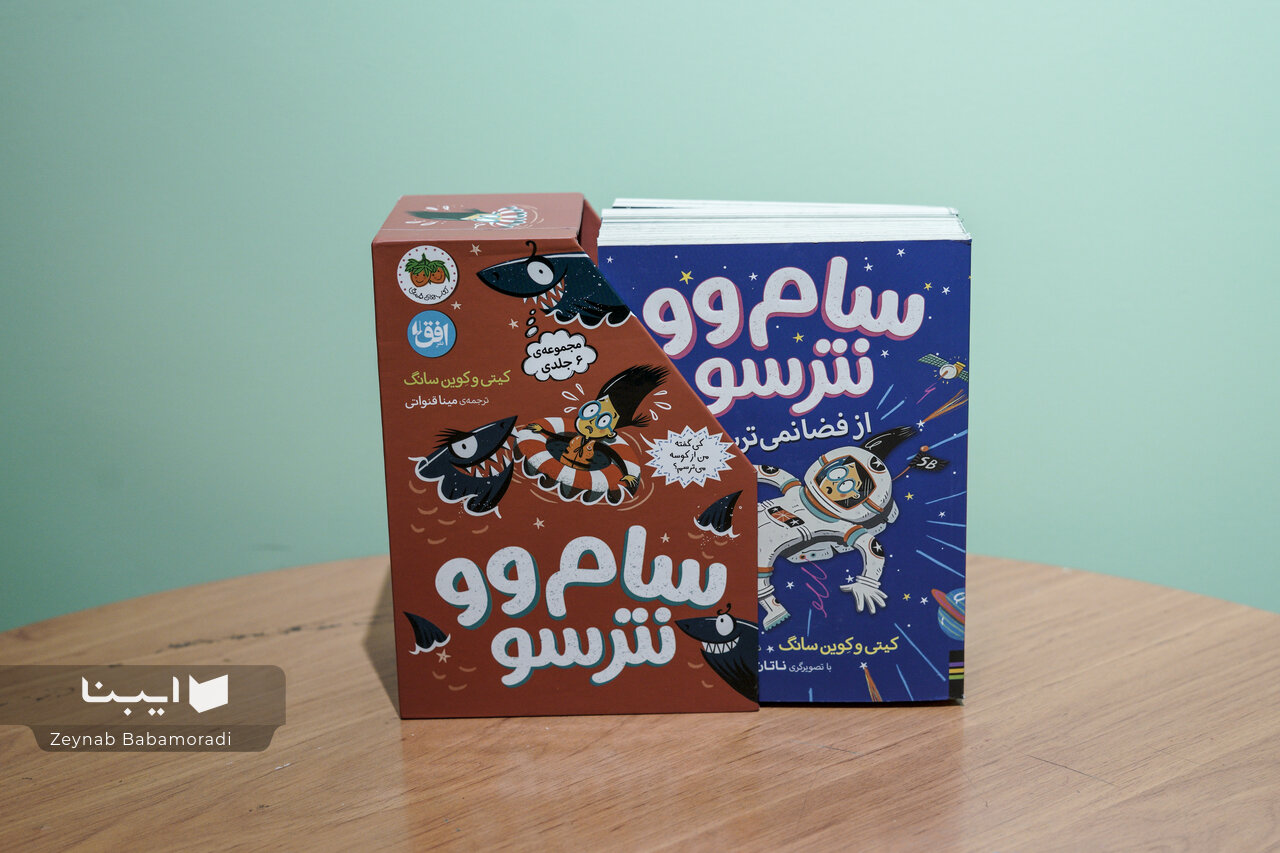
Iran Book News Agency (IBNA) Children and Youth Service – Saye Barin: The collection “Sam Wu is Not Afraid,” whose Persian translation has been published by Ofogh Publishing, presents a new perspective on children’s fears. This collection is about a boy named Sam Wu who has many fears but tries to be brave with the help of his friends and overcome his fears. The “Sam Wu is Not Afraid” series features beautiful illustrations, and its smooth and humorous language is appealing to children and young adults.
Mina Ghanavati, the translator of this series, discussed its most important challenges and features in an interview with IBNA and shared her experiences in this regard. We read this interview together:
When you first encountered the “Sam Wu is Not Afraid” series, what captivated you and made you decide to translate it?
Sam Wu was suggested to me by Ofogh Publishing, and the experience of previous books assured me that this work was selected carefully and intelligently. The main attraction for me was the clever integration of child psychology, classic narrative structure, and situational humor. The character of Sam Wu, with all his exaggerated fears and childlike defense mechanisms, provided an accurate and empathetic representation of a child’s inner world when facing anxiety-inducing situations. What convinced me that this work was suitable for translation, beyond its entertaining aspects, was its smooth text and expressive illustrations, as well as its psychological credibility; because the story neither ignores nor belittles fear, but teaches the child how to overcome helplessness through the “humorous confrontation” plot. This approach aligns perfectly with the goals of therapeutic children’s literature, and I believed it was worth transferring to the Persian-speaking audience.
Although this collection has a simple text, a specific humor and rhythm are visible in the dialogues. What were the difficulties in transferring child-friendly humor from the original language?
The main challenge in transferring the humor of this collection was crossing linguistic and cultural boundaries without destroying the humor mechanism. Children’s humor often revolves around tangible situations, exaggeration, and simple language games. My task as a translator was to find suitable equivalents and create situations that would provoke the same cognitive-emotional reaction in the Persian-speaking child, which required a deep understanding of the target audience’s cognitive and emotional level. My guide in this path was to prioritize the transmission of the humor’s function over the literal translation of its form. For instance, a pun based on wordplay in English might need to be converted into a joke based on action or sound in Persian to be on the same level and medium for the child.
The character of Sam Wu and the world he lives in are full of catchphrases and exaggerated reactions. What methods did you use to find equivalents for these elements?
Catchphrases and exaggerated reactions are actually tools for expressing the character’s emotions. My approach to finding equivalents for these elements was based on recreating the character’s inner voice in the new cultural context. That is, by analyzing Sam’s personality parameters (imaginative, emotional, slightly dramatic) and the situational context of each scene, I sought equivalent linguistic patterns in Persian children’s discourse. This process was not merely a lexical translation, but a performative reconstruction; similar to what a voice actor does for dubbing. The goal was to maintain the consistency and authenticity of Sam’s “voice” throughout all the adventures, so that a Persian-speaking child could naturally empathize with his anxieties and triumphs.
The translation of children’s books is usually accompanied by limitations in volume, rhythm, and readability. How did you balance fidelity to the text and fluency in the Persian language?
Achieving this balance requires shifting from a perspective of “fidelity to the word” to “fidelity to the child’s reading experience.” I considered the text not as a series of sentences, but as a rhythmic-auditory pattern that should be engaging and processable for the Persian-speaking child’s mind and language. This meant that sometimes a complex sentence would be broken down into two or three short, interrogative, or exclamatory sentences to accompany the child’s breathing and comprehension pattern. The same applies to sentence length, syllable weight, and verbal music. The guiding principle was: if the child can read the text without extra pauses and with the correct intonation, then the translation has succeeded in maintaining the rhythm, even if the grammatical structure deviates slightly from the original.
These books convey a significant portion of their narrative through images. What decisions did you make when the image completed or altered a meaning?
In children’s picture books, text and image are two intertwined sign systems that together create a narrative whole. The translator’s task here is not just to translate the text, but to translate the relationship between text and image. When faced with scenes where the image had the dominant or complementary meaning, I used this “Synergy of Signs” or “Semiotic Synergy” to benefit the translation. For example, I might include a small linguistic hint in the translation of a dialogue or description to draw the child’s attention to the connection between text and image. In a multifaceted work (like a picture book), two or more different sign systems (like words and pictures) do not act independently, but interact dynamically to create meaning that neither can fully convey alone. The interaction between these two completes, enriches, and layers the story, and the translator does not just deal with words, but faces a semiotic ecosystem and must preserve, strengthen, or in rare cases, repair this ecosystem after transferring it to the new language, so that the same rich and integrated experience is possible for the target language child audience.
Were there instances where part of the original text did not match the illustration, forcing you to rewrite or rearrange sentences to make them more harmonious?
This did not happen in this particular book; sometimes the text simply had more details than the illustration, or vice versa. However, this issue is one of the specific challenges of translating picture books. Since a child’s understanding of the story is primarily formed through visual comprehension, any inconsistency between the translated text and the illustration can lead to cognitive confusion. In such situations, rewriting or rearranging sentences is not merely an obligation, but a professional necessity. The fundamental principle was: the translation must serve and reinforce the illustration, not contradict it or cause confusion.
Sometimes jokes in picture books are based on visual details. How did you convey jokes that are only understandable through the image in translation?
According to one of my esteemed professors, in a children’s book, the translator acts as an intermediary between the sign system of the image and the sign system of the target language. My goal was to use linguistic possibilities to guide the child’s attention to the image. I did this not through extra explanation, but by careful word choice, tone, and sometimes adding an indicative adverb or adjective. For example, converting a simple declarative sentence into an exclamatory sentence that draws the child’s curiosity to the humorous subject in the image. The goal was to build a bridge between what the child reads and what they see, without compromising the independence or finesse of the visual joke.
Children of different age groups have different understandings of humor, fear, and action. How did you consider the target Persian-speaking audience during translation?
Targeting the audience in children’s literature translation is a multi-layered process. For me, it involved familiarity with the cognitive-emotional profile of the primary audience for the book (children aged 8-12) based on developmental psychology literature, and also field observations of Persian-speaking children’s reactions (in family, educational environments, and virtual spaces) to complement theoretical discussions. The key point for me was paying attention to the evolution of the concepts of fear and humor at this age. More realistic fears replace imaginary fears, and humor shifts from physical humor toward situational and simple linguistic humor. I had to consider this developmental transition. Additionally, attention to cultural context in shaping these understandings was necessary; for example, what situation is considered “strange” or “funny” for an Iranian child.
In translating names, sounds (like comic effects), and children’s slang, what approach did you take? Did you find equivalents or create new words?
If a name was part of the character’s cultural identity (like characters’ names, places, foods…), I preserved it to maintain the cultural diversity of the story and act as an element of familiarization and learning for the Iranian child. For sounds and effects, if the original sound was unfamiliar or unnatural for the Persian-speaking child, I looked for an equivalent sound that conveyed the same sense of movement, collision, or noise. For children’s slang, I first looked for existing cultural equivalents. If a suitable equivalent wasn’t found, I created a term based on the structural patterns and rhythm of the Persian language and the common discourse among children. All these choices were weighed against criteria of readability, euphony, and maintaining the mischievous spirit of the original text.
After the experience of translating this series, what features, in your opinion, make a children’s picture book suitable or unsuitable for translation? And what advice do you have for novice translators in this field?
In my view, a children’s book suitable for translation revolves around emotions and situations that transcend cultural boundaries (like friendship, fear, curiosity, victory). Second, it must establish a dynamic and intelligent balance between text and image, such that removing one makes the other incomplete. Furthermore, its humor or message should not be based on untranslatable cultural stereotypes. In contrast, books that are overly dependent on specific linguistic wordplay, jokes relying on presupposed cultural knowledge, or illustrations with deep-rooted cultural significance are challenging to translate.
I don’t have advice and only narrate what I have learned from my limited experience: Sometimes one must be able to become a child and immerse oneself in the world of childhood. Dedicate more time to studying theoretical child psychology and direct observation of children. Reading the text aloud, many times over, is very helpful. Children’s translation must resonate orally, not just look appealing on paper. Rhythm, weight, and internal music are more important than any seemingly precise word. Third and most importantly, remember that a child is an intelligent and sensitive reader. Children’s book translations should not be simplistic or preachy. A child deserves the best words, the most authentic humor, and the deepest respect. Translation for a child is an ethical and artistic responsibility, not a simple technical exercise.