Punching in the Translation Ring; Behind the Scenes of a Controversial Translator
IBNA Art Service – Mahrokh Ebrahimpour; “Truly, one must be a bookseller to appreciate the value of Zabihollah Mansouri. Whenever I reach under the counter and pull out a clean, beautiful copy of Sinuhe and give it to a customer with great reluctance, I pray for his soul. In these days of recession, paper shortages, and decreased sales discounts, only Mansouri saves us. What a shame that his books are rationed, otherwise I would order them five hundred at a time.” These lines are from Karim Emami’s note about Zabihollah Mansouri.
This note is important because due to Zabihollah Mansouri’s working method, few intellectuals were willing to write positively about him. Although many professors and writers started reading books or became interested in history and literature after reading his books, they usually avoided stating this fact.
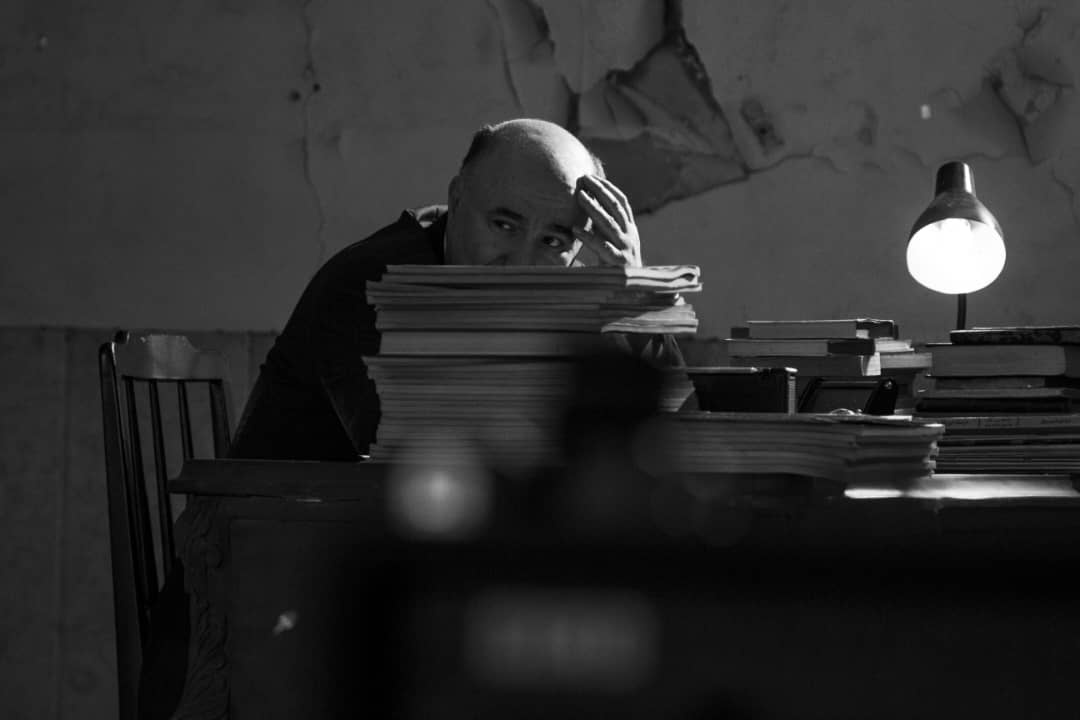
Zabihollah Mansouri is an author and translator who is the subject of the documentary film “Punching in the Translation Ring” directed by Hanif Shahparrad; a portrait-based documentary that addresses Mansouri’s personality and career.
In this film, Reza Behboudi plays the role of Zabihollah Mansouri, and its main narrative is based on Esmaeil Jamshidi’s interview with Mansouri; two interviews that Jamshidi conducted with this author and translator in his youth and another interview conducted in the final years of his life, both of which were done at different historical times, and now these interviews form the core of Shahparrad’s film.
However, the director did not stop at these interviews and sought out individuals who had connections with Mansouri or had views about his books. The people who speak about Zabihollah Mansouri in “Punching in the Translation Ring,” guided by the director, analyze his personality, works, and era through their own perspectives.
It is noteworthy that not only friends and colleagues of Zabihollah Mansouri are present in this documentary; rather, the camera goes among ordinary people and interviews a fruit seller, a housewife, a teacher, and a student, asking their opinions about Zabihollah Mansouri. Most of these people have read his books; books whose reading pleasure still remains in their memories.
The documentary camera questions people in the street, park, school, and university about Zabihollah Mansouri. While answering the questions, the audience emphasizes that they later realized Mansouri added sections to the text during translation and re-created the works in a sense. Among the people speaking about Mansouri on the street, all age groups and different social strata, from the middle class to other groups, are seen.
Another interesting point in this documentary is the introduction of individuals who have a special interest in Zabihollah Mansouri; people who have collected all his books and even obtained copies of his handwriting. Among these individuals is Amirabbas Tabatabaei, who, with a special interest in Mansouri, has collected a set of his works, photographs, and handwritings, and has even translated the novel “Sinuhe” by Mika Waltari.
One of the features of the documentary “Punching in the Translation Ring” is the verification of some statements about Zabihollah Mansouri, the author and translator; including his claim in an interview with Esmaeil Jamshidi that he was a boxer in his youth and even won championships. To investigate this claim, the director approaches a boxer; an individual who owns the book “Boxing Champions in Iran” and does not find Mansouri’s name in it. After seeing Mansouri’s photos, he also definitively states that Mansouri was certainly not a boxer, because, in his words, “no mark of any punch is visible on his face.”
Another notable point that makes Mansouri’s portrait more engaging is the presence of Fatemeh Aliasghar, a journalist and researcher, in this documentary. By writing the book “The Unfinished Event; A Narrative of the Fall of the Invincible Alamut Castle,” she examined the translation of “Lord of Alamut” by Paul Amire and translated by Zabihollah Mansouri and specified some serious historical errors in this work from a research perspective. Fatemeh Aliasghar talks about her research experience and her encounter with this translation in this documentary.
Hanif Shahparrad presents an extensive portrait of Zabihollah Mansouri in the documentary “Punching in the Translation Ring” and includes many individuals who were connected in some way with him and his works in this narrative. The range of these individuals is diverse, including Ali Dehbashi and Masoud Behnoud up to Esmaeil Riyahipour.
In this documentary, a hint is also made at an individual who published Zabihollah Mansouri’s books under his own name through plagiarism. The director approaches this individual, seats him in front of the camera, and asks questions. This person also admits without evasion that many individuals have plagiarized Mansouri’s books.
An analysis of Mansouri’s political actions and character is also one of the attractive parts of the documentary; a section that includes a comparison of his works’ sales figures with those of Ali Shariati and has become one of the controversial parts of the portrait. In this section, Alireza Raisdana believes that Mansouri’s books, unlike Shariati’s works, always have selling potential and have maintained their audience, while in his opinion, Shariati’s books lack such a characteristic.
It seems that Hanif Shahparrad stubbornly attempts to present a portrait of this controversial translator’s personality in this documentary that is both compatible with the times and includes the characteristics of today’s era, and also reflects his non-political personality who unfortunately died in poverty and did not receive a share from his creative and prolific pen, but did not enter the political sphere and remained enduring based on translations that were recreated in a way and captivated thousands of Iranian readers.