Darwin: Spencer’s Book is Entirely ‘Babble’ and General Principles / Spencer, a Self-Taught Polymath and 19th-Century Celebrity Philosopher
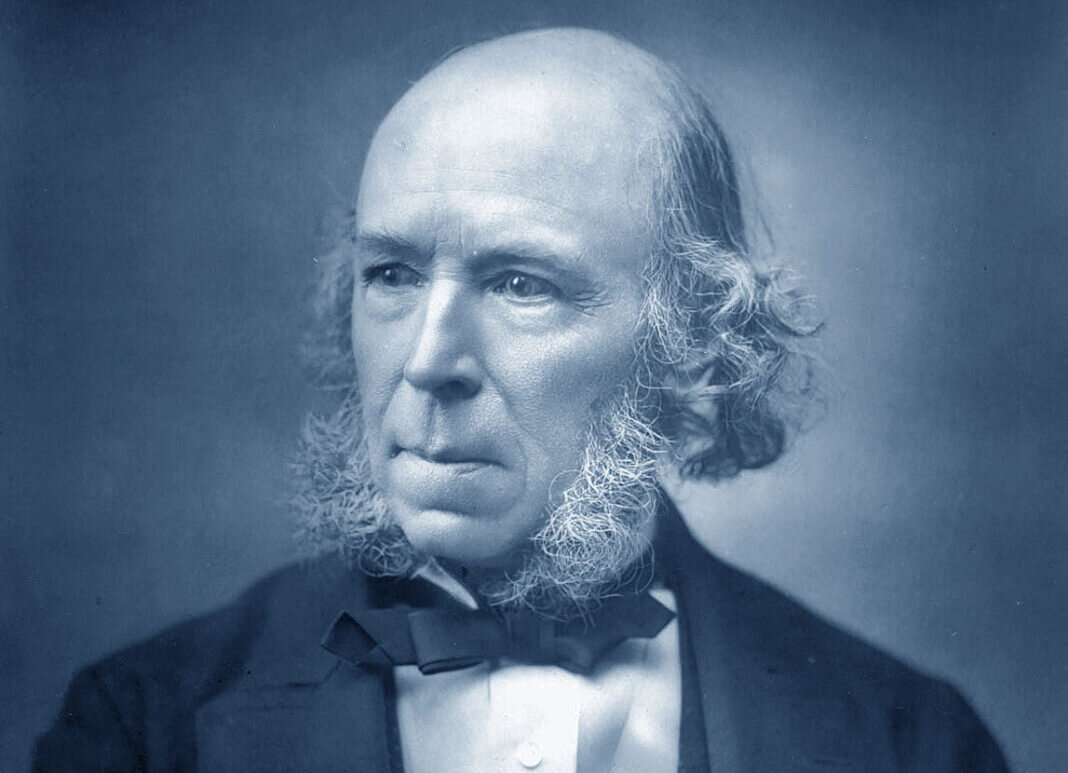
According to Khabar Online news agency, Reza Dastjerdi wrote in the introduction to his interview with Ata Kalirad, in the Religion and Thought service of Ibna: December 8th, coinciding with Azar 17th, marks the death anniversary of Herbert Spencer, one of the greatest 19th-century philosophers of England. Spencer applied the achievements of biologists in the field of sociology and considered evolution not only a science but also a way of life, including moral life. The foundation of his philosophy was also based on the ‘laws of evolution,’ illuminating the entire universe as a progressive movement from one stage to a more complete stage. Like Saint-Simon, Auguste Comte, and Karl Marx, he sought to interpret society and change it. On the occasion of Spencer’s death anniversary, Ibna has conducted an interview with Ata Kalirad, a researcher in evolutionary biology and ecology at the Max Planck Institute for Biology in Tübingen, Germany. The translations of ‘Biology in a Few Minutes’ and ‘Taming the Wild Fox’ by Nashr-e Shahr and Fatemi Publications are two of Kalirad’s works.
Ata Kalirad
Very few works about Spencer are available in Persian. Please tell the audience who Spencer is and what his place and importance in the history of human thought are?
In my opinion, Herbert Spencer can be considered on par with figures like the French philosopher Henri Bergson. Thinkers who were celebrities in their time but were forgotten after their deaths. Of course, perhaps Bergson can be considered slightly more successful than Spencer from this perspective, as Bergson was buried in the Pantheon in Paris and is still mentioned in discussions related to the discovery of the nature of heredity, concerning the concept of vital impetus (Vital Lané) in biology texts, but Spencer did not have such a happy ending.
Spencer (1820-1903) was a self-taught polymath who, throughout his life, wrote on subjects such as sociology, anthropology, psychology, and biological evolution. His philosophy no longer found buyers at the beginning of the 20th century, but due to the high sales of his works during his lifetime, reflections of some of his ideas can be found in famous literary works of the early 20th century.
Spencer is known as an evolutionary philosopher who made modifications to Darwin’s thought. What is his role and position in the stream of evolutionary thought?
Spencer owes his fame in evolutionary biology to coining the phrase ‘Survival of the Fittest,’ which he proposed in his Principles of Biology after studying Darwin’s On the Origin of Species (1859 AD). Darwin also found this term useful.
Interestingly, Darwin himself did not find Spencer’s ideas on evolutionary biology particularly interesting. One of Darwin’s personal traits was that he disliked disputes with people, and therefore, numerous instances can be found where Darwin praised someone in public but spoke ill of them in private correspondence.
Regarding Spencer, Darwin wrote the following about him in a letter to Dr. Hooker dated June 23, 1863: ‘You asked me what my opinion was of Spencer’s great book [the first volume of System of Philosophy]. Apart from the last part of it, I never wanted to read the rest, and that last part deeply disappointed me: entirely babble and general principles.’
Charles Robert Darwin
What impact did Spencer have on evolutionary biology?
Aside from Darwin’s sarcasm towards Spencer, the phrase ‘Survival of the Fittest,’ rather than aiding the understanding of evolutionary biology, has led to misunderstanding. Natural selection by no means chooses the fittest; rather, in most cases, it eliminates the worst types. Daniel Milo, in his recent book ‘Good Enough’ (2019), thoroughly elaborates on this discussion and shows to what extent natural selection preserves a wide range of traits.
The perception of natural selection as a perfecting force that selects only the supreme forms is not only an inaccurate reflection of what occurs in nature but also leads to the intertwining of unscientific racist ideas with biological evolution, creating a monster clothed in science.
On the other hand, Spencer, or even Darwin and Wallace, were fundamentally focused on natural selection as the sole creative force of nature. However, it was only in the mid-20th century, especially through the research of Motoo Kimura in the late 1960s, that the concept of genetic drift was formulated as a random component of the evolutionary process. Genetic drift refers to all random events that diminish the effect of natural selection on gene frequencies.
Now there is ample evidence for the main role of genetic drift in shaping living organisms, and even in the last two decades, the concept of ecological drift has gained many adherents, playing a random role in shaping a biotic community and, as an explanation, highlighting macroecological patterns (patterns that emerge over decades or hundreds of years) more than ever.
Regarding the operation of natural selection, Spencer believed that natural selection alone could not explain evolutionary processes, and therefore he tried to blend Lamarckism with Darwinism. In parentheses, I should mention a point about understanding the historical views of scientists and philosophers, especially in the field of the history of biological evolution, with which I am more familiar.
Many times, the understanding and comprehension of Darwin’s or Spencer’s beliefs are based on an image presented by historians or philosophers of biology; sometimes, these images are, wittingly or unwittingly, altered by the author’s beliefs. From this perspective, referring to primary sources or sources written from a historical perspective close to the historical period of the individual in question will be helpful. I am fully aware that historian friends will consider this point in parentheses to be the most trivial of points, but in reading the history of evolutionary thought, such a problem is very common.
With this introduction, if we refer to the book ‘Darwin and Modern Science,’ published in 1909, which is a collection of articles by figures such as William Bateson, Hugo de Vries, and Ernst Haeckel, we will find a clearer picture of contemporary biologists’ views on Spencer’s opinions.
For example, August Weismann, a biologist who played a fundamental role in our understanding of the nature of heredity and emphasized the distinction between genetic changes in somatic cells and germ cells as the key to understanding the effect of natural selection on hereditary material, says this about Spencer: ‘Spencer’s main goal was to prove the validity of the Lamarckian principle, which many had doubted in its collaboration with natural selection. […] However beautiful Spencer’s explanation may be, I consider it unacceptable, because the premise of this explanation is the inheritance of functional changes (what are called acquired traits), which is not only unobservable but also theoretically improbable.’ (p. 33).
Weismann’s reading itself is a sign of changing evolutionary views at the beginning of the 20th century, which ultimately led to the synthesis of genetics and evolutionary biology and gave rise to population genetics. In this context, Spencer’s views and his philosophizing about Darwinism gave way to research into the nature of hereditary material and explaining the compatibility of Darwinism with this scientific finding. Perhaps it can be said that with the prominence of genetics as the beating heart of evolutionary biology, there was no longer a need for philosophizing, but for experimentation.
Darwin’s theories have transcended biology. Have Spencer’s views and thoughts also transcended biology?
Although Spencer was by no means Darwin’s equal, he played a prominent role in shaping sociology, and his ideas on government and economics influenced, to some extent, the thoughts of Friedrich Hayek and the Austrian School of Economics.
Why has Spencer received little attention in Iran? Is it because he is liberal and right-wing? From what perspective should attention be paid to his ideas today?
In my opinion, the inattention to Spencer should be attributed to the outdatedness of many of his beliefs, as Spencer is not very famous even in the English-speaking world. Many of his ideas about the nature of governance or economics can be found within contemporary movements such as libertarianism in the United States. However, such movements also owe more to a collection of ideas from philosophers and thinkers than to a single person like Spencer, and perhaps among all these individuals, Spencer plays a minor role.
From another perspective, the framework of his philosophy, especially regarding the philosophy of biology, no longer holds appeal for the scientists of our era, though it held no appeal even for Darwin. My personal opinion is that reading Spencer only helps to understand the historical context of many ideas in sociology or evolutionary biology, but unlike Darwin, apart from this historical importance, no novel ideas are found within it.
Personally, I prefer re-reading the works of someone like Francis Galton to Spencer, because Galton had a more scientific framework for examining various subjects. Despite these descriptions, reading Herbert Spencer’s book ‘First Principles’ can provide the reader with a general picture of his beliefs in sociology, biology, psychology, and religion, and make the intellectual atmosphere of the second half of the 19th century in England clearer.
To familiarize the audience with Spencer, what book or article do you recommend in Persian?
As far as I know, only his book ‘Man Versus the State’ has been published in Persian. Perhaps the best solution would be for one of the readers of this text to undertake the translation of Spencer’s ‘First Principles’!