More Gently Than the Scent of a Flower
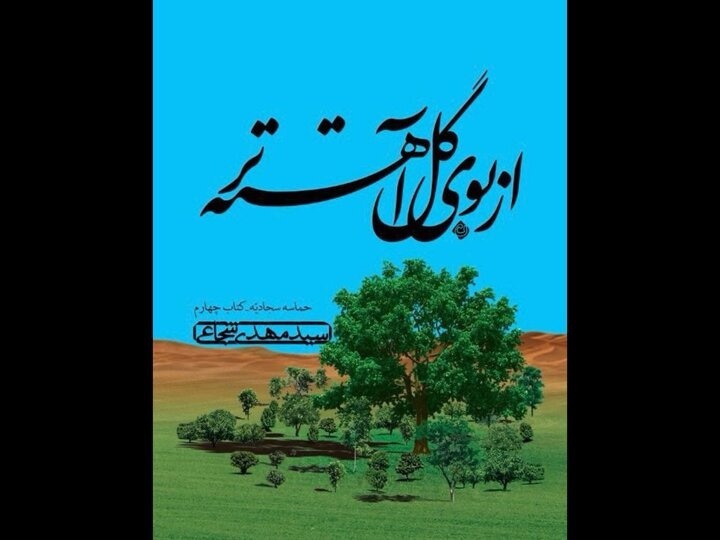
The religion and thought service of Iran’s Book News Agency (IBNA): “More Gently Than the Scent of a Flower” is the title of the fourth volume of the Sajjadiyah Epic series, penned by Seyed Mehdi Shojaei, which has recently been published and released to the book market by Neyestan Honar Publishers. The three previous volumes of this series are, respectively: “You Are in Place of All,” “If Grief Gathers an Army,” and “Except for the Story of a Friend.” As the series title suggests, the Sajjadiyah Epic is dedicated to the life and conduct of Ali ibn al-Husayn (AS). The Sajjadiyah Epic recounts documented events from the turbulent life of Imam Sajjad (AS). The author, alongside concise and detailed references to the life and conduct of Imam Sajjad (AS) and narrating less-known miracles attributed to him, provides a glimpse into the style of governance and rule of the Umayyads and Marwanids and their supporters, comparing that form of government with the Alawi Islamic rule, thus offering criteria for distinguishing between Alawi and Umayyad governments.
Fundamentally, the author’s choice of the title “Epic” for this series is a subtle point whose secret may not be immediately apparent. Ostensibly, Ali ibn al-Husayn (AS) was taken captive, sought refuge in the wilderness for a time, was repeatedly targeted for assassination, and was never safe from the harassment and persecution of the caliphs and tyrannical rulers. So, what could “epic” mean for such a difficult and harsh life? The answer lies in the truths of Imam Sajjad’s (AS) life and conduct, which the author has strived to introduce us to in this collection.
This work, like the three previous volumes of the Sajjadiyah Epic series, opens a perspective for the reader through authentic historical narratives, enabling them to distinguish truth from falsehood and right from wrong.
Shojaei, with fluent language, presents the heaviest and, in some cases, bitterest truths to the reader. By deftly introducing narrators, he advances the work in a way that the multitude and abundance of characters do not confuse the audience. In this volume, too, we deal with a wide range of characters, from the Imam’s (AS) sincere and loyal companions to his staunch enemies.
Another feature of the Sajjadiyah Epic series is the deciphering of some historical ambiguities. Among these ambiguities, one can refer to the manner of death and burial place of two of Imam Sajjad’s (AS) aunts, namely Zaynab (SA) and Ruqayyah (SA). According to popular belief, these two noble ladies are buried in Sham (Syria) and Egypt, whereas the author of “More Gently Than the Scent of a Flower,” by narrating a hidden truth, puts an end to this ambiguity. Another feature of the fourth book of the Sajjadiyah Epic series is its reference to the Treatise of Rights (Risalat al-Huquq) by Ali ibn al-Husayn (AS) and the removal of the dust of obscurity from this great work. Seyed Mehdi Shojaei, through the words of a Christian bishop, introduces this treatise and reminds that by studying, contemplating, and acting upon its provisions in individual, familial, social, political, and other spheres, many injustices, aggressions, and enmities can be prevented or resolved. The Sajjadiyah Epic series serves as a platform for re-presenting Islam and explaining the vital role of the rightful Shi’ite Imams in showing the path of truth from falsehood. Below, we read a section from this book:
God has established the rules of circumambulating His House in such a way that people – all people – set aside all distinctions and peculiarities before entering the sacred precinct and enter the House in a uniform and identical state… God has established the rules of His hospitality in such a way that the poor and the king are not distinguished from each other, and all enter His House equally. This rule was strengthened and established during the time of the Seal of Prophets (PBUH) and continued until the end of the rule or caliphate of Amir al-Mu’minin (AS). However, after the martyrdom of Amir al-Mu’minin (AS), Muawiyah tried to disrupt this rule and open the door to material and worldly advantages and superiorities in this space… and Abd al-Malik Marwan is one of the clear examples of such a ruler and government. He, too, when he came for Hajj and circumambulation, brought with him servants and retinues, preceding and following, so that everyone would be aware of his presence and make way, and manifest their obedience and subservience with bows and deference… But among them, there is only one person who, with a special and different spirit, is engaged in circumambulation and supplication to God. And he sees neither the caliph nor anyone else… The Imam finishes his circumambulation and is about to start his prayer when he is summoned by the caliph. The caliph abruptly says: “Am I the killer of your father that…” The Imam calmly and composedly replies, “The killer of my father destroyed his worldly life, and my father destroyed his afterlife. If you also seek such a transaction, then by God!” The caliph stutters, “No, no, my intention was why don’t you associate with us so that you may benefit from our world? If you sometimes seek us out, our hands are open for financial aid and gifts.” Instead of any reply, the Imam sits on the ground and spreads his cloak, addressing God, “O God, show this man the status of Your saints.” In the blink of an eye, the Imam’s entire cloak fills with pearls and jewels… The Imam adds, “One who has such a status with God will never be in need of your world.” And addressing God, he says, “O God, remove these jewels, for I have no need of them.” And he rises and casts his cloak over his shoulder and goes to perform his circumambulation prayer.





