The Story of the Preserved Body of a Scholar Who Wrote a Book About Lady Fatimah (PBUH)
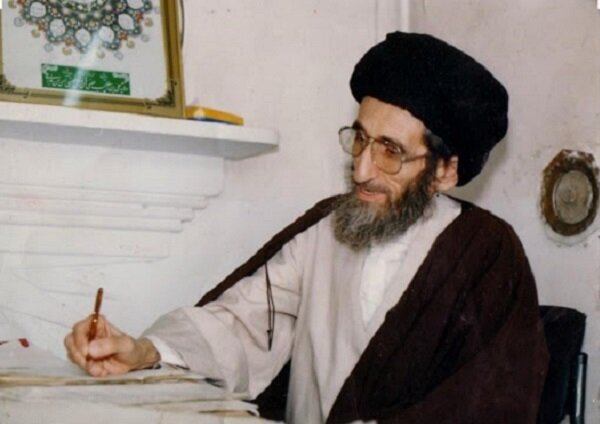
According to the Fikr va Farhang Moballeq base, the life of Ayatollah Seyyed Mohammad Kazem Qazvini was full of devotion and love for the Ahl al-Bayt (AS). Despite battling laryngeal cancer, he passed away 32 years ago in the holy city of Qom. After a fervent funeral procession, his pure and sacred body was interred in the Karbalaei Husseiniyah in Qom, specifically in the mihrab (prayer niche) of the Husseiniyah, directly beneath the pulpit from which he had spent years expressing his devotion to the Ahl al-Bayt.
According to Mehr News, the book “Fatimah al-Zahra (S) Min al-Mahd ila al-Lahd” (Fatimah al-Zahra from Cradle to Grave) had been placed on the chest of this great scholar. This book, translated into various languages including Persian, represented the depth of his love for Lady Fatimah (S) and his commitment to promoting the teachings of the Ahl al-Bayt (AS). Seventeen years later, due to the expansion of the Holy Shrine of Lady Fatimah Ma’sumah (S), his family requested that the aforementioned Husseiniyah be demolished due to its proximity to the holy shrine. Consequently, his grave was exhumed, and it was observed that his body remained fresh, and his shroud was intact and preserved. The book “Fatimah al-Zahra (S)” was still resting on his blessed chest. Finally, the luminous body of Ayatollah Seyyed Mohammad Kazem Qazvini was temporarily kept in one of the mortuaries in the holy city of Qom and then transferred to Karbala for reburial, where it was laid to rest beside the shrine of Imam Hussein (AS).
Who was Ayatollah Qazvini?
The late Ayatollah Seyyed Mohammad Kazem Qazvini was born in 1348 AH in the holy city of Karbala, into the scholarly and clerical Qazvini family, considered one of the noble and deeply-rooted families of that heroic region. The lineage of this learned man of struggle and his family traces back to the leader of the pious and oppressors’ adversaries, Imam Kazem (AS). From this renowned family, great scholars, thoughtful orators, purposeful and passionate poets, learned authors and exegetes, and distinguished jurists and mujtahids emerged, each providing valuable scientific, intellectual, cultural, ideological, ethical, and social services to the Islamic world. While striving to convey the message of the Quran and the luminous imams to the people, they diligently upheld the honorable traditions of their family and the prophetic mission, like conscious and self-sacrificing soldiers. Among them can be named Ayatollah Seyyed Hashem Qazvini, Ayatollah Seyyed Mohammad Ibrahim Qazvini, Ayatollah Mohammad Hasan Qazvini, and Ayatollah Seyyed Mohammad Kazem Qazvini himself.
Journey to Perfection
The late Ayatollah Qazvini was nurtured in his childhood under the shadow of his esteemed father, the late Ayatollah Seyyed Ibrahim Qazvini. From the earliest stages of his life, guided by his father, he began striving to acquire knowledge and adorn himself with human values. In the light of his abundant intelligence and tireless efforts, he embarked on his life’s path, ascending the steps of progress one after another.
In the spring of his life, Allamah Qazvini lost the blessing of his loving parents, and the heartbreaking sorrow of their absence, a crucial support in his life, weighed heavily on his young and affectionate heart. He himself participated in their funeral procession and, recalling his master Imam Hussein (AS) and reciting elegies in his honor, guided the storm-tossed ship of his heart to the shore of patience and tranquility. Despite the passing of his parents, amidst life’s challenges, the onslaught of hardships, and the pressures of poverty and deprivation, he did not abandon the path of acquiring knowledge and perfection that he had embarked upon under his father’s guidance and supervision. Instead, he continued his path with great effort, and after completing his preliminary studies at the seminary of Karbala, he spent many years attending advanced jurisprudence and principles lessons taught by the great scholars of that region. He then shone like a brilliant star, and in addition to his preaching, he taught jurisprudence, principles, and exegesis through sermons and lectures. He nurtured many students, especially in the art of oratory and message delivery, with his capable hands. A group of these students are now considered learned and renowned orators, honored to convey messages and serve the culture of the Quran and the Ahl al-Bayt in various countries.
He was a learned and powerful orator and speaker. Although he spoke calmly and pleasantly from the pulpit, he possessed an extraordinary power in conveying his message, captivating his audience. During his sermons and speeches, he imparted knowledge, and when he invoked the name of Hussein, he depicted the tragic event of Ashura in such a way that it ignited fervor and emotion. In all his speeches, he drew inspiration from the Quran, Nahj al-Balagha, and narrations, conveying the best lessons from the greatest book and the worthiest individuals. As he himself was a sincere and spiritual person, his words left constructive impacts and softened hearts. Among God’s blessings upon Ayatollah Qazvini was that he was a man of the pen, and his pen served the culture of the Quran, the family, and the prophetic mission. Some of his intellectual and literary works include:
- Sirat al-Rasul al-A’zam (The Biography of the Greatest Prophet)
- Ali Min al-Mahd ila al-Lahd (Ali from Cradle to Grave)
- Sharh Nahj al-Balagha (Commentary on Nahj al-Balagha, in three volumes)
- Fatimah al-Zahra Min al-Mahd ila al-Lahd (Fatimah al-Zahra from Cradle to Grave)
- Al-Imam al-Husayn Min al-Mahd ila al-Lahd (Imam Hussein from Cradle to Grave)
- Fajia’at al-Taf wa Maqtal al-Husayn (The Tragedy of Karbala and the Martyrdom of Hussein)
- Zaynab al-Kubra Min al-Mahd ila al-Lahd (Zaynab al-Kubra from Cradle to Grave)
- Mawsu’at al-Imam al-Sadiq (The Encyclopedia of Imam Sadiq, in sixty volumes)
- Al-Imam al-Jawad Min al-Mahd ila al-Lahd (Imam Jawad from Cradle to Grave)
- Al-Imam al-Hadi Min al-Mahd ila al-Lahd (Imam Hadi from Cradle to Grave)
- Al-Imam al-Askari Min al-Mahd ila al-Lahd (Imam Askari from Cradle to Grave)
- Al-Imam al-Mahdi Min al-Mahd ila al-Zuhur (Imam Mahdi from Cradle to Appearance)
and other valuable books, some of which have been translated into various languages.
Man of Migration and Jihad
He was a man of migration and undertook important missionary journeys to convey the message of the Quran, the family, and the prophetic mission, which yielded brilliant results. He traveled to Morocco, Australia, Egypt, Kuwait, Hijaz, India, Pakistan, Syria, Lebanon, Thailand, and some African countries, and his aim everywhere was to deliver the message of the Quran and the Ahl al-Bayt. Armed with knowledge, insight, faith, and action, he left constructive impacts during these journeys. One example was in Morocco: “Based on a fabricated narration stating that Noah’s Ark landed on Ashura and Adam’s repentance was accepted on Ashura,” the day of Ashura was officially celebrated as an Eid, hundreds of marriage ceremonies were held, and sweets were distributed. However, after his scholarly, intellectual, and literary efforts, this dark Umayyad tradition was uprooted, and sermons and mourning ceremonies for the Master of Martyrs replaced them.
He was a true man of Wilayah, deeply enamored and passionate about the Household of Revelation and Prophethood, and his heart was bound by their love. In the difficult ups and downs of life, he sought their intercession, and by the blessing of their name and remembrance, he repeatedly received grace in the toughest conditions and was saved from grave dangers.
Just as he was a man of knowledge, insight, and faith, he was also a man of jihad and enjoining good and forbidding evil. His courageous stances against the tyranny ruling Iraq, delivered from the Husseini pulpit, were admirable. For his truth-telling and resistance against autocracy, he repeatedly tasted the bitter experiences of imprisonment, captivity, exile, and pressure, and even faced martyrdom. The last time, he was sentenced to execution, but after months of clandestine life, by God’s help, he left Iraq. From there, he migrated to Kuwait, Lebanon, and then Iran. Finally, after a lifetime of effort, jihad, and sacrifice in various scientific, religious, and social dimensions, he bid farewell to the world on the thirteenth of Jumada al-Thani in the year 1415 AH.