The book «Wine of Death and a Few Illusory Love Stories» was unveiled.
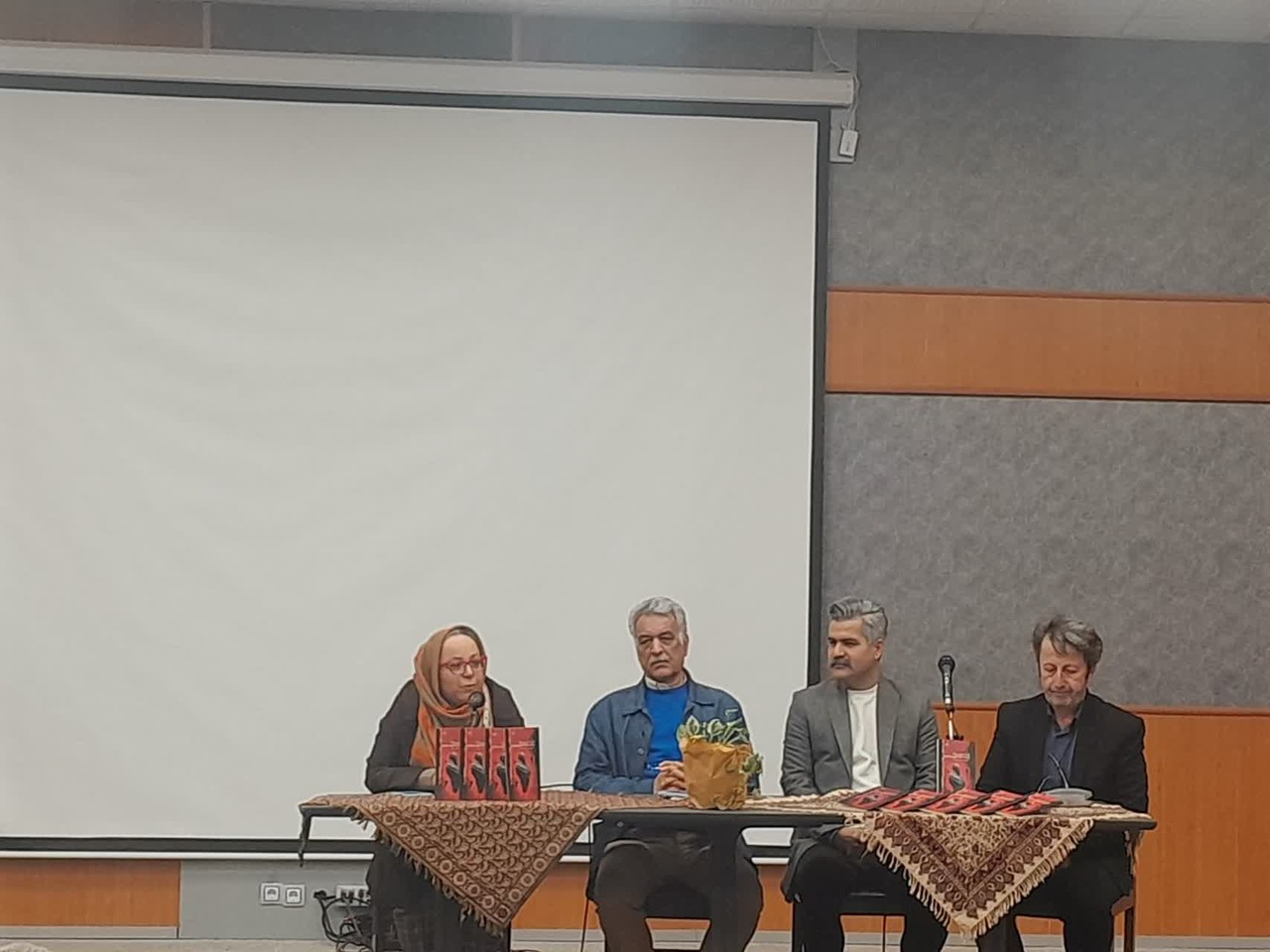
According to the correspondent of Iran Book News Agency (IBNA) in Qazvin, at the unveiling ceremony of the book “Wine of Death and a Few Illusory Love Stories,” Fatemeh Sharifnezhad served as host and expert, while Hasan Lotfi and Majid Rahmani delivered speeches.
Fatemeh Sharifnejad, a storyteller and instructor of storytelling, said at the beginning of the program: “When I looked at the writing history of ‘Wine of Death and a Few Illusory Love Stories,’ I realized that these stories are very close to each other in terms of time and belong to a specific period. Please explain to us how you came to write a collection of stories, why you chose this format, and what led you to center your work around the theme of love?”
Hamed Mokammeli replied to her question: “I had no intention of publishing a collection of stories at all. These short stories were written completely by chance and based on events that happened to me; even ‘Wine of Death,’ which is the longest story in the collection, was written in a single session.”
The author added: “When the number of stories reached a point where they could be put together, I felt it wouldn’t be bad to publish them as a collection; because, as you said, they all have a kind of internal coherence. Ultimately, I arrived at ‘Wine of Death’; a combination that, in my opinion, just as the word ‘wine’ is complex and illusory, creates an even more complex combination next to the word ‘death.’ That’s why I embarked on the short story collection ‘Wine of Death and a Few Illusory Love Stories.'”
In response to Sharifnejad’s question, “Despite the decreasing inclination of writers towards minimalist stories in recent years, where did your choice to write in this format come from?”, Mokammeli stated: “As I said at the beginning, these were all events that occurred. In my opinion, art is fundamentally an ‘event’; it’s not something we invite, art comes uninvited.”
He explained: “As for why imagination is more prominent in this collection, I must say it has roots in our philosophical tradition. In Greek philosophy, from Aristotle to Plato, the levels of perception are defined as: intellect, senses, and imagination; and imagination holds the lowest rank. But in Iranian philosophy, which begins with Farabi, the status of imagination rises one level higher; meaning it stands above the senses and moves closer to intellect. This is why in Iranian culture we have a ‘more open embrace’ towards imagination and establish a deeper connection with it. Perhaps that is why not only this collection, but also the plays and sometimes even the poems I write, have such a structure.”
Mokammeli added: “Regarding whether these are stories or story-poems, I once discussed it with Mr. Hasan Lotfi. He believed that perhaps these texts are closer to ‘story-poems’ than stories, because at certain moments, the reader suddenly enters a space of imagination from reality. This back-and-forth between reality and imagination might be the characteristic that separates these works from conventional storytelling formats.”
Continuing the session, Hasan Lotfi, director and writer, said: “Before talking about the book, let me say one point. In the past month or two, I participated in several book unveiling sessions, and this was encouraging for me. Once, if you wanted to find a Qazvin-based storyteller, their number was very small; but today, the number of young and active writers has significantly increased. I’m not talking about quality; my discussion is about quantity.”
Lotfi added: “Even those who write popular novels have audiences who live with those works, and that is respectable to me. These are all signs of a new storytelling movement in Qazvin. I believe Qazvin will be one of the pillars of Iran’s future literature. You just need to stand by the writers of the city and support them.”
The author emphasized: “I also have a recommendation: entrust your works to a good publisher; a publisher for whom a book is not just a ‘commodity’ and who publishes it conscientiously.”
Referring to the book “Wine of Death and a Few Illusory Love Stories,” Lotfi said: “I read Hamed Mokammeli’s book both with him and separately. At first, I thought I was facing seventeen short stories, but then I realized an important point; if we don’t consider the book’s preface as part of the stories, a significant part of the work is lost. The preface Hamed wrote, unlike many prefaces, is not meant to explain or dissect the book; rather, it is written very intelligently and dramatically. This is a characteristic of a writer who understands drama well and conveys meaning not on the surface, but in the hidden layer of narration.”
He elaborated: “When you read the book’s preface, you encounter a writer familiar with dramatic literature who very directly and openly tells you what to look for in this book. In this collection, Hamed Mokammeli is pursuing something beyond ‘story’; the very topic we discussed earlier: love. It’s true that love has been discussed many times, it’s true that perspectives differ, but this subject is redefined in every era. Mokammeli conveys this in the same preface.”
The director added: “In the preface, Mokammeli indirectly says, ‘Don’t just look for a story.’ What is important to the writer is what he wants to express from within; that is, the love he wants to narrate or even ‘sing.'”
He concluded his remarks by stating: “This statement is a tangible reality; and the author sets the expectation there and then with you on how to read this collection. The preface is essentially like the beginning of a film that gives you a ‘code’ in the very first scene to understand how to follow the narrative. If you don’t grasp this perspective, you will get confused when reading some of the stories.”
Next, Majid Rahmani, a storyteller, offered his opinion on the book, saying: “The best description I can provide for this book is that Mr. Mokammeli’s work is theme-centric. That is, the perspective and viewpoint he holds regarding love, lost companions, and the concept of distance flows throughout the book, independent of the narrative. This viewpoint is expressed in a language that is, on one hand, simple, and on the other hand, possesses a rhythm suitable for the text.”
Rahmani concluded his remarks by adding: “In my opinion, the presence of the element of imagination and that hidden poeticism in the prose allows the reader, at certain moments, to feel like they are receiving ‘poetic prose’ or even ‘prose poetry.’ The rhythm of the sentences, whether long or short, aids the content, or perhaps I should say, it is the content itself that has shaped this language and brought it to its appropriate form.”
The short story collection “Wine of Death and a Few Illusory Love Stories” comprises 18 short stories and flash fictions, written by Hamed Mokammeli and published by Sham’avid Publications.





