Stoppard in his works is highly moral-centric, with his own specific liberal view
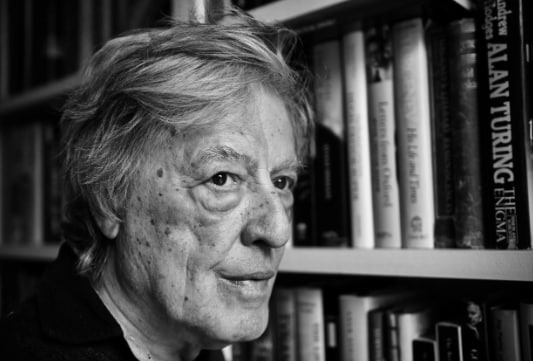
Iran Book News Agency (IBNA) Art Service – Bahare Golparvar; Tom Stoppard, the prominent playwright and creator of enduring works in contemporary English theater, passed away yesterday. He was known for his human-centered, philosophical, and ethical perspective in his works. Stoppard was also active in cinema, and one of his notable screenplays was ‘Shakespeare in Love,’ which won the Academy Award for Best Original Screenplay in 1999. His works are always a blend of humor, philosophy, and social analysis, which finds its audience globally. Most of this author’s works in Iran have been translated by Araz Barseghian. He believes that, contrary to initial appearances, performing Stoppard’s works is very difficult; this has led to less frequent performances of this author’s works in Iran. We interviewed Barseghian about the world of Stoppard’s works and his position, which you can read below.
How do you define Tom Stoppard’s position among contemporary playwrights?
He is more prominent in England than anywhere else, followed by the United States; his works have been widely received and consistently noticed in these two countries. It can almost be said that every time he presented a work, it was at the peak of attention and popularity. He even won the Academy Award for Best Original Screenplay for ‘Shakespeare in Love’.
Should we consider him a follower of the classical tradition or a founder of a new narrative style?
Tom Stoppard was initially considered a postmodern writer at the beginning of his fame. However, due to the very different and sometimes vague definitions of postmodern theater, and our usual conflation of it with postdramatic theater, Stoppard cannot be accurately placed in this category. Nevertheless, in the early years of his career, when he wrote his first play, ‘Rosencrantz and Guildenstern Are Dead,’ he adopted a different approach to narrating ‘Hamlet’ in terms of writing style (not school of thought), focusing on two minor characters to describe their lives. This play is one of Stoppard’s most widely read and performed works, and a film has also been made based on it. Information regarding its text and performances is also very extensive and complete.
At that time, Stoppard was told that he was influenced by Samuel Beckett and the absurd movement; although his play does not fit the mold of absurd theater.
It should be noted that absurd theater itself did not have a very clear and unified definition. In fact, Stoppard pursued his own theater and worldview, acting based on his personal opinions and beliefs. He has a unique narrative style; a narrative that, even when approaching grand narratives, still retains his personal narrative quality.
Stoppard has a trilogy called ‘The Coast of Utopia,’ which consists of three consecutive plays from a longer text, and its full performance would last at least twelve hours. When he delves into these grand texts and major historical narratives, he presents reinterpretations with a liberal Western approach. He is generally such a writer: a Western writer and a proponent of liberalism; even when writing about the left-wing movement.
His personal experience has also influenced this view; as he immigrated from a left-wing country to England and his family had Jewish origins. His real name is ‘Thomas,’ and one of the characters in the play ‘Rock ‘n’ Roll’ is also named Thomas, bearing a strong resemblance to Stoppard himself: a young man interested in left-wing issues and revolution, caught up in the fervor and allure of rock music.
As I said, when Stoppard turns to grand narratives, he employs a liberal type of storytelling and redefines history through this lens.
He also uses Isaiah Berlin’s theory for the source and definition of narrative, and if we want to examine these individuals from a viewpoint perspective, Stoppard’s viewpoint is a liberal one; a liberalism that operates within the context of England, and his plays are intensely human-centered. This human centrality prevents him from basing his ideology on the left, not saying ‘now we examine the left-wing human.’ He portrays a human living within a left-wing structure and criticizes that same left-wing structure; but the question is whether he criticizes the right-wing structure to the same extent? Yes, he has criticisms, albeit more detailed ones, of the right-wing movement. For example, at the end of the play ‘Rock ‘n’ Roll,’ he alludes to the right-wing structure and the capitalist system. Or he makes critical references to the structure of the world after the fall of the Berlin Wall. He also wrote this play in 2006.
Araz Barseghian, writer and translator





