A House Whose History Was Not Erased; Publication of the Persian Translation of ‘Golda Slept Here’
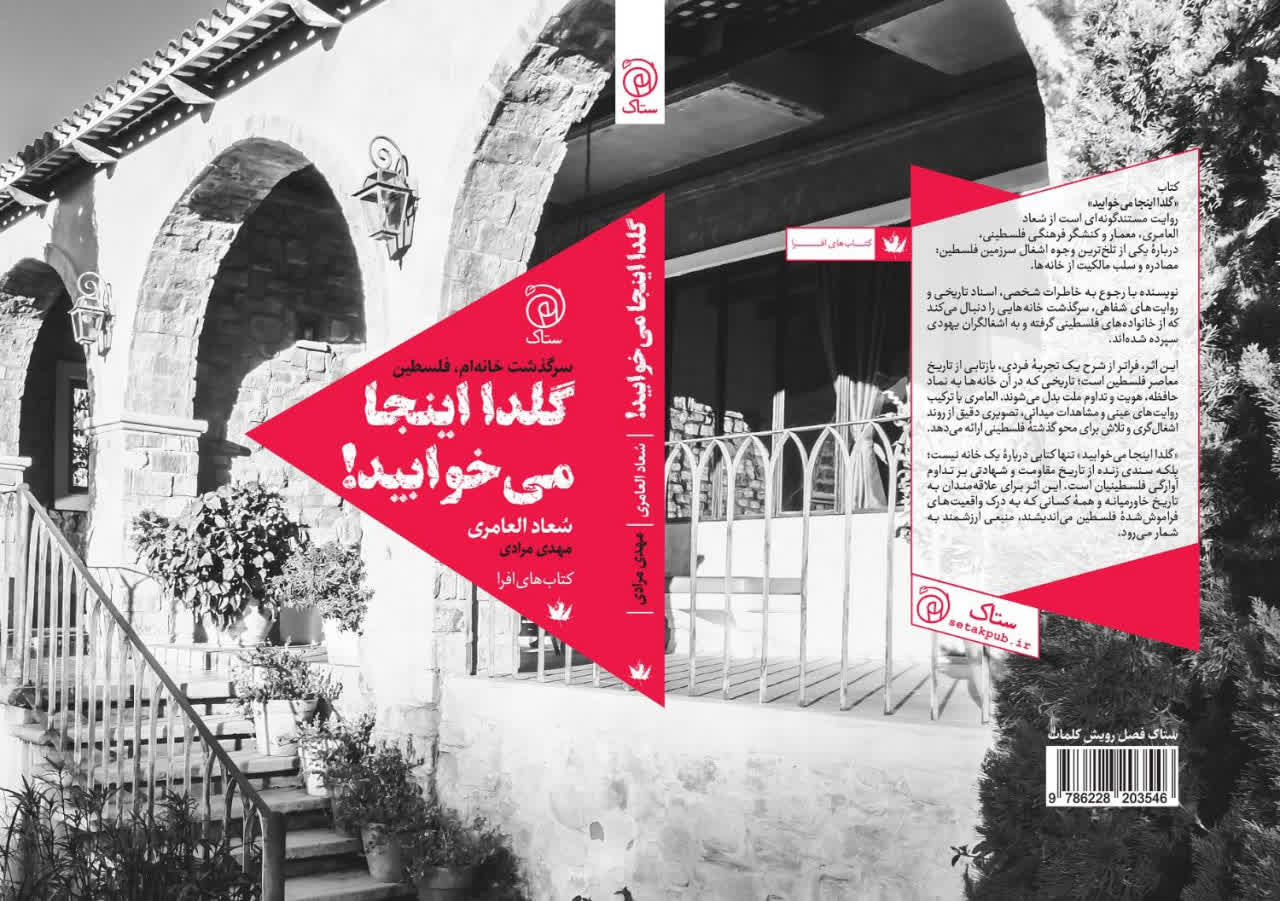
According to a reporter from the Iran Book News Agency (IBNA), the book “Golda Slept Here” by Suad Amiry, a Palestinian writer, architect, and cultural activist, has been published by Setak Publications with a translation by Mehdi Moradi. This work is a hybrid narrative of memoir, essay, and social documentary that addresses the issue of the Zionist regime’s occupation and the dispossession of Palestinian homes. In this book, Suad Amiry, through her personal experience of searching for her ancestral home in Jerusalem, delves into the fate of houses that were forcibly taken from their original inhabitants and are now occupied by Israeli settlers; homes that are not merely physical structures but carriers of the memory, identity, and historical narrative of a nation. This book is a journey through the alleys of Jerusalem and Jaffa, amidst family stories and the tears of displaced generations; a narrative of resistance against forgetting and an effort to reclaim a home that is not just four walls, but a part of identity and history.
“Golda Slept Here” is not merely a description of suffering; rather, it is an invitation to listen to voices that the world has often sought to silence. A voice from the heart of Palestine, for all those who wish to seek the truth amidst distorted narratives.
The title of the book “Golda Slept Here” is inspired by a symbolic incident. While walking in the Talbiya neighborhood of Jerusalem, the author comes across “Harun al-Rashid’s Villa,” a house confiscated from the Palestinian Bisharat family and converted into the residence of Golda Meir, then Prime Minister of the Israeli regime. The power of this title lies in its evocation of the overt and hidden meaning of occupation; because Golda Meir, by destroying Palestinian ownership documents, sought to erase any trace of the house’s true owners so that visitors, including the UN Secretary-General, would not be aware of its real identity. This contrast between Palestinian historical memory and the attempt to erase it resonates throughout the book, turning it into a symbol of displacement, identity erasure, and resistance.
Suad Amiry, born in Jaffa in 1951, studied architecture at universities in Beirut, Texas, and Edinburgh. In recent decades, she has played an effective role in preserving Palestinian architectural heritage and documenting the daily lives of people in the occupied territories. Her works have gained a special place in contemporary Arabic literature due to their intimate language, subtle humor, and focus on women’s narratives from Palestine. She writes in a part of the book: “I learned to tell jokes around our dining table. My brother Ayman, who is two years older than me, would tell funny stories and hilarious jokes, but I, being the youngest, would repeat the same joke over and over whenever we sat around the table as a family, and since everyone would burst into laughter the moment I opened my mouth, I concluded that jokes become funnier with each retelling. Perhaps my style of speaking and writing in adulthood stems from this.”
A section from the book reads: “Meanwhile, British officials, defenders of the Zionists, with their biased policies in favor of Zionists, subjected all Arabic programs on the PBC to severe censorship. This led many Palestinians working in the Arabic section to resign. My father’s best friends were also among those who resigned; ‘Ibrahim Abdel Fattah Touqan, the famous Palestinian poet, and Khalil Qustandi Sakakini, the prominent Palestinian teacher, immediately resigned to their British boss upon hearing a Jewish announcer declare: “This is the Land of Israel.” Khalil Sakakini shouted at his British superior: “If this is Israel, then where is the land of Palestine?” The British officer replied: “Very well. He speaks from his own perspective, you come and state your opinion too.” “What perspective? When the official name of this radio station is ‘Palestine Radio Station,’ why does he say Eretz Israel?…'”
The book “Golda Slept Here” by Suad Amiry, translated by Mehdi Moradi, has been published by Setak Publications.