A Document from the Second Century on the Martyrdom of Lady Fatimah (PBUH)
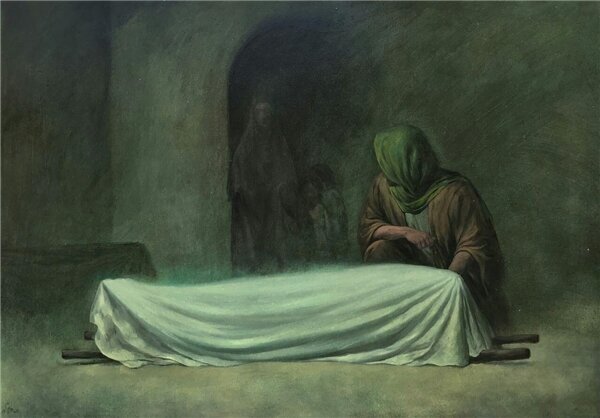
According to the Fikr va Farhang Moballeq website, Hassan Ansari, a prominent researcher of Islamic history and thought, has reacted on his Telegram channel to recent events and views regarding the events leading to the martyrdom of Lady Fatimah (PBUH), by citing a historical text.
His text on the channel is as follows:
The Event of the Martyrdom of Siddiqa Tahira Lady Fatimah Zahra (PBUH) based on a valuable document from around the mid-second century AH
In the important work “Kitab al-Rudud” by Abdullah ibn Yazid al-Fizari, a prominent and influential Ibadi theologian from Kufa (and Baghdad) in the mid-second century AH, a section addresses the beliefs of Shiites regarding issues related to Imamate. The information presented in this section is of great importance from the perspective of proving the antiquity and validity of the beliefs of Shiites and their various groups on these topics, and it is considered a highly reliable document for historical discussions and research. An interesting point is that we know Fizari was a business partner of Hisham ibn al-Hakam in Kufa and was fully acquainted and connected with him, and later in Baghdad, he also had contact with Hisham in the councils of the Barmakids and participated in their debates with Hisham and other theologians of the era, such as Dirar ibn Amr.
In our opinion, what Fizari narrates in this section about the beliefs of Shiites and also another group, whom he refers to as “Rafidha,” is most likely beliefs that Fizari himself heard directly from Hisham ibn al-Hakam or read in his works. From this perspective, the information in this section has double importance. In the continuation of our notes, we will write more about Hisham’s influence on Fizari and, God willing, will explain various theological and doctrinal issues in Fizari’s works with detailed content analysis.
One of the interesting points in this section is that Fizari absolutely makes no mention of a belief similar to the distortion of the Quran in order to prove Imamate from a Shiite perspective, and this itself shows again that in that period, Shiites were not at all known to believe in the distortion of the Quran.
Here are his statements in this section:
Abdullah said: Then another group came to its leader and said: What do you say about Ali ibn Abi Talib? For some people have disassociated themselves from him, declared him an infidel, and fought him. He said: Beware of them, for they are innovators. Write down what I tell you. We have narrated that Ali was the first to accept Islam and the best among them with the Messenger of Allah (PBUH), and the most revered by him in Islam and in fighting the polytheists. Indeed, the Prophet (PBUH) established brotherhood among his companions, then he established brotherhood with Ali, and said: ‘You are to me as Aaron was to Moses, except that there will be no prophet after me.’ And he said: ‘Of whomsoever I am Mawla, Ali is his Mawla. O Allah, befriend whoever befriends him, and be hostile to whoever is hostile to him, and help whoever helps him, and forsake whoever forsakes him.’ And the Prophet (PBUH) sent Abu Bakr [to convey] Surah Bara’a to recite it to the people at the season, and to annul the covenant of every covenant-holder. Then Gabriel (PBUH) descended upon him and said to him: ‘Indeed, no one can convey from you except a man from among you.’ So the Prophet (PBUH) gave the Surah to Ali ibn Abi Talib, and sent him with it to the season.
And he (PBUH) said: ‘Indeed, among you is one who will fight for the interpretation of the Quran just as I fought for its revelation.’ Then Abu Bakr, Umar, and the companions of the Messenger of Allah (PBUH) stood up, and each one wished that he would be the one to fight after the Messenger of Allah (PBUH). And Ali was in a corner mending his sandals. Then the Messenger of Allah (PBUH) said: ‘The mender of sandals will do that,’ meaning Ali. And he (PBUH) said one day when he wanted to eat a bird that had been cooked for him: ‘O Allah, bring to me the most beloved of your creation to eat with me from this bird.’ So Allah brought Ali. When the Prophet (PBUH) saw him, he rejoiced and said: ‘O Allah, befriend whoever befriends him, and be hostile to whoever is hostile to him, and forsake whoever forsakes him, and help whoever helps him,’ and similar well-known hadiths regarding Ali’s virtues. So a group accepted that, and they were the common people, and they believed in it and supported Ali, and fought with him against all who opposed him, and they are the Shiites, the Mu’tazilites, and the general community.
And a group of Shiites arose and exaggerated concerning Ali, as their narrator also narrated to them that the Prophet (PBUH) said: ‘Ali is my successor in my nation and my executor after me,’ and he appointed him as Imam for the people, and entrusted to him matters of revelation which he did not teach his nation, and placed the affair of his wives after him in his hands, and that the sun was returned to him when he missed Asr after it had set, and that he is the creature of Allah who will emerge before the people, and with him is the staff of Moses and the ring of Solomon (peace be upon them both), and that he is the divider of people (or: of Hellfire), who divides its inhabitants, saying: ‘This is for me and this is for it,’ and that Abu Bakr and Umar (may Allah be pleased with them both) struck Fatimah, daughter of the Messenger of Allah (PBUH), until she miscarried, and that Abu Bakr ordered Khalid ibn al-Walid, when Ali delayed his allegiance, to strike his neck when Abu Bakr finished the prayer. But when Abu Bakr sat for the Tashahhud, he changed his mind and said before finishing: ‘O Khalid, do not do what I commanded you.’ And similar fabricated, misleading, and misguided hadiths for those who believed and accepted them. Those exaggerators believed in them and declared those who preceded Ali as infidels.
And they claimed that the entire nation apostatized after the Prophet (PBUH) when they did not appoint Ali as ruler, and that he was oppressed and subjugated, and they disassociated themselves from Abu Bakr and Umar, and from whoever did not bear witness to their testimony, and they are the Rafidha, may Allah curse them. They resorted to that through narrations and poor interpretation (pp. 9-10; Brill edition).
This researcher, in a text published after this article, reacted to baseless statements about the fame of Lady Fatimah and Shiite history:
“Recently, a gentleman gave an interview to a Salafi network and claimed that the event of the martyrdom of Lady Fatimah Zahra (PBUH) is not as Shiites narrate it. Of course, this gentleman himself admits that he has no specialization in history. However, despite this, he casts doubt on this issue with weak justifications and meaningless arbitrary opinions. Of course, it is not expected that he would be familiar with works from the second century AH or even, for example, be able to distinguish between the history of Baladhuri and Nasek al-Tawarikh by مرحوم Sepehr and the importance of each. With this description, I brought the above text to say that if scholars like Fizari, an Ibadi theologian from the mid-second century AH, narrated this Shiite belief, it means that he heard this belief from Shiites (he was a contemporary and colleague of Hisham ibn al-Hakam), and Shiites in the early second century AH held this belief.
Shiites of the early second century AH naturally narrated these reports here and there and in their circles, and this is precisely what led a group to ask Zayd ibn Ali (PBUH) to state his position on the first two caliphs when he rose against the Umayyads. He, of course, did not express his opinion, and saw its expression as contrary to his overall political interest in creating unity among the Kufans across anti-Umayyad factions. Naturally, those who narrated these traditions in the early second century AH had heard them from their fathers, and this belief was narrated among various Shiite factions in Kufa in the second half of the first century AH; precisely when some of the younger generations of companions and those present at the Saqifa incident were still alive, and if these narrations were not correct and were fabricated by Shiites, they would have had enough motivation to reject and deny them. Fizari’s report also appears in Al-Tahreesh by his contemporary, Dirar ibn Amr. Dirar is one of the most important theologians of the second century AH in the era before Muhammad ibn Idris al-Shafi’i, and many Mu’tazili and even Ash’ari theologians were later influenced by some of his ideas.
The first condition for expressing an opinion is expertise and knowledge of sources. If you do not have the necessary literacy, please do not express opinions on scientific matters.”