From Anger to Love
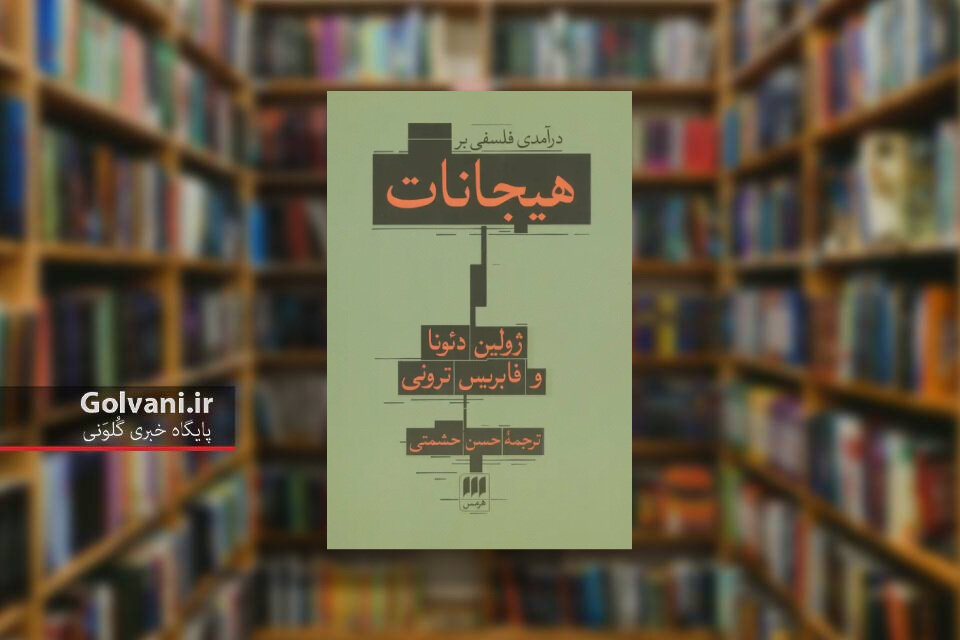
In a world where we face immense waves of information, images, and feelings every day, understanding emotions has become more essential than ever. The book “Introduction to the Philosophy of Emotions,” written by Julien Deonna and Fabrice Teroni, two prominent Swiss analytic philosophers, stands precisely at this sensitive point, striving to examine emotion not as a marginal psychological phenomenon, but as one of the main pillars of human experience, moral life, and understanding the world, with a clear, precise, and argumentative language. This book, first published in French in 2012 under the title “Introduction à la philosophie des émotions,” has now been released in Persian translation by Hermes Publishing.
Emotion: From the Margins to the Center of Philosophy
Until just a few decades ago, emotion in Western philosophy was often considered an obstacle to rationality. From Plato, who likened emotion to a wild horse, to Descartes, who called it “passions of the soul,” and Kant, who based ethics solely on reason, emotion was often overshadowed by intellect. But in the twentieth century, with the emergence of phenomenology, analytic philosophy of mind, and cognitive sciences, this situation changed.
Philosophers such as Heidegger, Sartre, Nozick, and more recently, Martha Nussbaum, considered emotion not only a part of human experience but also a way to access values, meaning, and reality. Deonna and Teroni, in this book, continue this new tradition but with an analytical and interdisciplinary approach.
They not only delve into the philosophical history of emotion but also engage with findings from empirical psychology, neuroscience, and even cultural anthropology. The result is a work useful and engaging for professional philosophers, psychologists, neuroscientists, and even general readers interested in self-knowledge.
Structure and General Approach
The book, across multiple chapters, begins with the phenomenology of emotion and gradually moves to more complex epistemological, ethical, and metaphysical discussions. The authors carefully show that emotion is not merely an “inner state,” but an “intentional relationship” with the world.
When we get angry, our anger is “about” something: an injustice, an insult, a threat. This intentionality distinguishes emotion from physical pain or hunger. Pain might exist without an object, but emotion always has an “orientation.” This view—rooted in analytic philosophy of mind and phenomenology—forms the basis of many subsequent arguments in the book.
Deonna and Teroni demonstrate that emotion is not only a reaction to the world but “reveals the world to us.” Fear shows danger; shame, the violation of social norms; love, the high value of another. In other words, emotions have “representational content” and can be true or false, just as beliefs can.
Emotion and Value: An Indissoluble Link
Perhaps the deepest part of the book is the discussion about the relationship between emotion and value. Deonna and Teroni argue that emotions are evaluative; that is, through emotions, we find the world “valuable.” When we are angry at injustice, this anger is not just a feeling, but a value judgment: “This act is unjust.” Similarly, when we enjoy the beauty of a landscape, this enjoyment indicates its aesthetic value.
This view has significant implications for moral philosophy. If emotions play an evaluative role, can ethics be considered purely rational? Is a moral act without emotional accompaniment truly moral? The authors subtly show that reason and emotion are not in opposition but in continuous dialogue with each other. Reason can critique emotions, and emotions can guide reason towards forgotten values.
The translation by Hassan Heshmati, who previously translated works such as David Chalmers’ “The Conscious Mind” and Paul Grice’s “Studies in the Way of Words” into Persian, shines particularly in this book. By choosing precise and fluent words, he has made complex philosophical terms understandable for Persian-speaking readers.
Words like “intentionality,” “cognitive appraisal,” “mixed theory,” and “emotional rationality” are not only correct but also pleasant-sounding and memorable. Hermes Publishing has also enhanced the richness of this work with quality paper, professional typesetting, and a detailed index.
Why Read This Book?
“Introduction to the Philosophy of Emotions” is more than an academic book; it is an invitation to deep reflection on ourselves. In an era where emotions are often relegated to psychotherapy, medication, or entertainment, this book reminds us that emotions are not only a part of our humanity but “the key to understanding the world, others, and ourselves.”
This book is essential for students of philosophy, psychology, cognitive science, and humanities, but it is also readable and transformative for anyone who wants to have a richer, more conscious, and more ethical emotional life. Deonna and Teroni have shown with this work that the philosophy of emotions is not a marginal field, but one of the liveliest and most dynamic areas of contemporary philosophy.
Hermes Publishing, by releasing this book, has taken a significant step in enriching Persian philosophical literature, and Hassan Heshmati, with a brilliant translation, has built a strong bridge between French analytical philosophy and Iranian readers. Reading this book is a combined intellectual, emotional, and ethical experience that encourages every reader to rethink their daily emotions and perhaps open a new window to a deeper life.





