Inauguration of the Office of Literature, Poetry, and Persian Language / Seyyed Abbas Salehi: We have currently drafted the job descriptions, and the general framework is clear.
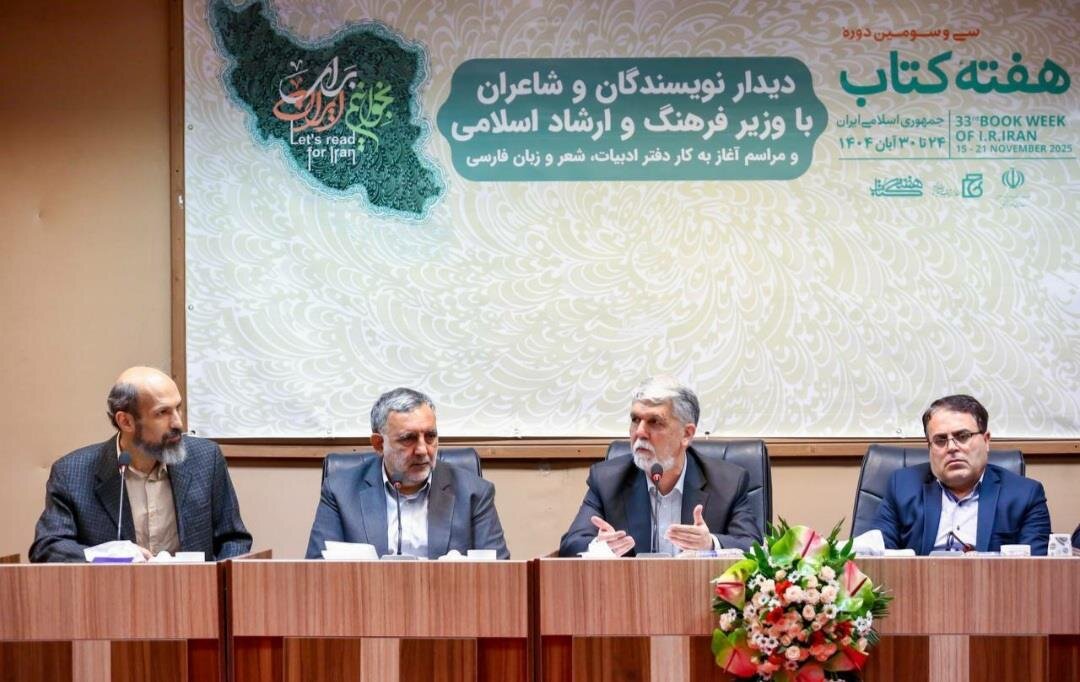
According to Khabar Online News Agency, quoting the press committee of the 33rd Iran Book Week, on the occasion of this event, a group of writers and poets met and discussed with Seyyed Abbas Salehi, the Minister of Culture and Islamic Guidance, on Tuesday (November 17, 2025).
Salehi stated in this meeting: ‘It was felt that the Persian language needed a clearer governmental position within the government structure; meaning that if we want to pursue issues related to the Persian language (both domestically and internationally), it must be clear which ministry is responsible for this matter.’
He added: ‘The Iran Book and Literature House is, of course, a subset of the Cultural Affairs Department; but when it comes to interacting with ministries or the international sector, it requires a specific institution within governmental and state structures.’
Salehi, stating that efforts had been made in various periods to create structures in this field, clarified: ‘Given the policy of streamlining and downsizing structures in the country, it was naturally not an easy task to convince the Administrative and Recruitment Organization to establish the Office of Literature and Persian Language.’
The Minister of Culture and Islamic Guidance said: ‘An ‘office’ refers to an institution that performs a combination of research and executive work; if part of its duties is research-oriented, the title ‘office’ is used for it, but its operational level is equivalent to a general directorate and sometimes even higher.’
He added: ‘Convincing the Administrative and Recruitment Organization, as well as gaining internal cooperation, given the issue of downsizing, was not an easy task, but by the grace of God, it happened.’
Salehi, stating that a structure has been created within the government that defines the position of the Persian language at the executive level of the government, added: ‘When we want to communicate with institutions like the Ministry of Education, it must be clear which part of the government and the executive branch is responsible for pursuing issues of Persian language and literature as a defined position within the government structure.’
He stated, emphasizing that ‘we are still at the beginning,’ that ‘we have currently drafted the job descriptions, and the general framework is clear.’
The Minister of Culture and Islamic Guidance concluded this part of his remarks by saying: ‘This discussion can help us understand how to protect this position during its establishment phase and to outline a correct vision and a clear path for two important issues of the country, namely the Persian language and literature (which is the driver of the Persian language).’
He continued, noting that Iranian literature holds a central position in the field of books, adding: ‘Even now, if we look at the publication statistics for the year 1403 (2024-2025), the first row is related to literature books; after that comes the children and young adults category, and then educational textbooks.’
Salehi continued: ‘Out of approximately one hundred and twenty thousand first and second printings, the share of literature is still significant, with about twenty thousand books in the field of literature; furthermore, in the area of readers’ interests, literature holds a prominent position. According to one of the surveys we conducted for Book Week, with results completely similar to previous surveys such as the survey on Iranian cultural consumption, in this survey, avid readers were asked what topics they are most interested in, and among the answers, novels and stories ranked highest.’
He added: ‘Also, among the top ten bestsellers at this year’s book fair, seven titles belong to fiction; this indicates that literature (both from the perspective of publishing and audiences) holds its own position.’
The Minister of Culture and Islamic Guidance said: ‘There are topics in the field of books and literature within the Ministry of Culture and Islamic Guidance where writers and poets can help us by offering their ideas.’
Salehi, referring to the issues raised regarding the censorship and expert review of literature, poetry, and stories, clarified: ‘One of the difficult areas of the Cultural Department is expert review and oversight. Poetry and stories have significant interpretive areas, and for this reason, they sometimes get caught up in different tastes; sometimes there are subjective views that at times question the core issue.’
He added, stating that the diverse tastes stem from the breadth and variety of human resources in this field: ‘You and your friends who are writers have also faced problems and gained experiences in this area; in the current situation, we must see how to act to ensure that the rights of writers and publishers are respected, as well as ethics and the law.’
The Minister of Culture and Islamic Guidance said: ‘A significant portion of our works falls within the field of literature; therefore, a considerable part of supervision and censorship is related to this area, and if we can reduce errors and create clearer standards, it will be a major step.’
He added: ‘The second topic is Iran’s literary diplomacy; within cultural diplomacy, due to the prominent position of literature in Iran’s history and contemporary era, literary diplomacy is of great importance. In discussions we have had with cultural officials of foreign countries at various times, literature is a topic that greatly attracts attention.’
The 33rd Iran Book Week, with the slogan ‘Let’s Read for Iran,’ began on Saturday, November 14, 2025 (24 Aban 1404) and will continue until November 20, 2025 (30 Aban 1404).





