A Book That Will Forever Change Your View of China / The Chinese Worldview Reaches Third Print
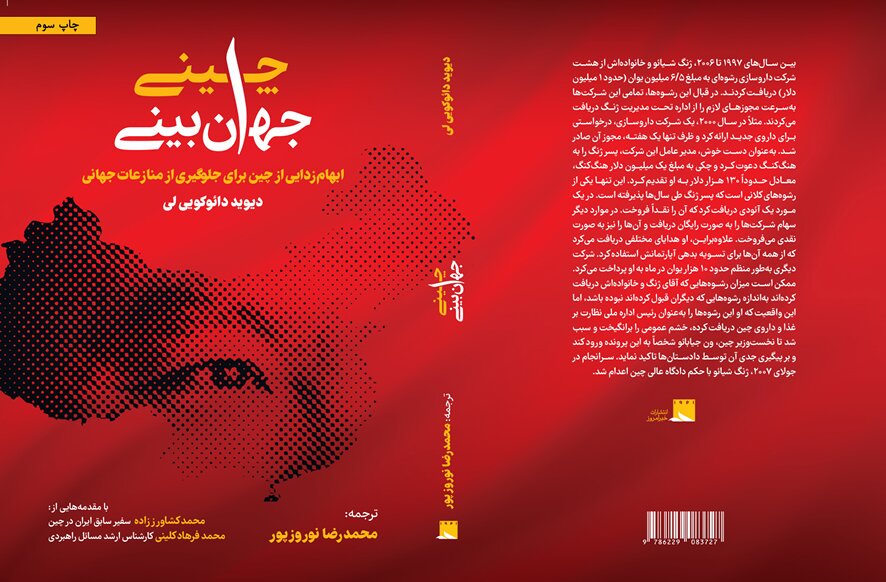
This work, in a short period since its initial publication, has gained significant standing among international relations researchers, academics, and foreign policy activists.
The book, featuring introductions by Mohammad Keshavarzadeh, former Iranian Ambassador to China, and Mohammad Farhad Koleini, a senior strategic analyst, was published and immediately introduced as a credible source for understanding China’s political and strategic mindset.
One of the most engaging parts of the book is the author’s vivid account of the famous “Munk Debate” in Toronto, where David Daokui Li, alongside Henry Kissinger, Niall Ferguson, and Fareed Zakaria, debated before thousands on the question: “Does the 21st century belong to China?” This scene-driven narrative, which opens the book, immediately places the reader at the heart of one of the world’s most critical strategic dialogues.
Furthermore, the book uncovers how China operates during major crises, from central government decision-making to navigating the 2008 financial crisis. The author, by providing real examples from meetings, policies, and risk management models, creates a behind-the-scenes picture of China’s political economy—an image often distorted or unavailable in Western sources.
The chapter on corruption is also one of the most readable and unique sections of this work. Drawing on his close experiences with China’s governance structure, Li provides precise examples of real corruption cases within the party, military, and government, showing why China, contrary to Western media portrayals, utilizes the most stringent punitive and control mechanisms in dealing with corruption. This section is particularly appealing to Iranian readers, as it allows for a comparison of corruption control structures in China and Iran.
At the book’s climax is the chapter “The Chinese Worldview,” which explains China’s perspective on the future of the world, its sensitivity to a “new Cold War,” its understanding of American policies, and its interpretation of the international order. The author demonstrates how cultural, historical, and political misunderstandings can fuel global tensions and why the West still views China not based on reality, but through the lens of old fears and stereotypes.
This book is a rare resource, especially for international relations researchers, policymakers, and foreign policy analysts, as it explains the inner layers of decision-making in China not from an external perspective, but from the Chinese point of view. It is also essential for government officials and economic actors involved in cooperation with China, as the book’s introductions emphasize that without understanding the mindset of Chinese decision-makers, no action or agreement will achieve its desired outcome. Journalists and media activists also benefit greatly from this book, as it offers a more accurate understanding of how Sinophobia has formed globally and the role of media in exacerbating or mitigating it. Finally, general readers interested in today’s world will enjoy the book’s smooth narrative, real-world examples, and understandable analyses.
The importance of studying this book stems from the fact that the dominant image of China in global media is often mixed with misunderstandings, exaggerations, and sometimes Western-centric unilateral narratives. In a world where China’s rise is considered the most significant geopolitical transformation of the century, ignoring this change means ignoring the future. David Daokui Li, who himself has been involved in China’s governance structure, provides an unmediated picture of the country’s society and politics—a picture whose understanding is a serious necessity for Iran, as a country engaged in strategic cooperation with China. With an accurate translation and credible introductions, this book offers one of the clearest and most documented accounts of the Chinese mindset to Persian-speaking readers, and reading it is not just a recommendation but an analytical necessity for understanding tomorrow’s world.