Is War Good or Bad? / Machiavelli Against More
According to Khabaronline News Agency, quoting IBNA, Sobhan Kiani wrote: ‘Political Philosophy in the Renaissance’ by Michael Hornqvist, translated by Aref Masoudi, has been published by Qasidehsara Publishers. This book is the thirteenth volume of ‘The Oxford Handbook of the History of Political Philosophy’, edited by George Klosko. This collection consists of works that discuss fundamental and foundational topics in the history of political philosophy from several angles. This collection comprises articles published by one of the most prestigious universities and publishers in the world, Oxford.
Oxford Handbook
The Oxford Handbook is structured into four main sections. The first section, titled ‘Method’, presents theories on the methodology of studying and researching the history of political philosophy and examines them in several articles. The second section covers the history of political philosophy, from ancient Greece to the contemporary era, primarily presenting the ideas of political philosophers within schools of thought and historical periods, in terms of their importance and influence, rather than solely focusing on their opinions. The third section of this collection of works is dedicated to fundamental concepts of political thought, from ancient to modern, such as the state, sovereignty, social contract, feminism, and so on. The fourth section briefly addresses the history of political philosophy in the East.
Political Philosophy in the Renaissance
As mentioned, the current article is dedicated to the thirteenth volume of ‘The Oxford Handbook of the History of Political Philosophy’, titled ‘Political Philosophy in the Renaissance’, written by Michael Hornqvist and translated by Aref Masoudi, published by Qasidehsara Publishers. This book examines the developments in political thought during the Renaissance and the transition from medieval political philosophy to modern thought.
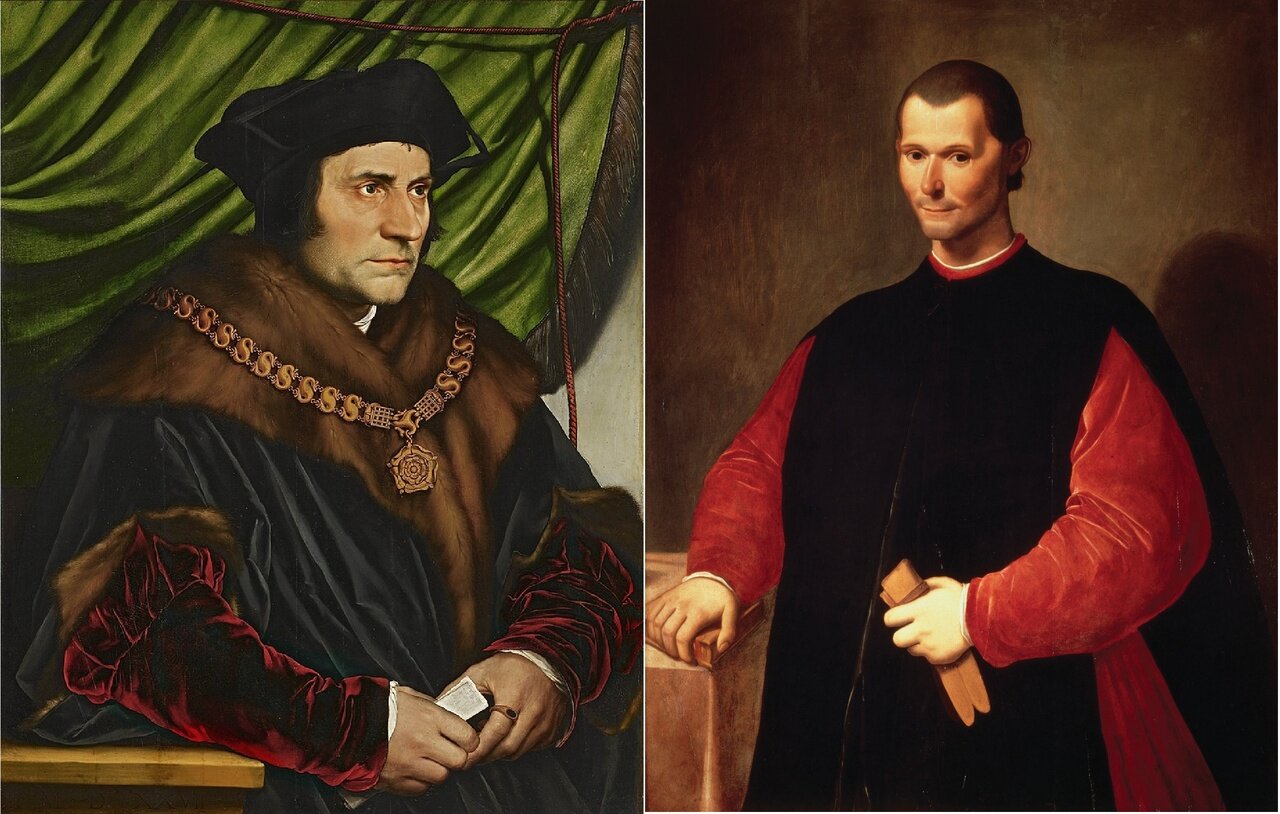
This writing emphasizes two of the most prominent and influential thinkers of the Renaissance: Niccolò Machiavelli and Thomas More. The special importance of these two stems, on one hand, from the unparalleled quality and richness of their works, and on the other hand, from the connection of their research approaches to politics that has persisted to our time. The Renaissance, as presented in this book, stands both as a golden age of culture and great creations and as a transitional period struggling to control, and ultimately surrendering to, historical forces it had itself unleashed.
In the second section of the book, titled ‘Machiavelli and Florence’, the author shows that Machiavelli’s ideas are a result of his lived experience in the unstable political climate of Florence. This is when Machiavelli separated politics from ethics and emphasized the preservation of power. This section briefly outlines Machiavelli’s theory. The author considers the founding of states a recurring and central theme in Machiavelli’s works and a suitable starting point for an investigation into his arguments, noting that no classical writers, with the exception of Plato, gave as much importance to this topic as Machiavelli did.
In his Discourses, Machiavelli generally addressed the founding of states, particularly in Rome. In The Prince, he also considers good laws along with good arms as the foundation of all states. Machiavelli believes that a prince needs two things to contend: one, law, and two, recourse to force. However, he does not consider force and laws sufficient for a firm foundation. In Machiavelli’s view, every prince, especially new princes, must fear everything and everyone without the support of the people.
At the end of this section, it is mentioned that ultimately, Machiavelli, due to his Roman and classical dogmas, by insisting on conceptualizing his desired republic from the perspective of honor, virtue, dominance, and glory, instead of free trade, enlightened self-interest, and wealth accumulation, could only provide a formal framework for such a nascent political-economic system but was alienated from its real content.
The next section of the book discusses Thomas More’s Utopia. Here, economics and capitalism, which are overlooked in Machiavelli’s theory, deeply engage us in Utopia. In his treatise Utopia, he discusses the effects of capitalist exploitation more than others. In his Utopia, a picture of a just and communal society is seen, which, unlike Machiavelli, is organized based on virtue and reason, not on power and force.
The final section of the book delves into a dialogue that never historically occurred but is a symbolic and analytical discussion between Machiavelli and Thomas More to highlight the ideological conflict between two different perspectives in the Renaissance era. Machiavelli, representing political realism and the preservation of power during this period, and Thomas More, with an ethical and humanistic view, believed that politics should serve the people. Among the contradictions between these two that the author points out is that Machiavelli considered conflict constructive, while the other side views it as potentially destructive but beneficial if managed correctly.
What emerges from this dialogue is that while Machiavelli’s theory failed to account for changing economic realities, More equally neglected the potential impact of scientific and technological developments. Political thought of the Renaissance continuously oscillates between power and virtue, and between idealism and reality. Neither Machiavelli’s extreme realism can build a just society, nor can More’s ethical idealism manage politics in the real world.