Display of a Thousand-Year-Old Quran Copy at Sharjah Book Fair
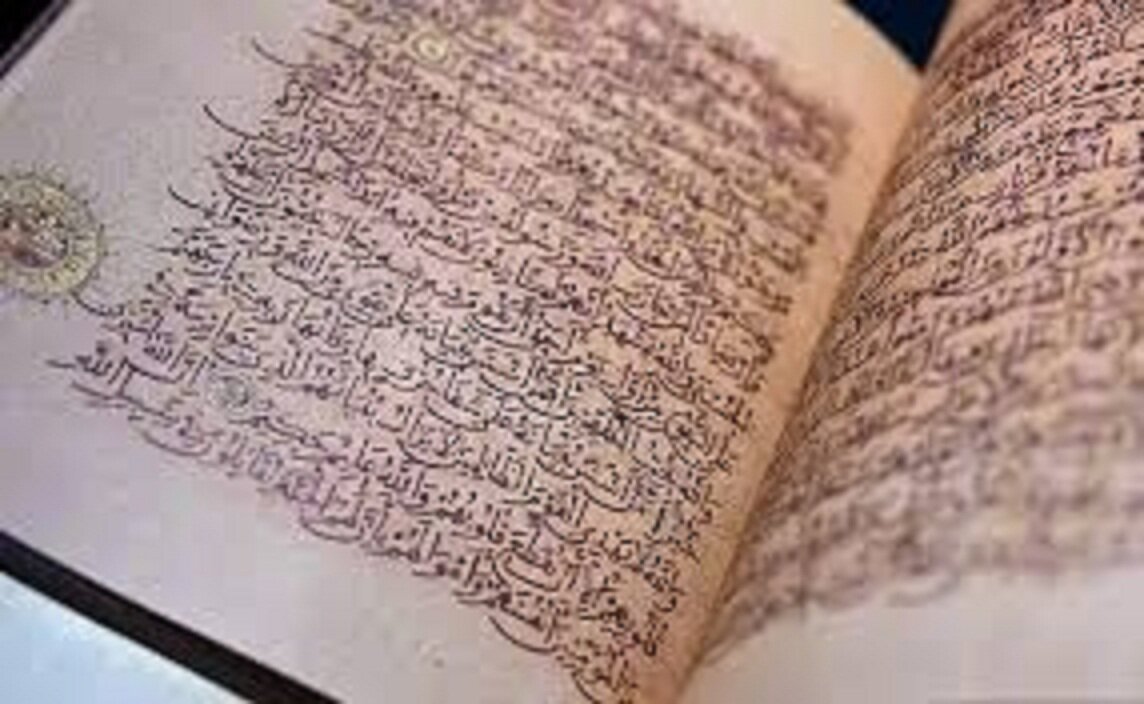
According to the Mubalegh Thought and Culture website, this facsimile copy of the original Mushaf, housed in the Chester Beatty Library in Dublin, offers visitors a rare opportunity to closely observe Islamic calligraphy art from the 11th century AD. This Mushaf was written by Abul-Hasan Ali ibn Hilal, known as Ibn al-Bawwab, and is considered a perfect example of the works of a famous calligrapher.
According to Ibna, quoting Khaleej Times, Hamed Dahdashti, the representative of the Safir Ardehal stand from Tehran, said: “This is one of the oldest complete Mushafs written by a specific hand. The facsimile version displayed in Sharjah is a reproduction of the original Mushaf that Ibn al-Bawwab penned in 391 AH, approximately 1000 AD. The original is securely preserved in the Chester Beatty Library in Dublin. Ibn al-Bawwab was not only a calligrapher but also transformed Arabic script into an art of perfect proportion and spiritual beauty.”
He added: “This Mushaf is written in Naskh script, a style that Ibn al-Bawwab perfected and brought to its zenith. Each page has 16 lines of balanced text. The letters are soft and flowing, the spacing is precise, and the lines are regular. In this copy, one can see that each letter ‘breathes’ within its space. Ibn al-Bawwab believed that beauty lies in balance, and every curve and every dot was designed with specific harmony and rhythm.”
Dahdashti further stated: “Compared to the old Kufic scripts, which were angular and cubic, Ibn al-Bawwab’s Naskh style has greater fluidity and readability. His lines flow like poetry, and these same rules are followed a thousand years later in Arabic calligraphy, printing, and design.”
He also reminded: “The Chester Beatty Mushaf was probably entirely written and decorated by Ibn al-Bawwab himself. He not only copied the verses but also designed the headings and golden decorations. Natural ink, a precisely angled reed pen, and animal skin paper all contributed to preserving the quality and durability of the work.”
The stand representative added: “For visitors, this facsimile is not merely an old book, but a window into history and human skill. What you see here is pure human art; no machine can reproduce the harmony of ink, line, and faith.”
Dahdashti concluded: “Ibn al-Bawwab’s original copy is one of the greatest treasures of Islamic civilization and is kept under special protection in the Chester Beatty Library, but having its facsimile in Sharjah is also valuable. This copy reminds us how Muslim artists of past centuries inspired the world with their art, and their works continue to inspire today.”





