A look at the film ‘Oppenheimer’ and the book ‘Malvil Castle’ / Could the atomic bomb become a national issue?

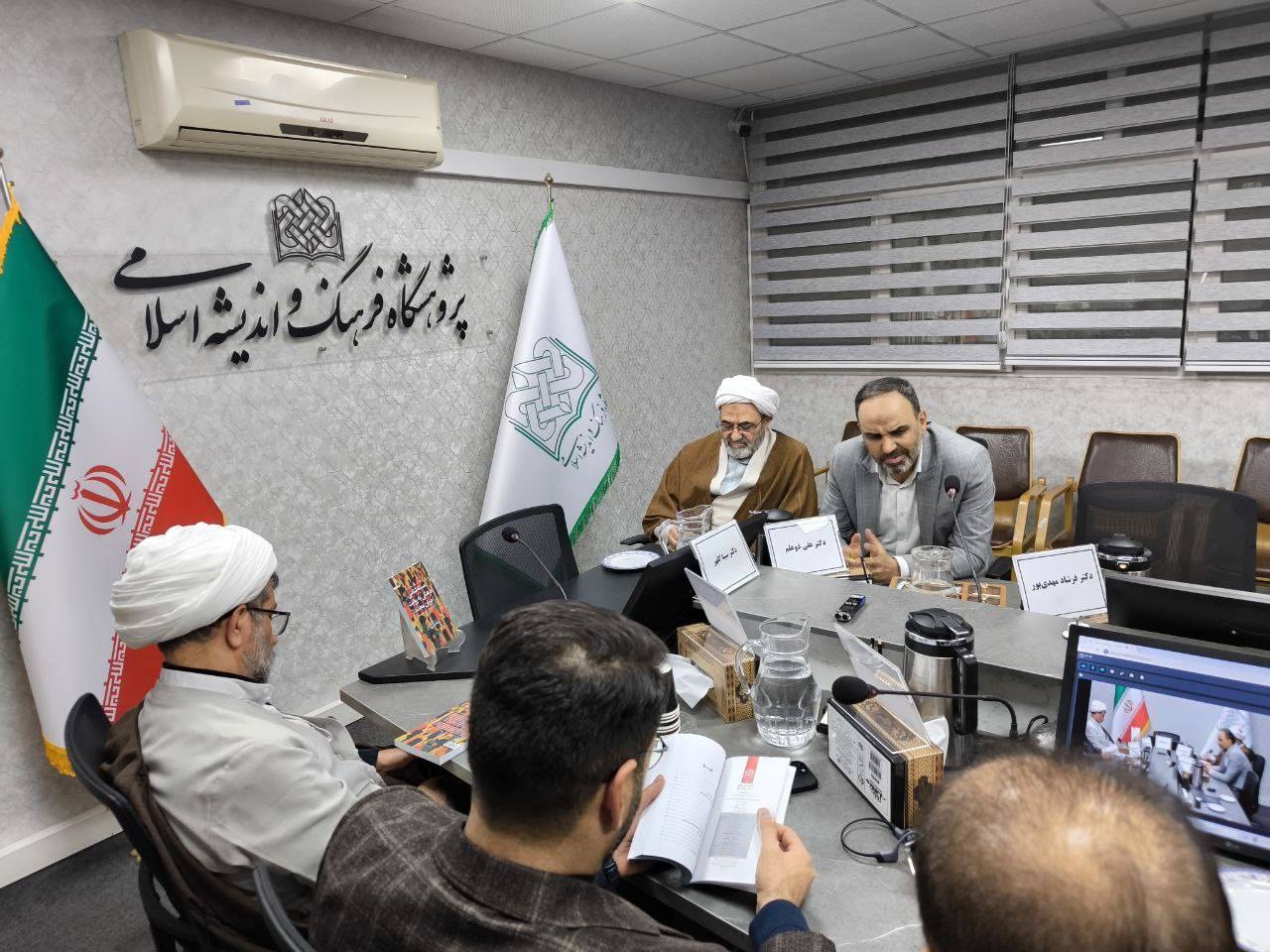
According to Iran Book News Agency (IBNA), this event was held with the moderation of Nader Sohrabi, hosted by Abasaleh Taghizadeh, a political science researcher, and Mohammadreza Asnafi, a media analyst, in cooperation with the Youth Thought Association.
Nader Sohrabi, the secretary of the session “Does the atomic bomb create a superpower?”, began his remarks by saying: “After the 12-day war, discourses resurfaced about why we need an atomic bomb. This led us at the Duzist editorial board to address the various dimensions of war in life.”
Abasaleh Taghizadeh, a political science researcher, referring to the issue of the atomic bomb, said: “When we usually talk about the atomic bomb and nuclear war, we try to think about the end point of the war. In war, we talk about victory and defeat, but such a thing does not exist in nuclear war. The reality of war is that every time we fight, we are defeated in some way and victorious in some way.”
He continued: “Machiavelli, in his book ‘Discourses’, uses a term called ‘Pyrrhic victory’, quoting a historical phrase that says if we defeat Rome one more time, we will be destroyed. For this reason, they use this phrase that sometimes victory is a defeat.”
He added: “Friends who talk about the atomic bomb prevent us from discussing it, and when the issue of the atomic bomb arises, they somehow prevent the audience from discussing the manner of war.”
Has ‘Oppenheimer’ portrayed American characteristics?
Taghizadeh, referring to the film ‘Oppenheimer’, said: “I think ‘Oppenheimer’ is a very bad film because it deprived Americans of the opportunity for self-knowledge, by separating the character of the atomic bomb’s creator from the destructive character of the atomic bomb itself, depicting him as a good person.”
He continued: “America had the opportunity to show a character of its own way of fighting by using the atomic bomb. America itself has used the atomic bomb, and this is very compatible with the American spirit, but the creator of ‘Oppenheimer’ failed to portray the American spirit in the manner of war.”
We cannot steal the way of fighting from other countries
This researcher, referring to Iran’s way of fighting in “Narrative of Victory” by Martyr Avini, stated: “But in Avini’s ‘Narrative of Victory’, we were able to display our war in its entirety and with our own birth. This work showed us how to fight, and we evolved within it. If we want to talk about the atomic bomb, we must know that we cannot steal the way of fighting, but rather from ourselves and our understanding of war, we can learn how to fight.”
Mohammadreza Asnafi, in response to the question of whether we are the ones who should use the atomic bomb, explained: “Do we know who we are? No, this is a question that no one can answer, and we have reached it through a long-term existence and a collective identity, but whatever it is, we suffer from a theoretical sloppiness.”
He added: “On the one hand, we do not know what relationship the atomic bomb has with us; there is a realistic view that the atomic bomb is dangerous, and we must have a bomb for deterrence. On the other hand, recent wars have shown that the existence of a bomb does not provide much deterrence.”
He continued: “The second view is that they will not let us have an atomic bomb, and we should not pursue it at all. Some also say, ‘What else did you build with the two thousand three hundred billion dollars spent on nuclear energy?’ There is also a third view that sees the world based on mystical analysis; in this view, life, defeat, and victory have another meaning, and there is no authenticity at all.”
History cannot be estimated
Taghizadeh, in response to Asnafi’s remarks, said: “We cannot easily estimate our own history, unless there is an abstract framework. No country, when it gains knowledge, has easily calculated its outlook.”
He stated: “Countries, at some point, develop a collective will and want to do something, and this collective movement leads to the emergence of a talent within them. In a predicament and a movement, a talent appears in them, and this talent is one of the most important aspects of that science.”
He referred to the growth of industry in England, saying: “For example, industry in England adopts one policy, and in Germany, another policy. Germany’s industrial policy is different. The fact that a nation moves forward does not easily have a clear outlook; it is more related to a kind of national resilience.”
This researcher continued: “It is not that we can say if we had sold X amount of oil from 2003 until today, the situation would not be like this; such an estimation and discussion do not exist. It is quite possible that if a certain decision had not been made in a certain year, the situation would have been worse. My example for this issue is that we cannot compare Germany before the Industrial Revolution, after the Industrial Revolution, and after the World War.”
This researcher, referring to the importance of how to fight, said: “I return to my first point; the reality is that we cannot eliminate the ‘how to fight’ aspect and then argue, because if we present an analysis in this way, it will not be real.”
Is carpet a national industry or nuclear energy?
Nader Sohrabi, the moderator of the session, asked: “You say that the nuclear project is a national project, but Mr. Asnafi does not share this opinion. How, in your view, is this project national?”
Asnafi, referring to the national issue, explained: “A national issue means that all our lives are tied to it, but there is no connection visible between the nuclear issue and the people, and this lack of connection is clear in Mohsen Rezaei’s letter to Imam Khomeini. Because the nuclear project was initially a military strategy, I don’t want to compare, but the national industry in Iran is carpets, not the nuclear bomb. We have a theoretical sloppiness regarding the nuclear bomb, economic affairs, social crises, and everything else.”
Abasaleh also replied: “I want to ask what claim you have? How is our presence determined? The reality of society is not like this. In my opinion, carpet cannot be a national industry; something is national if it can invite me to something. Nuclear could be such a thing; I don’t know its origin, but I know that at some point it became a symbolic topic for defining the lines between Iran and America. It cannot be denied that nuclear energy has a national relationship with the people.”