Lost details of early Islamic battles published in a book
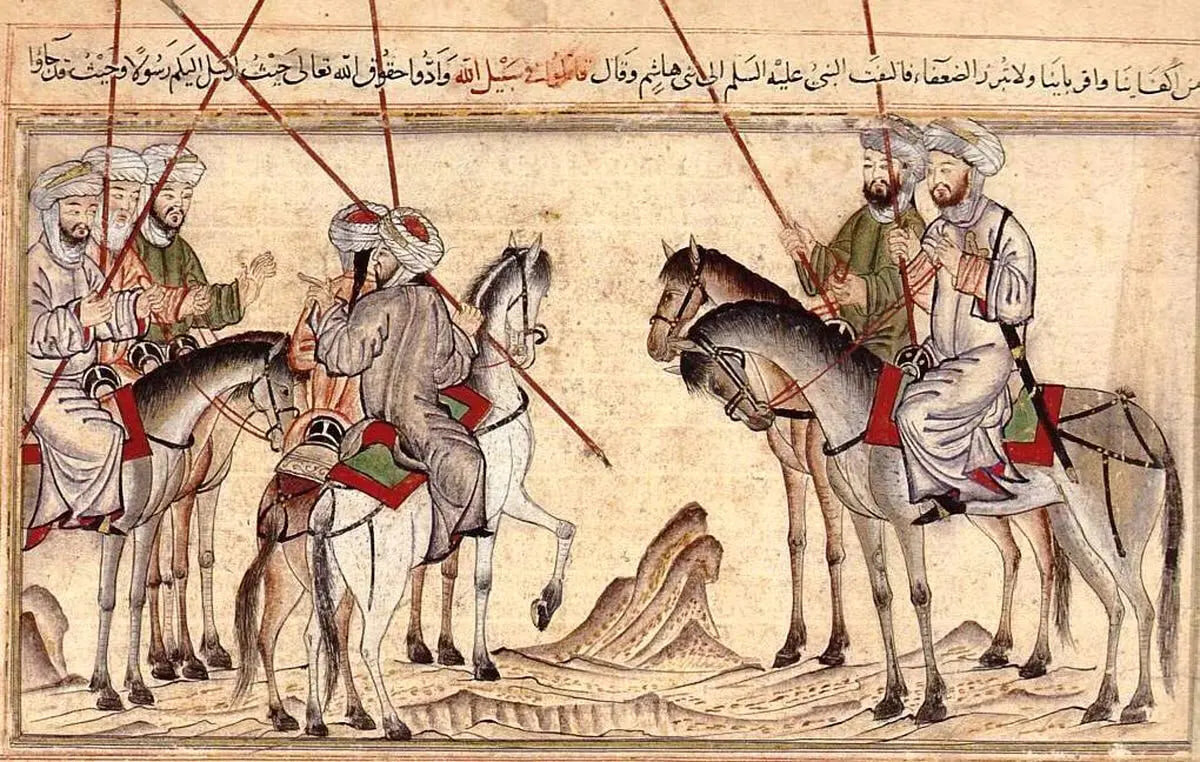
According to the Muballigh Thought and Culture website, the book ‘Al-Maghazi’ by Muhammad ibn Umar Waqidi narrates the details of the Prophet Muhammad’s (PBUH) battles with unparalleled precision. This work, which is the result of his travels to battlefields and listening to accounts from the Companions, depicts not only the events but also the motivations and even the anxieties before the war.
Among the early biographers, Muhammad ibn Umar Waqidi is a figure who, with historical precision and a narrative approach, strived to record and even reconstruct the battles of the Prophet Muhammad (PBUH). His book, ‘Al-Maghazi,’ like a vivid map of the battlefields, places the reader amidst the events.
According to ILNA, quoting the Public Relations of the House of Book, Waqidi was born in 130 AH in Medina. For writing ‘Al-Maghazi,’ besides relying on oral and genealogical narratives, he also traveled to battle areas and questioned tribal elders about the accounts. In his chain of narrations, names like Ibn Abbas, Jabir ibn Abdullah, and Anas ibn Malik shine.
In ‘Al-Maghazi,’ Waqidi not only presents the order and details of battles with unparalleled precision but also speaks of motivations, consultations, and even the anxieties on the night before the war. He narrates a moment when the Prophet (PBUH), at Badr, took dust in his hand and cast it towards the enemy army, and also indicates the anxiety in Abu Jahl’s heart. This narration is not merely history but the lived experience of battle.
Alongside narrating the battles, Waqidi looks upon figures like Ali ibn Abi Talib (AS), Hamza, Zubayr, and Sa’d ibn Abi Waqqas with an admiring gaze. In the Battle of Uhud, he recounts Hamza’s cry on the battlefield and the Prophet’s sorrow over his body with a mournful tone. At Khaybar, he speaks with passion and grandeur about Ali’s (AS) hands opening the fortress gate.
In the modern era, the Arabic version of ‘Al-Maghazi’ was first published in 1966 in London by Marsden Jones, with a research introduction about Waqidi and his place in the tradition of biographical historiography. Marsden Jones wrote in this introduction that Waqidi should be considered the founder of military historiography based on observation and field research in the Islamic tradition. He emphasized, referring to Waqidi’s travels to battle areas, that Waqidi did not merely rely on oral narrations but, by being present in the historical geography, accurately examined the locations, distances, and natural features of the battlefields. This approach distinguishes him from contemporaries like Ibn Ishaq.
Jones also points to the chronological and spatial order and precision in Waqidi’s reports. For each Ghazwa (expedition), he recorded the exact date, names of commanders, number of forces, Prophet’s deputies in Medina, and even the battle slogans of the Muslims. This unity of approach and presentation of a consistent pattern in battle reports transformed Waqidi’s ‘Al-Maghazi’ into a unique work and a model for subsequent historiography.
He also emphasized that Waqidi, contrary to the accusations of some hadith scholars, used a critical and analytical method in historiography and, in cases of conflicting narrations, evaluated and selected accounts with phrases like ‘in our opinion, this is more correct’ or ‘this statement is proven.’ This characteristic, which is not even seen in later works like Baladhuri’s, indicates Waqidi’s scientific spirit and relative impartiality in recording events.
However, the Persian translation of ‘Al-Maghazi’ by Mahmoud Mahdavi Damghani was published in 1362 (1983 CE) by the University Publishing Center and was introduced as the ‘Book of the Year’ in the same year. Mahdavi Damghani, in his introduction, provided an extensive explanation of Waqidi’s method and praised his precision in the details of battles and events.
Read an excerpt from the ‘Battle of Raji” below:
In the month of Safar, the thirty-sixth month of Hijra,
Musa ibn Ya’qub narrated from Abul-Aswad, who quoted Urwah, that the Prophet (PBUH) dispatched a group of companions to Mecca to gather news about the Quraysh. They set out via Najd, and as soon as they reached Raji’, the Banu Lahyan ambushed them.
Muhammad ibn Abdullah, Ma’mar ibn Rashid, Abd al-Rahman ibn Abd al-Aziz, Abdullah ibn Ja’far, Muhammad ibn Saleh, Muhammad ibn Yahya ibn Sahl ibn Abi Hathma, Mu’adh ibn Muhammad, and another group whose names I do not know, each narrated a part of this story to me. Some of them heard it from others, and I have collected what they narrated to me and I say: They say: When Sufyan ibn Khalid ibn Nubayh al-Hudhali was killed, the Banu Lahyan tribe went to the tribes of Adal and Qarah and offered them rewards to go to the Messenger of God (PBUH) and speak with him so that he would send some companions to them to invite them to Islam. And they had agreed to kill some of the companions who were involved in Sufyan’s killing, and to take others to Mecca and hand them over to the Quraysh, saying that they would receive a significant reward from the Quraysh; for nothing was more valuable to them than capturing one of Muhammad’s companions and killing and mutilating him in retaliation for those killed at Badr. Seven men from the tribes of Adal and Qarah, who are branches of the great tribe of Khuzaymah, seemingly acknowledging Islam, came before the Prophet (PBUH) and said: ‘Islam has become apparent among us. Send a group of your companions to us to teach us the Quran and Islamic laws.’ The Prophet (PBUH) sent seven men with them, namely: Marshad ibn Abi Marshad al-Ghanawi, Khalid ibn Abi Bakr, Abdullah ibn Tariq al-Balawi, an ally of Banu Zafar and his maternal brother Mu’attab ibn Ubayd, who was also an ally of Banu Zafar, Khubayb ibn Adi ibn Balharth ibn Khazraj, Zayd ibn Dathinah from Banu Bayadah, and Asim ibn Thabit ibn Abil-Aqlah. It is also said that there were ten of them, and their commander was Marshad ibn Abi Marshad; some also said that their commander was Asim ibn Thabit ibn Abil-Aqlah.
They departed from Medina, and when they reached Abi of the Hudhayl tribe, which was near Hudayda and called Raji’, suddenly a group ambushed them and called for help from those whom the Lahyanis had prepared. The companions of the Prophet (PBUH) had no help or reinforcements, while the enemies numbered a hundred and were all armed with bows, arrows, and swords. The companions of the Messenger of God (PBUH) drew their swords and stood ready to fight. The enemies said: ‘We do not want to fight you, and we make a covenant with you and call God as witness that we will not kill you; rather, we want to hand you over to the people of Mecca and receive a reward.’ Khubayb ibn Adi, Zayd ibn Dathinah, and Abdullah ibn Tariq surrendered to captivity; Khubayb said: ‘I have a right of patronage over the people of Mecca.’ But Asim ibn Thabit, Marshad, Khalid ibn Abi Bakr, and Mu’attab ibn Ubayd did not accept the enemy’s safety and refuge. Asim ibn Thabit said: ‘I have vowed never to accept the protection and refuge of a polytheist,’ and he began to fight them, reciting this war poem (rajaz): ‘What is my motive? I am a nimble sage, and my bow and arrow are fearsome. From my bowstring, tall arrows fall, death is true, and life is false. What God has decreed comes to man, and man goes towards it. If I do not fight you, may my mother mourn me.’
Waqidi says: ‘I have not seen any of his companions who did not consider this rajaz authentic.’ He said: ‘Asim began to shoot arrows until his arrows were exhausted; then, he started fighting with his spear until his spear broke, and only his sword remained. Then, he prayed: ‘O Lord, I, at the beginning of the day, defended Your religion. You, at the end of the day, protect my flesh.’ This was because the enemy would strip naked anyone they killed. He said: ‘The hilt of his sword also broke, but he continued to fight until he was killed. He had wounded two enemies and killed one. While fighting, he recited this rajaz: ‘I am Abu Sulayman, and there is no skilled archer like me. I have inherited greatness from a noble group, and I killed Marshad and Khalid while they were standing.”





