Romantic Revolt Against Absurdity; How to Live Without Hope? / How Does Absurdity Turn into Madness? / How Can One Live in a Meaningless World?
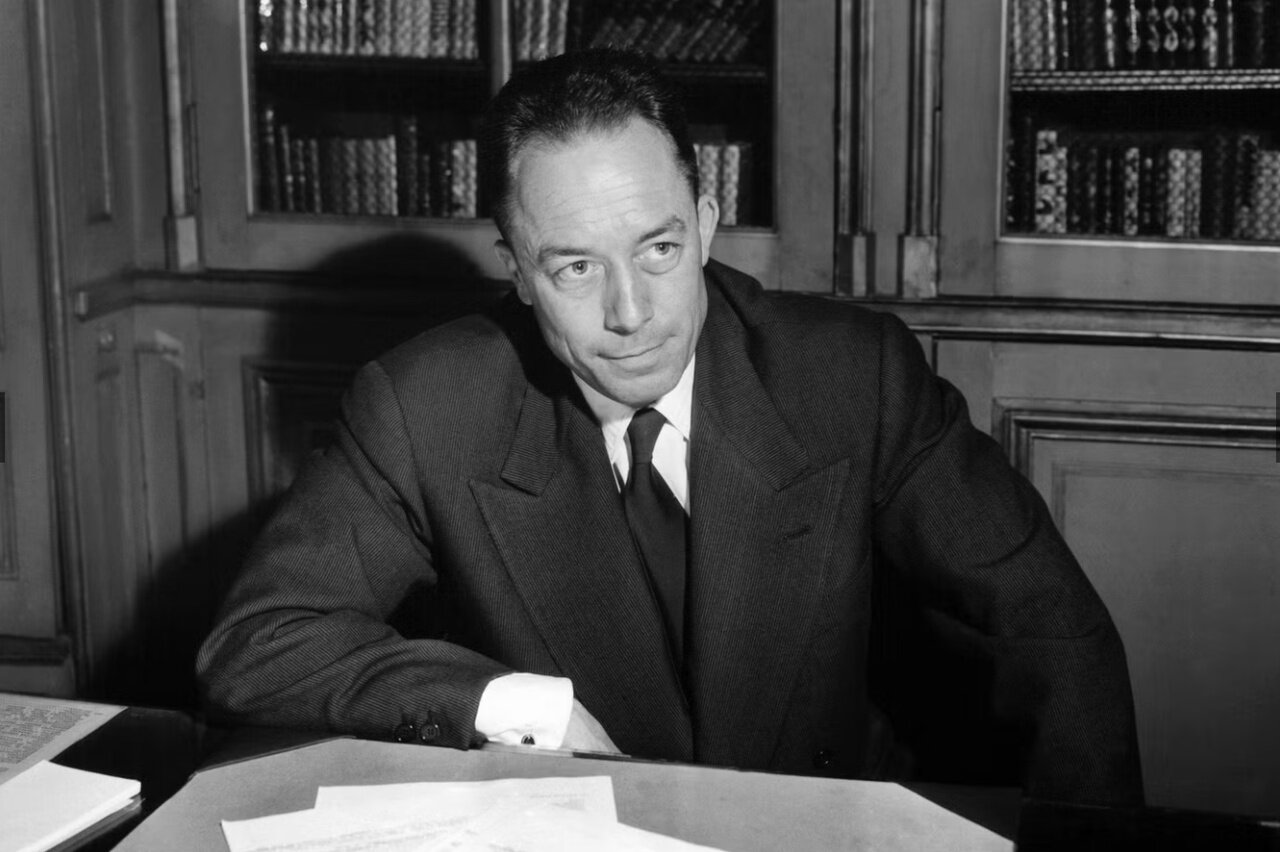
Albert Camus’s intellectual world is a world of fundamental contradictions that moves between “absurdity” (the distance between humanity’s thirst for meaning and the indifferent silence of the world) and the “passion for living.” This article by Alireza Pirouzan, published on the book page of Iran newspaper, discusses Albert Camus’s thoughts. According to Pirouzan, Camus accepts absurdity as an inevitable truth but never surrenders to it. His philosophy, in the face of this void of meaning, proposes a “meaningful revolt” and a “responsible earthly ethic.” His key works, including The Stranger, The Plague, and The Fall, illustrate this. According to the author, what distinguishes Camus from other existentialists is his “passion for living” and “light without hope.” In The Myth of Sisyphus, he summarizes revolt in Sisyphus’s conscious acceptance and heroic smile at the moment the rock falls. In The Rebel, he considers revolt to be saying “no” to injustice and defending human dignity; a revolt that stems not from hatred, but from love for humanity. Ultimately, Camus calls the reader to a “faithless spirituality”: acceptance of absurdity while remaining loyal to life, work, love, and laughter, even without any ultimate hope.
The world of Albert Camus (1913-1960) is a world of contradictions that, despite their destructiveness, are astonishingly human. He is not a writer of despair, but an explorer amidst the void of meaning. His world constantly moves between two poles: absurdity and meaning, death and the passion for living, silence and outcry, loneliness and friendship, and ultimately a kind of earthly faith in humanity. Camus accepts absurdity as an inevitable truth at the heart of existence, but he does not derive a philosophy of surrender from it. For Camus, absurdity is not the denial of life, but the starting point for understanding it. In the face of the void of meaning, he proposes a meaningful revolt with a passion for living and human responsibility, through an ethical and existential response.
In Camus’s view, existence is neither absolute light nor endless darkness; rather, it resides in a strange and resounding neutral balance, which itself is an enigmatic and incomprehensible phenomenon. This neutrality is the essence of “absurdity”: an infinite distance between humanity’s thirst for meaning and the world’s indifferent silence in the face of this thirst. From this very gap, his fictional characters emerge in search of an answer; an answer that manifests not in the realm of metaphysics, but in the act of living, in touching moments, and in experiencing contradictions. For Camus, novel writing is not merely a display of form or a reflection of society; rather, it is a form of lived philosophy, a philosophy breathed into the flesh and bones of characters, presenting meaning not as an idea, but as a tangible experience.
From Alienation with the World to the Fall of Judgment
In The Stranger / L’Étranger (1942), his first and perhaps most symbolic novel, Camus creates a figure of contemporary man suspended between life and death, between presence and indifference. Meursault is neither a hero nor an anti-hero. He is the man tired of interpreting the world; a man who decides to accept the world as it is, without any logical justification. When he says, “it was because of the sun,” he is not truly speaking of the heat, but of the inexplicable pressure of existence.
In a world where reason and meaning have vanished, action itself is a kind of answer, a silent but decisive one. In Meursault, Camus not only actualizes the concept of absurdity but also shatters the boundaries of traditional ethics. He shows how society, in confronting a person who deviates from conventional meanings, resorts to punishment. At the end of the novel, Meursault achieves a kind of peace by accepting death and looking at an empty sky; a peace rooted in the self-awareness of meaninglessness.
If The Stranger narrates the silence and individual loneliness, The Plague / La Peste (1947) tells the collective story of humans facing absurdity. This novel, set in a closed, diseased city, is an allegory of our world; a world where death circulates like a relentless virus, and humans are forced to choose between escape and resistance. The main character, Dr. Rieux, in silence and exhaustion, continues to fight without hope of victory. He knows there is no ultimate salvation, but he still does his work.
This is where Camus’s philosophy crosses the boundary of absurdity and reaches ethics; an earthly ethic, yet full of a sense of responsibility towards humanity. In The Plague, Camus achieves the figure of a silent hero; a hero who fights not for a metaphysical faith, but for loyalty to being human. He does not shy away from the suffering of others and, even in the heart of despair, radiates a faint but human light. In this sense, The Plague is more a statement about conscience than a novel about disease.
In The Fall / La Chute (1956), Camus enters another realm; the realm of confession. Jean-Baptiste Clamence, a former lawyer and now a “penitent judge,” in a long monologue, speaks of his own moral fall. He neither wants to justify nor to repent; he only wants to confess, in a world where there is no longer any authority for judgment.
In this work, Camus’s bitter irony reaches its peak. Clamence, as a fractured image of modern humanity’s conscience, speaks to us of hypocrisy, self-absorption, and absurdity. He is a mirror to the reader; a mirror that shows how, in the absence of a supernatural force, man considers himself his own judge and falls at that very moment. The Fall is, in fact, the end of the thought line that began with The Stranger. If Meursault accepted life with indifferent silence, Clamence condemns himself in a clamor of doubt and shame. These two are two sides of the same coin: acceptance and fall, both responses to a world without judgment.
In his plays, from Caligula to The Misunderstanding, Camus rediscovers tragedy, but not in a classical form, but in a philosophical guise. His characters, especially Caligula, are not merely mad or bloodthirsty; they are philosophers embodied in power. When Caligula says, “I want the moon,” he is actually crying out humanity’s impossible longing. A longing that is never fulfilled, yet he does not give up.
In The Misunderstanding / Le Malentendu (1944), a mother mistakenly kills her son, so steeped in poverty and despair that she doesn’t even remember love. This play is an allegory of a world where recognition and meaning have vanished; a world where even love, if separated from awareness, leads to violence. Camus’s plays teach us that absurdity, if it does not manifest in action, turns into madness. This is why, at the end of Caligula, death is not defeat but freedom: a return to the primal silence, where no command exists anymore.
Revolt and the Passion for Living
What distinguishes Camus from his existentialist contemporaries is precisely this passion for living. In the face of the inevitability of absurdity, instead of surrender, he proposes a kind of poetic rebellion. In the essay The Myth of Sisyphus / Le Mythe de Sisyph (1942), he summarizes this rebellion in the image of a man condemned to push a rock to the summit and watch it roll down again. But Sisyphus, in Camus’s view, is not a victim but a hero, because he is aware and accepts. He smiles at the very moment the rock falls; a smile that comes from awareness, not from hope. Camus, unlike pessimistic nihilists, does not flee from life. For him, every breath, every Mediterranean breeze, every ray of sunshine, is a testament to the world’s beauty even in the absence of meaning. He builds a bridge between philosophy and aesthetics: a philosophy that, instead of denying life, embraces it, and a particular aesthetic nourished by the sorrow of awareness.
In The Rebel / L’Homme révolté (1951), Camus explicitly states his philosophy: revolt, not to change the world, but to preserve human dignity. Revolt against absurdity means saying “no” to injustice, but without resorting to absolutes. Especially in his critique of 20th-century ideologies, including communism and fascism, he insists that any system that seeks to sacrifice freedom in the name of justice ultimately leads to violence. But this revolt is not born of hatred. Camus’s revolt is romantic; a revolt that springs from love for humanity, not from resentment towards the world. That is why, at the end of his life, he distanced himself from all ideological dichotomies and sought a kind of “deliberate thinking”; a thinking that knows truth is never absolute in any camp.
Light Without Hope
Perhaps the essence of Camus’s thought can be summarized in this phrase: light without hope. He was born in Mediterranean Algeria, in a light that shone on the sea and land from his childhood. This light permeates all his works: a defenseless, unguaranteed, yet vibrant light. From summer in Algeria to his return to Tipasa, he regards life as a physical revelation, not an abstract doctrine. In his view, even in the heart of suffering, there is something to be praised: the moment of sunshine, the sound of the sea, the presence of another.
From this lived experience, he creates a kind of ethic; an ethic built not on faith, but on the passion for life. Camus’s human, although he knows death is the end of everything, creates meaning from this very awareness. In his final years, when Camus became isolated due to disagreements with Sartre and Parisian intellectuals, he sought refuge in a human silence. This silence was not isolation but a kind of dignity; the dignity of a human weary of ideological shouts, returning to the silent light of life. In his notes, he repeatedly speaks of fatigue, loneliness, inner silence, and the anxiety of meaning; that is, what is rooted in the duality of man: the desire for meaning in a meaningless world.
His sudden death in a car accident seemed to confirm the allegory of his life: sudden, causeless, but at the height of light. At the accident site, the unfinished manuscript of the novel The First Man was found, a work intended as a return to his childhood and earthy roots; a return to where his philosophy had begun: light, earth, and man.
Today, reading Camus is not just a return to a mid-20th-century writer, but a renewed encounter with the fundamental questions of modern humanity: How can one live in a meaningless world? How can one find an unnamed, unmarked hope amidst despair? Camus’s answer throughout all his works is consistent: by loyalty to life, by accepting absurdity and yet rebelling against it. His world is a world of constructive contradictions; a world where solitude is the source of empathy, and awareness is the origin of love. Ultimately, Camus calls us to a kind of faithless spirituality; a spirituality in which man is a momentary companion between light and shadow. He wants us to know how to laugh, work, and love, even without any ultimate hope.





