The criterion for being revolutionary in satire is not being sharp / Heads that smell of Ghormeh Sabzi!
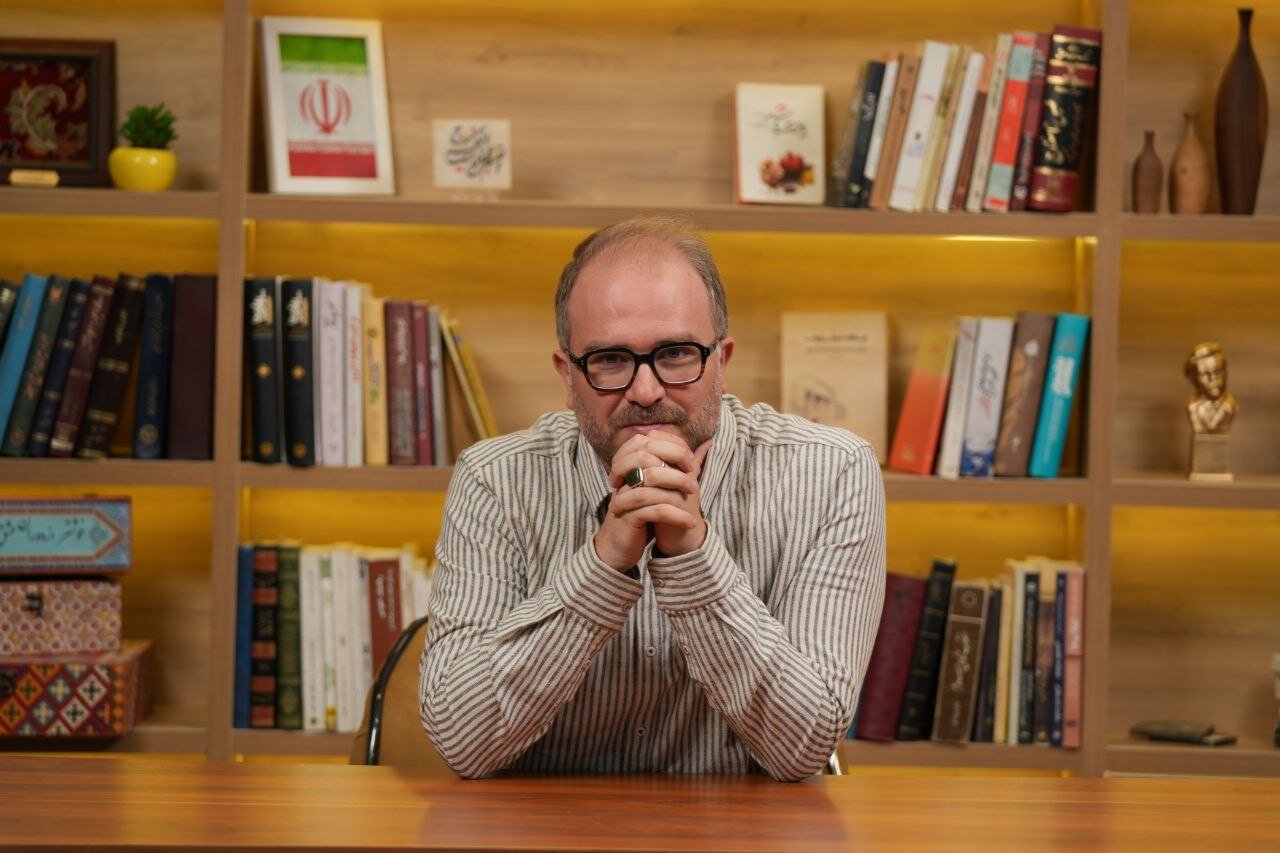
Mehr News Agency, Culture and Literature Group; Javad Sheikh Al-Eslami: Mikh Publication, a specialized satire publisher, is, according to its manager Mohammadreza Shahbazi, “the last specialized satire publisher in the country.” This publisher, which started its activities in the field of satire last year, is now preparing for its second year of presence at the Tehran International Book Fair and is currently preparing its new books.
On the occasion of the publication of two new books by Mikh Publication, “Reza Chakhan” by Naser Javadi and “Wormy History of the World” by Farzaneh Saniei, we interviewed Mohammadreza Shahbazi, the manager of Mikh Publication, to discuss the publishing house, his motivation for launching Mikh, its approach, new books, and the general state of satire books in the publishing market.
You can read the full interview below;
I believe this is your first interview about Mikh Publication. What led you to establish Mikh as a specialized satire publisher?
The background of Mikh Publication goes back ten to fifteen years when we were working in the field of satire and were concerned about it. At some point, the Revolutionary Satire Club was formed, where many young people were trained and worked. Some of these individuals gradually gained abilities that allowed them to write books, and good books too; especially in areas that satire had addressed less. Of course, this capacity had been active even before Mikh Publication, and we collaborated with other publishers, and the children’s books were printed by other publishers, but we saw that we had reached a point where we could have a specialized publisher and work more specifically in this field.
For various reasons, satire books are truly an neglected field. One of the most important reasons is that people consume satire daily in virtual spaces, cinema, and television, and therefore feel less need for satire books.
Satire, especially in the written form, has always been overlooked. If satire books have been published, it has mostly been in the field of satirical poetry or journalistic satire. This capacity has never been fully activated. In your opinion, why has satire not been taken seriously enough, despite its potential?
First, we must note that the overall state of books is not good, and if you talk to publishers, you will realize that they are mostly working with difficulty. Now, within the book industry, satire is truly a more neglected field, for various reasons. One of the most important is that people consume satire daily in virtual spaces, cinema, and television, and because of this, they feel less need for satire books. Their needs are met in various levels, formats, and media, and for this reason, they don’t often seek out satire books. Furthermore, virtual spaces have changed the definition of satire, and many people do not connect with satire books. Although I believe that if good satire books are written and can differentiate themselves from the satire prevalent in virtual spaces, they can gain acceptance from the audience. At Mikh Publication, we also try to have various formats of satire books; from stories and novels to collections of satirical notes, historical satires, and even satirical poetry. However, satirical poetry is even more difficult than other fields. Just as very few poetry books are published and sold now, satirical poetry is not in a good state either. Every day, the audience has easy and quick access to poets in virtual spaces and sees the poet’s voice and image with high quality, which is why the sale of serious poetry has also decreased. In short, the work is difficult, but we hope that by creating differentiations in terms of subject, literature, format, language, etc., we can publish good books.
One of Mikh Publication’s features is that it seeks out young writers and works with those who might publish their first book with Mikh. Why did you make such a decision?
As you said, at Mikh Publication, we have writers who are publishing their first book here, and we also have the book “At Leyli’s Alley” by Mr. Osani Ashari, who is among the older satirists and had published satire in “Tofigh.” Nevertheless, our focus is on young writers. We want to provide this opportunity for young people to add a new capacity to the country’s satire writing and publishing. These friends are mostly those who have been trained by the Revolutionary Satire Club and the Revolutionary satire movement. Although we have also had writers whom we met and took books from, our primary aim is to add something to the capacity of revolutionary satire by introducing young talents.
Is there any other reason you don’t approach older or more established writers?
It should be mentioned that our decision to collaborate with young people does not mean distancing ourselves or creating antagonism with older writers and masters in this field. As a fledgling and private publisher, we neither have the financial capacity to approach many masters, nor might the masters themselves trust us, and also, these masters do not remain idle; their books are taken and published by older publishing houses. However, there are many young people who are newcomers and should be trusted. For this reason, we work with these friends, and I hope it will have good results for the country’s satire.
In terms of statistics, visits, sales, and programs held at Mikh’s booth at the book fair, when we talked to older publishers, they said your presence in the first year was successful. The feedback on the books has also been good.
This year was your first time participating in the Book Fair. How has the audience’s reception and reaction to Mikh Publication’s books been so far? Both at the Book Fair and afterward.
Mikh Publication was formed a few months before the fair, and our presence at the Book Fair became very sudden. A few days before the fair, we found out we had a booth and had little time. Thanks to our friends in Ershad (Ministry of Culture and Islamic Guidance), a booth was provided, but we couldn’t have a very fruitful presence; at least from our perspective. But in terms of statistics, visits, sales, and programs held at the booth, when we talked to older publishers, they said your presence in the first year was successful. The feedback on the books has also been good. Although we are also gaining experience and proceeding by trial and error, overall we are satisfied. We hope it gets better day by day.
Those who know Mohammadreza Shahbazi to some extent might say that Mikh Publication is a satire publisher with explicit and sharp stances. Could you explain Mikh Publication’s approach and its addressing various topics through satire?
I don’t have such a classification or framing of the field of satire, its audience, and its writers, to say that we have a sharp, quick, and explicit satire, and a mild, soft, and calm satire. I think the correct framing is that every satire, every topic, and every audience requires, likes, and demands its own format, tone, form, genre, and even a specific model of bookmaking and cover design. Sometimes we address a topic and must do so very sharply and explicitly, and at other times we have a different topic and audience and must speak about it more subtly and softly. The criterion for being revolutionary is not being sharp and explicit in one’s stance or satire writing. Sometimes a topic needs to be expressed sharply and pointedly, and sometimes another topic should be expressed more softly and implicitly. Even the cover design of one book might be different from another. Regarding Mikh Publication’s approach, I must say that our approach is the same one we have been working with and pursuing throughout these years.
What works do you have ready for publication? Or, to put it another way, what books will be present at Mikh Publication’s booth for next year’s Book Fair?
In the field of stories and novels, works are being finalized and will reach the fair. In the field of travelogues, we are preparing works and hope they will be ready. We have worked on a satirical travelogue and intend to continue the satirical travelogue series. We hope some of its volumes will reach the Book Fair. We have a series called “Satirical Memoirs of Professions, Guilds, and Social Strata,” from which probably three or four books will reach the fair. Overall, I think we will come to the fair well-prepared and with great variety; provided that paper issues and financial matters permit.
In the field of travelogues, we are preparing works. We have worked on a satirical travelogue and intend to continue the satirical travelogue series. We also have a series called “Satirical Memoirs of Professions, Guilds, and Social Strata,” from which probably three or four books will reach the fair.
One of the branches we are pursuing is children’s and young adult satire, which, being more specialized and requiring specific carefulness, we are proceeding with deliberation. We also intend to launch a translation section. Those with experience in translation know that translating satire is a very delicate task, and if not done well, it can spoil the work. We are trying to activate various and diverse fields, and I hope we succeed.
Given this economic situation and the unstable conditions of books, have you not regretted establishing a specialized satire publisher?
Just as you are working in the field of culture and books and could certainly be doing media work in another field and earning more money, the situation is the same in the book field. That is, those who have entered the publishing field and are doing serious work, trying to make their work good and distinguished, and who don’t want to publish just any book, certainly “smell of Ghormeh Sabzi” (a Persian idiom implying they are idealistic or stubborn); because there were definitely other places where they could have earned more money.
But it must be noted that a publishing house is first and foremost an economic enterprise. If a publishing house cannot stand on its own, manage its income and expenses, and sell its books to the audience, it cannot continue and will collapse; especially a private publisher that is not connected to the government and does not have a budget line. Such a publisher must certainly be able to manage itself economically and sell its books. We are striving to maintain the quality of our books while also attracting the audience and turning them into customers. If these audiences do not become customers, we truly have difficult times ahead.
Many of your writers also do satirical media work. Does this help with increasing book sales?
We are also pursuing this ourselves and would like to approach our young people who are media figures and get books from them. It is natural that the more the audience knows the writer, the more interest they show in the book. But on the other hand, we also have limitations; because we ourselves are present in some media outlets, and our hands are tied for promoting books in those spaces.
Of course, there is so much undone work, so many unwritten books by authors, and so many unread books by readers that no matter how much publishers, writers, and books work in this field, they can still find their own market. We also believe that Mikh Publication can establish itself, grow, and advance in this space of books and reading.
At Mikh Publication, are only content, subject, and approach important to you, or are the technical, linguistic, and formal aspects of satire also considered and given attention?
In my opinion, when we talk about revolutionary satire, more than a specific stance being important, the approach is important. With this description, all topics in the world that people are engaged with fall within the scope of revolutionary satire. It is the approach that makes this pen and this content revolutionary or non-revolutionary or anti-revolutionary or anything else. In terms of subject, there is no difference in the work.
Regarding the quality of books in terms of technical, linguistic, and formal aspects, I must say that one can only go so far with subject and content; if there is no literary quality, an audience who has bought one or two of your books will no longer come back to you. We have our own strict standards and try to increase them and raise the quality. The books we have published in this past year generally have suitable quality. Of course, there are ups and downs, but it gets better as we progress. We think the books are enjoyable. That is, the audience can read these books and enjoy them.