Nima’s House, From Poet’s Sanctuary to Warehouse of Balloons and Scattered Papers + Photos
Reihaneh Eskandari: Nima Yooshij’s house, the father of modern Persian poetry, is one of Tehran’s cultural treasures that served for years as a private sanctuary for the poet and his family. But today, this house-museum has distanced itself from its historical fabric and the spirit of Nima’s life, resembling more a place for displaying scattered images and a half-broken statue. Spaces where Nima’s poetic voice once resonated are now, due to neglect and inappropriate changes in use, transformed into a storage area for papers and colorful balloons.
History and Architecture of the House
Nima Yooshij’s house is a building from the Mohammad Reza Pahlavi era, located on Dezashib Street in Tehran, with a total land area of 680 square meters and a built area of 160 square meters. The house has 5 rooms: 4 interconnected rooms and one separate room, which is said to have been Nima’s personal room. The entrance porch, with 8 blue circular columns, conveys a sense of entering a classic and distinct space, and the gabled roof of the building and the old trees in the yard offer visitors a glimpse of life in past decades.
According to Kamiyar Abedi, a writer and researcher, Nima Yooshij spent a significant part of his life in this house. This house was built with a loan that Nima’s wife, Alieh Jahangir, received from Bank Melli. After Nima’s death in 1959 and Alieh Jahangir’s death in 1964, Sharagim Yooshij sold the house in 1966.
He told Khabar Online: Nima’s house was sold by Sharagim, Nima’s son, after his wife’s death, and since then, the house has been in the hands of various people and used as a warehouse until a few years ago when there were plans to demolish it. I, along with others, protested this. Following these protests, Ahmad Masjedjamei, who was then the head of the city council, bought the house.
He believes that many houses of our poets and writers are not approved by their descendants because the changes made to them are either not expert-led or inappropriate, and the method of their maintenance is also often not good. These problems mostly exist for old houses that are closer to our era.
This literary critic believes that unless there is a dedicated custodian, the condition of none of these houses will change.
House-museums serve as living documents of literary history. These spaces not only preserve the personal belongings and works of poets but also keep alive the atmosphere of their lives, creativity, and thoughts for future generations. The houses of Simin and Jalal, Mo’in, and Shamlou are somewhat close to this function, but Nima’s house is miles away from it.
For example, there are many house-museums in the world, such as the Hemingway House Museum. This is where Hemingway lived for nearly 20 years and wrote important works like ‘The Old Man and the Sea.’ The house has remained largely untouched; his writing desk, personal library with over 9,000 books, and even his hunting rifle are in their original places. Visitors cannot enter the rooms but can view the interior spaces from behind the windows to preserve the authenticity of the environment. The garden and courtyard of the house are complemented by his taxidermied animals (cats and dogs) and his famous boat, ‘Pilar.’
However, in Iran, we have almost no house-museums with this kind of form and appearance. According to Kamiyar Abedi, perhaps the only house-museum that is properly maintained is the Ahmad Shamlou House Museum, thanks to the efforts of his wife, Aida.
The Ahmad Shamlou House Museum is located in Karaj Village. Past the boxwood hedges, beneath a tall tree, there is a tombstone inscribed with Shamlou’s name; this is where Shamlou himself had wished to be buried, but ultimately, his eternal home became Imamzadeh Taher.
In this house, Shamlou’s room has been preserved in the style of his lifetime; under a glass display case, a half-smoked cigar, glasses, and a lock of his hair are kept, surrounded by books. However, in Nima Yooshij’s house, there is no sign of such things. No trace of the personal belongings of the father of modern Persian poetry can be seen.
National Registration and Current Ownership
This house was registered on the National Heritage List in 2001 with number 4603, but in 2017, it was delisted due to a complaint from the then-owners and their claim of no documentation linking the house to Nima Yooshij. Following up by the Cultural Heritage Organization and an inquiry from the National Archives of Iran, Nima’s ownership of the house was proven, and it returned to the National Heritage List in February 2018. In June 2019, the Tehran Urban Beautification Organization reached an agreement with the owners, and the house was deeded to the municipality to allow public visits after restoration.
Current Status and Maintenance Challenges
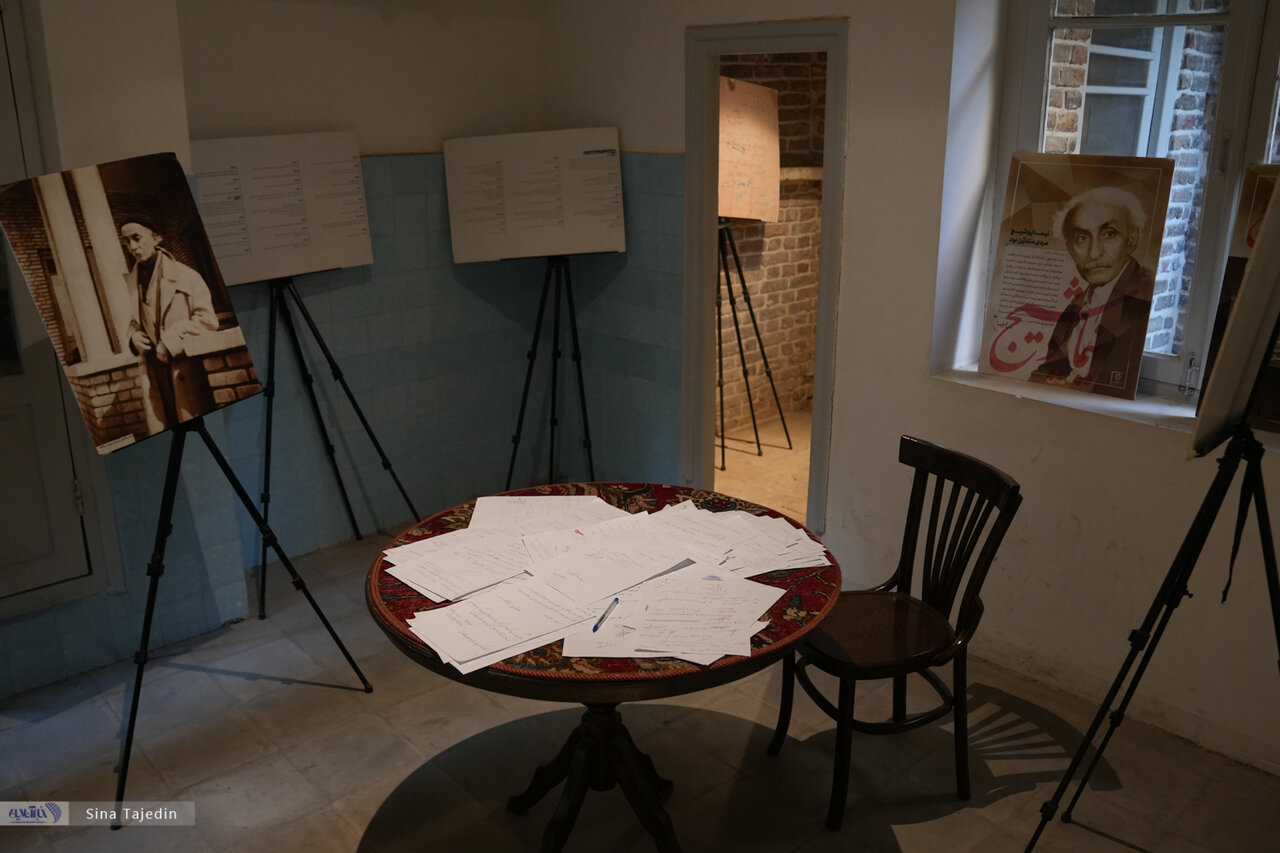
However, these days, according to Khabar Online’s reporter’s visit to this house-museum, its condition seems to be far from good. Upon entering the house, the first thing that catches your attention is the relatively empty and cold space. In one of the rooms that could have been the heart of the museum, there is a storage of papers and colorful balloons that completely overshadows the authenticity of the historical space. One of the fingers of Nima’s statue, seen at the entrance next to the statues of Simin Daneshvar and Jalal Al-e Ahmad, has broken off, and it appears that not only has no restoration been carried out, but there is no plan to address it. Of the main items in the house, only a table and a chair remain, on which some blank papers with visitors’ graffiti are left haphazardly. The house is so devoid of Nima’s personal belongings that it is impossible to tell whether even that table and chair truly belonged to Nima.
Relevant and irrelevant papers are attached to the walls, and even one of the announcements stuck to the walls dates back to April of the current year and has not yet been removed, which indicates that the house’s custodians do not pay sufficient attention to details. Overall, from the moment of entry, visitors can hardly feel that they have entered Nima Yooshij’s house. This is despite the fact that the essence of a house-museum is to preserve its old conditions along with caring for the deceased’s belongings and the house’s integrity. Something that is not felt at all in Nima Yooshij’s house, as if a shadow of coldness and decay has fallen upon the house.
Environmental Threats and Surrounding Constructions
One of the biggest concerns is the high-rise constructions that have taken place around and in front of the house. Buildings with many floors have dwarfed Nima’s house. This not only affects the view of the house but also eliminates the necessary overlap of that neighborhood due to the presence of the house-museum. This concern is similar to the situation that has occurred for the Simin Daneshvar and Jalal Al-e Ahmad House-Museum, less than 100 meters from Nima’s house, and will likely continue. Construction of a tall building is also underway in front of that house-museum. We will address this issue exclusively soon.
Visitor Experience and Lost Cultural Space
The house, which should be a place for visitors and enthusiasts of culture and literature, now resembles an empty gallery. Spaces that once were the birthplace of Nima’s poetry and thoughts have now lost their identity due to a lack of furnishings, neglect of restoration, and improper changes in use. The interconnected rooms and beautiful porch no longer tell a story of Nima’s life, and only scattered images of his life and works remain.
Need for Immediate Action
Nima Yooshij’s house requires immediate attention. Given the cultural and literary value of this house, it is essential that restorations are carried out properly and all spaces of the house are truly reconstructed as a museum and made ready for public visit. Preserving the authenticity of the building, protecting original works and belongings, and preventing inappropriate changes in use are among the most crucial necessary actions. Perhaps the most important question is: where are the original belongings of the house?
Nima Yooshij’s house, once the sanctuary of Iran’s great contemporary poet and a private gathering place for thought and poetry, now faces a lack of attention and environmental threats. Neglect of restoration, scarcity of original belongings, and threats from surrounding constructions could gradually erase this house from memory. To preserve this cultural treasure, cultural and heritage officials must act decisively and transform the house into a place where future generations can become closely acquainted with the life and works of Nima Yooshij.