Cooking in the Kremlin: Witold Szablowski’s New Book Explores Russian Power Through Food
The Literature Service of the Iranian Book News Agency (IBNA) – The first month of autumn 1405 in Safir Publishing was marked by the release of a new title in the “Silent Lines of History” series.
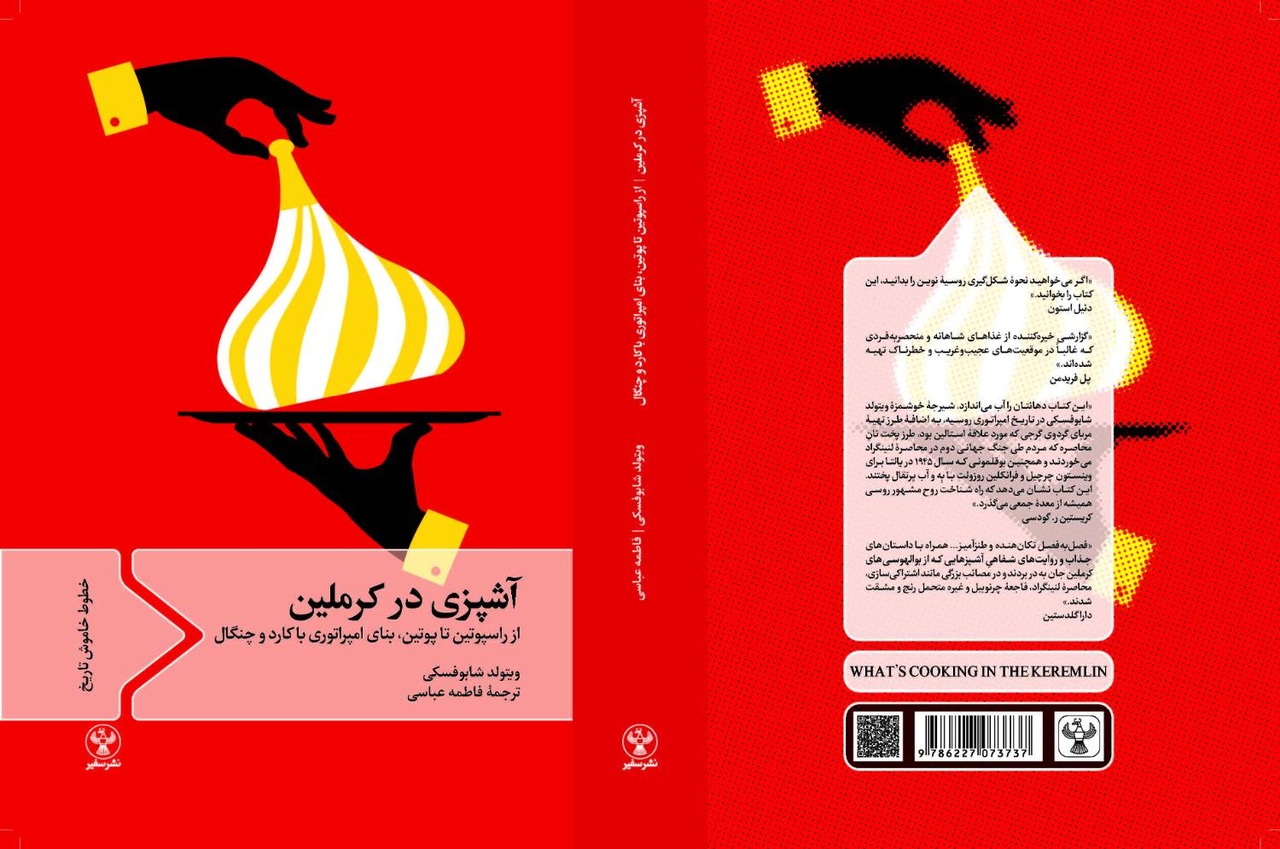
“Cooking in the Kremlin: From Rasputin to Putin, Building an Empire with Knife and Fork”, which is one of the recent works by the Polish author Witold Szabłowski, explores the relationship between the two seemingly unrelated categories of cooking and politics.
A subject that was also discussed and examined in the author’s previous book, published by Goman Publishing under the title “What They Ate: A History of Dictators Through the Stomach”.
Safir Publishing, focusing on the overlooked aspects of various historical narratives, has published the “Silent Lines of History” series, and so far, the books “Born in East Germany” and “Uncle Anwar’s Ballad” from this collection have been prepared and offered to audiences and history enthusiasts.
In explaining and introducing the book “Cooking in the Kremlin: From Rasputin to Putin, Building an Empire with Knife and Fork”, we must first introduce the young author of the book.
Witold Szabłowski is a Polish author, journalist, and reporter who pursued his education in the two fields of journalism and political science in Warsaw and Istanbul.
Living, studying, and working in Istanbul led Szabłowski to collaborate with the Turkish-language unit of CNN in Turkey, which provided him with extensive travel and exploration across that geographical and cultural region.
Subsequently, these work experiences paved the way for the young Szabłowski to return to Poland and begin his career at one of his homeland’s most well-known news networks.
This style of reporting and journalism took on a new form in April 2019, when Szabłowski continued his work at a radio station whose core theme was narrating life through his travels.
Delving into cases such as honor killings in Turkey, the failed assassination attempt on Pope John Paul II, the first interview with the Prime Minister of Burma, and of course her house arrest during a period of her life, drew even more attention and appreciation to Szabłowski from international institutions, earning him numerous awards in recognition of his work.
Szabłowski’s first book was published in 2010 with the English title The Assassin from Apricot City, winning the English PEN Award and the Beata Pawlak Award.
Two years later, with the article “Open That Road, You Bastards!”, he tackled a crucial issue: the migration of Albanian people to European Union countries following the collapse of communism in Europe and the closure of European borders to Albanians.
In order to fully fulfill his duty as a journalist, Szabłowski went through the unpleasant experience of crossing a border illegally, which helped bring the text of his article even closer to the lived reality of Albanian migrants.
During a trip to Cuba, Szablowski further analyzed the crisis of communism worldwide.
The result of this journey for Szablowski was experiencing life in Cuba alongside his wife and writing a book in the non-fiction genre.
Continuing his writing path, Szablowski authored Dancing Bears.
In this book as well, the policies of the European Union and the communist system came under severe critique by Szablowski. Naturally, the book also met with public acclaim and was nominated for Book of the Year in numerous polls and critics’ lists.
Following the publication of his other book in 2016, which focused its narrative and reportage on the massacre of his Polish compatriots, as well as a new edition of his first book, the author returned to his early profession. In an innovative move, he employed cooking and politics within an interdisciplinary framework as the subject matter of his pen.
The outcome of Szablowski’s work was two titles: How to Feed a Dictator and What They Ate in the Kremlin.
In these two works, Szablowski reached the pinnacle of his writing maturity, employing all his journalistic experiences and his sharp perspective on history and politics in the best possible way, combined with observations and field studies throughout both books.
The subject of the book What They Ate in the Kremlin is a pristine example of this exact kind of craftsmanship in the literary world.
Witold Szablowski, the renowned Polish author of this book, dedicated his youth to two different yet inseparable paths.
In his mid-twenties, after completing a culinary training course in Copenhagen, he turned seriously to journalism, and the quality of his valuable work over the course of two decades led to widespread acclaim from the international journalistic community, earning him awards such as the Ryszard Kapuściński Award, the European Parliament Journalism Prize, the Beata Pawlak Award, and the PEN English Award.
At the beginning of Cooking in the Kremlin, Szabłowski invites his reader on a turbulent journey into the heart of Russian history with these words: “The recipes in this book are provided strictly for these ingredients and cooking methods.
The publisher assumes no responsibility for allergies, health issues you may have that may require attention, and adverse reactions you might experience to the recipes, whether you prepare them as written in the book or modify them to suit your dietary needs or personal taste.” Cooking in the Kremlin is Szabłowski’s latest book, which hit the book market following the remarkable release and reception by audiences worldwide of his two previous titles, How to Feed a Dictator and Dancing Bears.
Cooking in the Kremlin: From Rasputin to Putin, Building an Empire with Knife and Fork, translated by Fatemeh Abbasi, has recently become available on bookstore shelves across the country.
The book “Remarkable Bookstore: A Memoir, A History” by Lewis Buzbee is a brilliant example of blending personal narratives and memoirs of the Californian author with the history of books and bookstores.
“Cooking in the Kremlin: From Rasputin to Putin, Building an Empire with Knife and Fork” by Witold Szabłowski, the Polish author and journalist, translated by Fatemeh Abbasi, has been published in the “Silent Lines of History” series by Safir Publishing and is now available in bookstores across the country.
Following the global success of “Dancing with Cucumbers: How Dictators Ate, Drank, and Ruled”, this book merges two seemingly unrelated categories—cooking and politics—and presents a fresh narrative of the history of power in Russia through recipes.
Ebrahim Heidari stated at the brainstorming meeting of institutions active in the field of children and young adults: “The Iran Book and Literature House, as a coordinating body among publishing trades, guilds, and policymaking institutions, is ready to provide facilities for operational projects of institutions active in the children and young adults’ sector.”
“Regime Change” can be read as more than just a book about Donald Trump; it is a work that attempts to examine the mechanisms of power in one of the world’s most important political systems.
Reading it provides an opportunity to distinguish between reported realities, the authors’ perceptions, and the potential consequences of political developments.
The book-signing event for “Nemat-e Jan” was held concurrently with Nurse’s Day at the Tehran Friday Prayers.
The scientific secretary of the 24th edition of the Sacred Defense and Resistance Book of the Year Award announced the extension of the deadline for submitting works to this literary event, stating: “Special attention to works related to the 12-Day War and the Ramadan War, the separation of the international and translation sections, and the expansion of support for selected works are among the most important programs of this edition.”
The director of “A Night in the Homeland” said: “This film is an adaptation of a Lebanese novel written by Ghadah al-Samman.”
While reading the novel, in the sixth story, I encountered an image that caught my attention: pulling up the basket of a person trapped in the battlefield.
This image became a fascinating motif for me, and I decided to use it as the basis for writing the screenplay.
The book “A Critical Reading of A Portrait of the Artist as a Young Man” written by David Seed, a professor at the University of Liverpool, translated by Manuchehr Badiei, has been released to the market.
The ceremony “A Conversation on Social History” will be held in collaboration with the House of History and Society, the Isfahan Studies Center, the House of Nations, and the Behar Book City.
The “White Authority” ceremony was held at the Golestan Cultural Center, coinciding with the auspicious birth anniversary of Hazrat Zeinab (PBUH) and Nurse’s Day, with the aim of honoring the memory of the three nurse martyrs of the 12-Day War: martyr Mahnaz Nemati, martyr Hooman Ghiasvand, and martyr Mahdiyar Pouryamin.
The book “Jam o Sabo”, containing the common manifestations of thought and expression in the poetry of Hafez and Shah Nimatullah Wali, has been published by Ostad Shahriar Publications.
“A Woman’s Cricket Chirp” possesses deeply charming and empathetic prose poetries that occasionally transcend poetic prose to become pure poetry itself, as seen in “My blue fantasy crossed the memory of the sea”.
文化的 Deputy for Cultural Affairs of the Ministry of Culture and Islamic Guidance commended Sara Zibadel, a bookseller at Sarv Gorgan Bookstore, who managed to achieve the rank of 33 in the nationwide university entrance exam while working at the bookstore.
Are these lost worlds merely plays of imagination, or do they preserve a part of historical truth within themselves?
“Nazaman” begins with this very question; in this book, Emmanuel Carrère is neither seeking to rewrite the past nor thinking of constructing an imaginary world.
What he explores is our very relationship with history; the long-standing belief that the past, having been realized once, is not only the past, but was also possible.
The managing director of Hezar-e Qoqnous Publications wrote about the changes and developments of the Frankfurt Book Fair 2026 on the occasion of its upcoming holding.
The “Mashq-e Zendegi” Book Club will hold its second meeting on Sunday afternoon, October 18, at the Sarv Cultural Center, focusing on the topic “The Book of Dos and Don’ts of Sex Education (from an Islamic Perspective)”.
The film opens with a quote from Oscar Wilde: “One should always be in love; that is the reason one should never marry.” Regardless of whether this statement is right or wrong, it outlines the overall situation of the two main characters as they face a shared life that has spanned many years.
What remains is a collection of failures and unfulfilled aspirations that seem to manifest themselves even more clearly in a shared life.
The book clearly fills the vacuum of political development texts in Iran.
Maryam Mosharaf, a researcher and professor at Shahid Beheshti University, noted the enduring status of Iranian literati in an interview with IBNA.
Hosted by the Scientific Association of Philosophy, a discussion meeting titled “What is Myth?” Will be held at Shahid Beheshti University.
Maryam Hosseini, a literary criticism researcher and text scholar, called Reza Seyed hosseini’s book “Literary Schools” the “cornerstone of literary schools in Iran,” stating: “No researcher in this field can produce a valuable work without studying it.” Praising Seyed hosseini’s mastery as a translator and his translations of Malraux, Sartre, Camus, and Balzac, she pointed out two shortcomings of the book: the absence of modernism and postmodernism, and the imbalance in the length of the chapters.
The book “Yadegar-e Nik” reflects part of the efforts of the Zoroastrian community in preserving the culture and history of Iran and Yazd, and demonstrates the cultural and social bond and alignment between the Zoroastrians and Muslims of Yazd.
“Yadegar-e Nik” reminds us of the memories, scents, flavors, sights, sounds, and names that once were and have now passed on.
Razavi Khorasan – Seyed Hossein Khadiyowjam, an author, translator, researcher, and scholar of Ghazali, had a deep passion for books, as he considered gaining access to the National Library of Iran and working as a librarian to be one of his dreams.
Ilam – The Director-General of Culture and Islamic Guidance of Ilam Province announced the submission of 135 book titles from the 8th Provincial Book of the Year Award to the Iran Book and Literature House for judging and evaluation.
Commemorating the centennial birth anniversary of the late translator and lexicographer “Reza Seyed Hosseini”, a ceremony was held on Tuesday, October 13, in collaboration with Soroush Publications at the Center for the Great Islamic Encyclopedia.
Mahshid Nonehali described him as “a world of love for the culture of this land”, Seyed Ali Al-e Davoud spoke of his collaboration on the “Dictionary of Works”, Mehdi Firouzan recalled meeting him at the 1364 Book Fair, and Ahmad Masjed-Jamei regarded him as the “child of suffering and humility”.
At the end, a documentary by Mehrdad Daftari was screened.
The book “From the Beginning to the End of Babylonian Civilization” is a narrative of a historical journey; from the birth of Babylon along the Euphrates to the era of powerful monarchs such as Hammurabi and Nebuchadnezzar II, from bloody battles with Elam and Assyria to its sudden conquest by Cyrus the Great.
Pirooz Mojtahedzadeh, a renowned figure in political geography and a prominent professor of Persian Gulf studies, passed away in London at the age of 81 following a period of illness.
Zanjan – The executive secretary of the 11th Zanjan Book Fair announced the extension of visiting hours until 22:00 on the final days of the exhibition, and praised the unprecedented turnout of citizens and cultural campaigns.
Lorestan – The Director-General of Public Libraries of Lorestan stated that a collection of 10,000 audiobook titles has been added to the resources of the blind section of the province’s central library.
Lorestan – Literary and cultural circles of Lorestan province commemorated Hafez Commemoration Day by holding diverse programs, including academic sessions and poetry nights, with a focus on honoring the Persian language and explaining his thoughts.
An evening session with Fereydoun Majlesi, on the occasion of the publication of the book “Negotiation in New York, Machiavelli in Isfahan” from the series of Roshan Afternoon sessions organized by Morvarid Publication, was held on Wednesday afternoon (October 13, 2026) at Badraghe Javidan Publication.
“The Blind Owl” is not one of those books that you can just read, close, and put aside.
Some novels stay in the mind after they are finished because they have told a good story or created a memorable character.
But The Blind Owl stays in a different way.
This book settles something in the reader, something akin to air, taste, darkness, and a kind of vague familiarity with a wound that may have already been inside a person, but had no name.
Fars – The book “Lari Coins; From the Persian Gulf to the Indian Ocean”, compiled, edited, and translated by Fatemeh Qamlaqi, was unveiled at the Larestan Pavilion in Expo 2026 Shiraz.
Kohgiluyeh and Boyer-Ahmad – Aftab Afredun, a writer from Dehdasht, believes that a major part of local writers, instead of analyzing the contradictions of power structures within the tribe, the tensions resulting from facing the transition period, and class divides, have turned to creating decorative and postcard-like images of the past.
Zanjan – Following the warm welcome from various segments of the public for the 11th Zanjan Book Fair, the executive secretary of this event announced an extension of visiting hours on Friday and a one-day extension of the fair until the end of Saturday.
“Doctor Zhivago” by Boris Pasternak and its cinematic adaptation directed by David Lean are considered among the most prominent examples of the intersection of literature, history, and cinema in the 20th century.
This work, beyond being a romantic narrative set against the backdrop of the Russian revolution, reflects a fundamental question: the destiny of the individual and personal ethics in a world overshadowed by history and ideology.
Professor Prigarina has received numerous international awards and medals from Pakistan, India, and Iran, among which are the gold medal for the best Persian language professor awarded by the Iranian government before the Islamic Revolution and the World Book Award of the Islamic Republic of Iran for her translation of the Masnavi in 2010.
“The Street That No One Falls in Love With Anymore: A Narrative of Javad Mojabi”; a poet who wrote for twenty years without being published.
From “My Former Shahreza Street” and the hangouts of a lifetime to dust-covered novels that spent years awaiting publication permits.
A note about a city that has left its youth behind, and a pen that, despite all constraints, never stopped writing and lived writing.
Khuzestan – The book “Ramhormoz in the Qajar Era” by Meysam Kazemi Far has been published by Tarikh Andish Publications.
During a meeting of the academic board for the 19th Jalal Al-e Ahmad Literary Award, the CEO of the Iran Book and Literature House spoke about the necessity of maintaining the award’s credibility, stating: One of the ways to uphold the brand credibility of this award is that if the jury panel does not find a worthy and prominent work in one of the categories, they should not feel obliged to introduce a selected work.
منبع: IBNA (FA)
#printed_in_iran #international_publication #printing #publishing #books #iran #persian #Witold_Szablowski #Fatemeh_Abbasi #Safir_Publishing #Political_Systems #Historical_Fiction