Goethe and the unending question of how to live
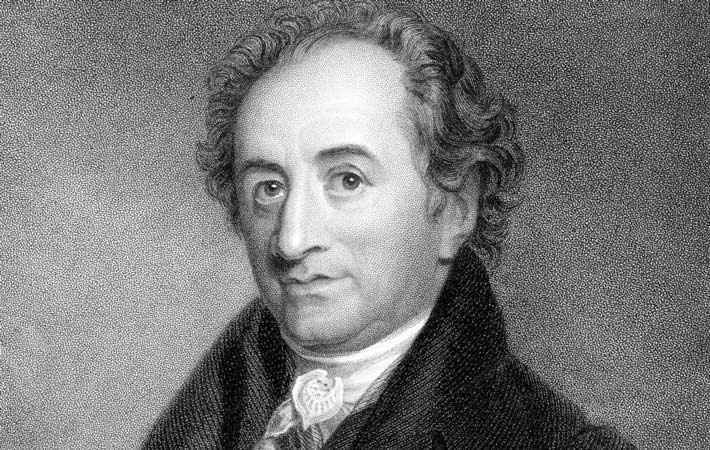
According to the Iran Book News Agency (IBNA) citing The New Yorker, among the brilliant names in world literature, Goethe has always been an exceptional figure; not only because of the volume of his works or the breadth of the fields he engaged with, but because his life and thought represent a rare example of a constant effort to understand how to live. Merve Emre, a Turkish-American author and scholar, presents a vivid and layered portrait of Goethe in her article: a poet who constantly oscillates between politics and art, body and soul, nature and culture, creating from this oscillation a kind of “unusual compromise”; a compromise that transforms his art into a world-shaping force.
1. Goethe: Life as an Era
One of the main appeals of Emre’s reading is her emphasis on Goethe’s inseparable relationship with his time. Goethe is not only the writer of his era, but its form-giver; so much so that the concept of the “Age of Goethe” has been ingrained in European cultural history for years. Emre demonstrates how a life can be understood as a historical system: from “Götz von Berlichingen,” which captures the spirit of Germany on the cusp of the modern era, to “Werther,” which ruthlessly exposes the oversensitive psychology of the eighteenth century.
In this portrayal, Goethe is not a one-sided figure; rather, he is a kind of centrifugal force who simultaneously enforces courtly law and secretly takes refuge in corporeality, lust, passion, and poetic disobedience.
2. Writing as the Recreation of Life
A central quote from “Poetry and Truth” resonates in Emre’s text: “We constantly recreate our entire lives.” This sentence not only anticipates a form of autobiography but also clarifies Goethe’s method of literary creation. He views life as raw material, but not in the manner of Romantic confessions; rather, with a kind of artistic distancing that transforms personal experience into the structural expression of an age.
From this perspective, Werther is no longer just a desperate lover; he is the connection point between Romantic individuality and the rigid structures of modern society. Werther’s tragedy is the transformed failure of the “self” when faced with a world whose order does not allow for the full expression of emotion.
3. Body, Objects, Nature: Goethe’s Late Renaissance
The sections concerning his journey to Italy, which Emre shrewdly narrates, are among the most prominent points of our understanding of Goethe: the discovery of the body, the discovery of light, the discovery of organic forms, and the connection between sensory experience and aesthetic judgment. “Roman Elegies” are lessons in perception, physical exercises in seeing. In this experience, Goethe touches a new “octave” of the world: a world where body and mind operate in the same orbit.
This part of Emre’s article views Goethe not as an arid intellectual or someone buried in government paperwork, but as a human being who is constantly vibrating and fluctuating between nature and politics, pleasure and duty.
4. Constructive Contradictions: Between Revolution and Conservatism
One of the outstanding points of Emre’s analysis is her attention to Goethe’s apparent contradictions. The man who wrote “Werther” in praise of emotional release is also a herald of order in politics and prefers “tyranny over chaos.” But Emre sees this contradiction not as a sign of weakness, but as a clear example of the modern intellectual tradition: the possibility for an individual to find refuge in form, order, and structure in the face of historical chaos.
Here, Goethe resembles a figure who already sensed the struggle of the modern era: the struggle between the desire for absolute freedom and the fear of the collapse of social foundations.
5. Why is Goethe Still Important?
Emre’s article implicitly answers this question: Goethe is special because he understands life not as a one-time narrative, but as a fluid and recreative process. He is an artist who is simultaneously a historian, scientist, statesman, lover, and thinker; a person who employs all possible tools—from the microscope to the weight of poetry—to understand the world.
In an age where lived experience is fragmented and broken up through social media, Goethe reminds us that living and creating both require an inner order; an order that rises from within chaos, not apart from it.





