The latest novel by Shams Langroudi was reviewed and criticized.
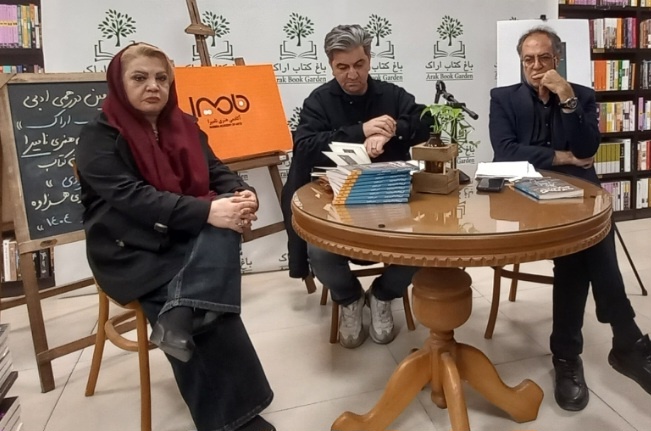
According to the correspondent of the Iran Book News Agency (IBNA) in Arak, Reza Mahdavi Hazaveh, in a special literary session reviewing the works of Shams Langroudi, referred to the entry of this poet and writer into the world of literature, stating: “Shams Langroudi initially submitted stories inspired by Alfred Hitchcock’s style to Ettela’at Haftegi magazine; stories that were not published, but this experience was his serious starting point in literature, and he later entered the fields of poetry and novel writing.”
Features of the Novel “I’m Going to the Concert”
He explained about Langroudi’s new novel titled “I’m Going to the Concert”: “This work is the third novel by this poet and writer, and one of its features is a surprising ending whose details cannot be revealed. Langroudi, unlike ‘plot-driven’ enthusiasts, emphasizes a specific ending, and this novel is written in the same vein.”
Mahdavi Hazaveh, referring to the process of the work’s formation, stated: “Langroudi began this novel in an intuitive space and has said that he didn’t know which direction it would take until halfway through. This approach, writing without an initial map, is a style that some writers dislike, but he ultimately brought the narrative to coherence.”
According to Mahdavi Hazaveh, the novel “I’m Going to the Concert” bears signs of the author’s personal life. The character Morad, with his bitterness, loneliness, and frustrations, contains traces of Langroudi’s lived experience. Even parts of the narrative, such as the description of time in prison, are derived from the author’s real experience; an experience he later referred to in an interview.
Shams Langroudi’s Intellectual Evolution
He continued: “For years, Langroudi believed that poetry could change the world, but at the age of 53, he reached a point of intellectual transformation. The publication of the collection ’53 Love Songs’ marked the beginning of his return inward and a kind of Khayyam-like view of life; a view that seeks truth not externally, but in an honest confrontation with oneself.”
Mahdavi said: “To understand Shams Langroudi’s intellectual world, it should be noted that he always emphasizes finding meaning in the heart of crises; the same meaning that, in his own words, everyone must seek in their ‘inner Auschwitz’.”
The World of Shams Langroudi: A Fusion of Simplicity, Sorrow, and Stubborn Hope
Faramarz Ahmari, a poet from the province, also provided a brief overview of Shams Langroudi’s life and career at this gathering, stating: “Shams Langroudi, born on November 17, 1950, in Langroud, began his professional activity with poetry in the 1970s and later gained a special position in contemporary literature with works such as ‘Analytical History of New Poetry’ and numerous poetry collections.”
He then, referring to Langroudi’s inclination towards simplicity in language, added: “Both in poetry and in fiction, his language is unadorned, colloquial, and straightforward. Critics like Reza Baraheni have criticized this simplicity, but there are elements in Langroudi’s spoken poetry that justify this choice; including concise imagery, bitter humor, and controlled emotion.”
Ahmari, emphasizing Langroudi’s departure from traditionalism, said: “In most of his works, a serious effort to move away from ancient literature and towards a modern perspective is seen. From Forough onward, our poetry has moved towards objectivism, and Langroudi is a continuation of this path.”
He spoke about the emotional and aesthetic components in Langroudi’s works: “In his poetry, there is a combination of sorrow, stubborn hope, and a kind of hidden music; music that is detectable even in simple and colloquial language. This simultaneous despair and hope is part of his poetic world.”
Ahmari, by reading examples of Langroudi’s poems, including images of rain, waiting, and loneliness, said: “Shams’s poetry is the narrative of contemporary man; a man between tradition and the modern world, caught in anxiety but still hopeful.”
He concluded by emphasizing: “Every poet has their own fingerprint, and in Langroudi’s poetry, this fingerprint is the mixture of love, sorrow, and hope that does not torment the audience but accompanies them.”
Discussion about the Fourth Book Garden Literary Session and Shams Langroudi’s New Novel
Reza Mahdavi, a writer and literary critic, also added about this session: “This book is Shams Langroudi’s third novel and narrates the story of a character named Morad; an individual who is engaged in conflicts with his father and the traditions around him, reflecting these challenges in the form of personal notes and narratives from childhood to adulthood.”
In response to a question about his recent activities, Mahdavi said: “I have recently published a book titled ‘I Wish the Days Were Night,’ which is a collection of seven narratives about the traditional market of Arak. These narratives were written by my students, and I prepared its introduction. The book has been published by ‘Dade’ publishing in Arak, but it has not yet been publicly introduced, and its unveiling ceremony will be held soon.”
A section of the book “I’m Going to the Concert” that was read at this session: “…When mother left, Zari became like a beheaded chicken, restless and unsettled; she would go to the window, pull back the curtain, look at the gate, and return to her place. We saw her eyes were red. Mother had nowhere to go. Her family lived in a distant city. Never had any guest, except very formal ones, stepped into our house. An hour passed, no news of mother. It was autumn. The air was getting cold. Where had mother gone? Our worry increased moment by moment. We didn’t know how to light the heater. The quilt-mattress was heavy, and we couldn’t pull it out of the closet. It was about eleven at night. Where could mother have gone? I got up. I opened the closet door. Such a biting cold burst out as if it had wings and was alive. I was thirsty. As I went to the kitchen, I saw my mother’s shadow, as if she was standing in the kitchen asking: ‘What are you looking for, Morad?’ We were afraid to go downstairs and pick up the water pitcher. Only the occasional sound of people passing in the alley reduced our worry and fear. From the hall, looking at the dark yard, I saw hordes of spirits and genies dancing and celebrating the emptying of the house. Zari was huddled in a corner of the room under a blanket, and I could hear her sorrowful breaths. I had picked up my instrument. I looked at it, but my hands and heart offered no help.
From that very childhood, there is always something to make you suffer. Later, I understood that some are defeated by suffering, while others learn from suffering and grow stronger. The importance of suffering is for this second group. Too much suffering numbs a person. Feelings and imaginations fade, and you become part of objects. We shed our skin in calamities and suffering, living anew with thicker skin until we officially turn into rhinoceros-like humans. And I was of the second type. I had suffered, I had become strong, but what good is strength in a place where life is stronger than you? …”





