Books Painted in the Heart of ‘Homian’ / Whispers of Stories on the School Wall
Iran Book News Agency (IBNA) Provincial Services: In the heart of Sarab Homian village, part of Kouhdasht county in Lorestan province, Ayatollah Dastgheib boarding school, with its plain walls, was waiting for color and life. This school is not just a place for education; it is also considered the second home for students, a place where its dormitory and cafeteria host teenagers every day who seek their future among books and lessons.
In this very space, art came to the aid of education; mural painting, as a vibrant and influential medium, transformed the school walls into a large canvas narrating Iranian culture, literature, and identity. These designs not only create beauty but also, through a smart selection of books and authors, connect students’ minds to the world of reading and imagination.
Reihaneh Karimian, an artist who has been active for years in illustration, caricature, and mural painting, has this time, inspired by Iranian literary works and national authors’ faces, turned the school walls into a cultural gallery. Along with a team of artists known as “Rural Wall Painters,” she managed to transform this region’s nomadic school into an inspiring and pleasant space for students; a space where every image plants a new question in teenagers’ minds and encourages them to discover books and get acquainted with authors.
Next, you can read IBNA’s interview with Reihaneh Karimian; an artist who has turned the walls of this nomadic school into a window to the world of literature and culture.
What prompted you to draw inspiration from Iranian books and authors’ names for the murals?
This project was for a nomadic boys’ boarding high school with a humanities major, which had dormitories and a cafeteria. The plan was to execute designs for the cafeteria and school hallways. My concern was that the designs should be appropriate for the students’ age group and that the cafeteria space should not become exaggerated and resemble fast-food restaurants.
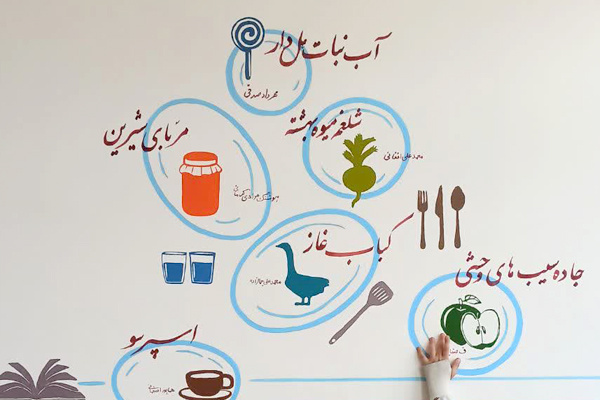
I designed the main cafeteria wall inspired by books with food-related names; it’s as if each book is placed inside a dish, reminiscent of the phrase “books are food for the soul.” Of course, this phrase wasn’t in my mind during the design process, and later a friend pointed it out, which was perfectly apt. The two blue lines below the images also symbolize lined notebooks; the very notebooks with which we all began writing in Persian.
For the hallway walls, I chose the faces of national authors and dedicated one design to Lorestan celebrities.
Where did the initial spark for this design come from? Did personal reading experience or a specific memory play a role?
Yes, exactly. I searched through my memories; when thinking about designing the cafeteria, the first spark was the book “Turnip, the Fruit of Paradise” by Mohammad Ali Afghani, which I had read before. Then I remembered “Cardamom Candy,” which I had recently seen in my father’s hand, then “Goose Kebab,” which we read during school, and finally “The Art of Cooking,” which I had in my own kitchen. This mental collection formed the basis of the design, and I searched for and added other books.
How do you select rural schools? Are only rural schools considered?
For several years, a group called “Rural Wall Painters” has been formed by Mr. Khoshjam. The goal of this group is to beautify deprived schools across the country and to create interest in school and education among students. Many prominent illustrators in the country volunteer; some in design and some in execution. This time, I had the honor of both designing and being part of the execution team. Of course, I wasn’t alone; Ms. Dehghani, the project’s executive manager, designed part of the walls with the theme of caves and the schoolyard, and a team of about 20 people completed the work.
Usually, schools themselves apply, and after review by the management and the “Rural Wall Painters” team, these schools are selected.
Why did you choose the wall as your canvas and not other media like painting canvas or digital art?
Although I also work on painting canvases and in digital spaces, this time, due to the school’s need, the design had to be executed on the wall. First, I prepared the design digitally, and then it was implemented on the wall. Mural painting is a part of visual arts that has a profound impact, especially in schools. Students encounter these images every day; even if they don’t look closely, they are seeing them. Therefore, the designs should enhance students’ visual literacy, create a sense of security and calm, and make the school a pleasant environment, without creating visual clutter.
How were the books and authors selected? Did you have specific criteria, or was it mostly based on personal interest?
For the cafeteria wall, books with food-related names were chosen. In the hallways, I depicted the faces of Iranian celebrities. For example, Houshang Moradi Kermani was selected due to his numerous works related to teenagers.
Which author or book has influenced you the most and why?
Among Iranian authors, Houshang Moradi Kermani has been very instructive for me with his personal life and the tenderness of his stories. Among foreign authors, I am interested in the works of Haruki Murakami because of his unparalleled imagination and the different world he creates.
What role do you think mural painting plays in introducing literary works to the younger generation?
Mural painting can make the younger generation interested in literary works; it can create questions and curiosity and encourage them to read. For example, in a project in Isfahan schools with a book theme, an image of a book with large headphones was designed, referring to an audiobook, and students would jump on it like a trampoline.
When you choose the name or content of a book, how do you translate it into an image?
In design, I try to creatively depict the most attractive point of the subject with defamiliarization to engage the viewer with the topic.
Did you face any challenges in executing mural paintings with the theme of books?
Yes, I had worked with the theme of books before, but this time the challenge was greater. I wanted the design to be creative, delicate, and at the same time profound, without occupying too much space. I believe that in rural schools located in the heart of pristine nature, one should not overstate; therefore, I used minimal lines and colored silhouettes.
Have you received any reactions from people, students, or the authors of the works to these paintings so far?
Yes, the feedback was very positive; both from the school staff and management, and students, as well as from the authors. For example, Mehrdad Sedghi, the author of “Cardamom Candy,” saw the design and shared it on his story with interesting comments. Mr. Sedghi also obtained the school’s address to send his signed book to the children, and Mr. Valizadeh, the deputy of the Art Bureau’s satire office, is also scheduled to send books to the students of this school.
What impact do you think these works have on the urban environment and the cultural identity of schools? Was your goal merely beautification, or did you want to convey a deeper message?
In my opinion, school paintings should go beyond beautification and incorporate education within them; creative and subtle education. Direct educational design makes students bored, and purely decorative designs are ineffective. A creative design should be layered; students should discover something new each time they see it.
If you were to continue the project, which authors or books would you like to explore?
I would like to work with the theme of books again. Although I don’t have a specific idea now, a long list of domestic and foreign authors and poets comes to my mind.
How do you see the future of this project; becoming a cultural movement or remaining an experience?
If a work influences people, it will turn into a cultural movement. Painting in rural schools is a popular and valuable movement, and combining it with the theme of books and culture has great potential. For example, in this short period, a nomadic girls’ high school also requested a design, and its management welcomed the idea of books and authors. Some school designs that are in harmony with the region’s climate are so strong that a book series can be produced from them. Therefore, I am very optimistic about the future of this project.