The Quiet Friendship of Books with Children Who See the World Differently
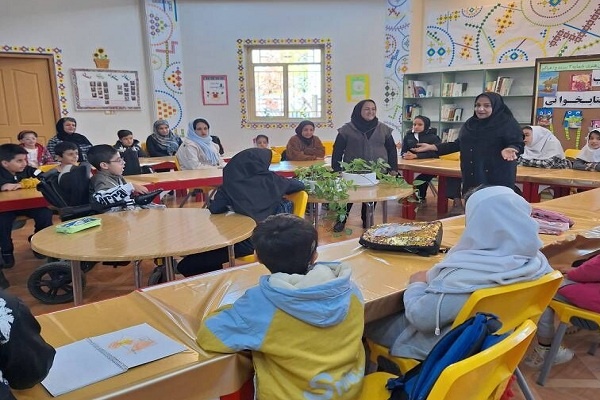
IBNA Provincial Service: Recently, cultural and artistic centers No. 1 and 3 of the Sanandaj Institute for the Intellectual Development of Children and Young Adults, in collaboration with the ‘Tawakkol’ Special School and the Saqqez Cultural and Artistic Institute, took on a special character with the presence of children with special needs. Children with low vision, hearing impairment, intellectual, physical, and motor disabilities, accompanied by their instructors and families, entered a space where every corner was designed and adapted for them.
A festival titled ‘Friendship with Books’ was held, adapted for children with special needs, aiming to create a joyful, safe, and empowering environment for them.
Interactive storytelling was the first part of the festival; instructors used picture cards, tactile books, finger puppets, and tangible objects to narrate stories so that each child could connect with the narrative according to their abilities. For children with low vision, tactile versions and verbal descriptions of images were provided, ensuring a tangible and profound storytelling experience.
Following this, a short creative performance was presented by the instructors; simple movements, vibrant colors, and an easily understandable narrative for all children led to greater participation and continuous smiles. In the art and creativity workshop, children created paintings and collages using adapted tools such as thick pencil grips, finger paint, and soft dough, focusing their works on the theme ‘My Favorite Book.’ Instructors were present with the children at all times to ensure their creativity was not limited and they could experiment freely.
The book introduction section featured a collection of tactile, embossed, audio, and large-print books, and instructors provided explanations on selecting appropriate books for children with special needs. Additionally, a short screening of animations ‘The Farmer Robot’ and ‘Lili Hawzak’ created an engaging visual and auditory experience for the children.
The presence of parents at the festival provided a valuable opportunity to observe children’s interactions and learn methods to encourage them to read, allowing families to become familiar with storytelling techniques and the importance of books in empowering their children.
The festival organizers emphasize that ‘Friendship with Books’ was more than just a cultural program; it created a joyful and supportive environment where children with special needs were not merely recipients but active, creative, and impactful participants. This event demonstrated that with creative methods and attention to individual differences, a culture of reading can be made accessible, enjoyable, and equitable for all children.
This year’s festival marked the end of a special day, but the beginning of a new path for cultural development and empowerment of children with special needs; a place where books are no longer just turned pages but transform into works and human experiences in the hands of children.
Based on similar experiences in other cities of the province, the Saqqez Institute for the Intellectual Development of Children and Young Adults has also held workshops focused on storytelling and artistic activities specifically for children with special needs. These programs have been welcomed by families and seen active participation from instructors, indicating that children’s interest in books and cultural activities is not limited to one center or city but can be extended across the province. Observing children’s interactions and their tangible experiences in these workshops is testament to the effectiveness of such programs in strengthening children’s social skills, self-confidence, and creativity.
This festival demonstrated that with precise planning and attention to individual differences, a reading culture can be transformed into an inclusive and accessible experience for all children. The active participation of children and positive feedback from families and instructors attested to the event’s success and proved that adapting cultural activities not only removes limitations but also fosters children’s creativity, self-confidence, and capabilities. Instructors and parents, by observing the children’s participation and joy, realized that even small activities can have profound effects on their social and emotional development and create lasting experiences in their minds.
Based on the experience of holding this festival in Sanandaj and Saqqez, the possibility of expanding such programs to other cities in Kurdistan province is also available, indicating that interest in books and cultural activities for children with special needs is not limited to one center or city. These achievements carry an important message for cultural policymakers and center managers: investing in accessible and creative programs can lay the groundwork for nurturing an empathetic, creative, and self-confident generation that experiences the value of books and cultural activities from childhood.





