Sharafi Khaboushan: The duty of literature is to influence, not to retell history
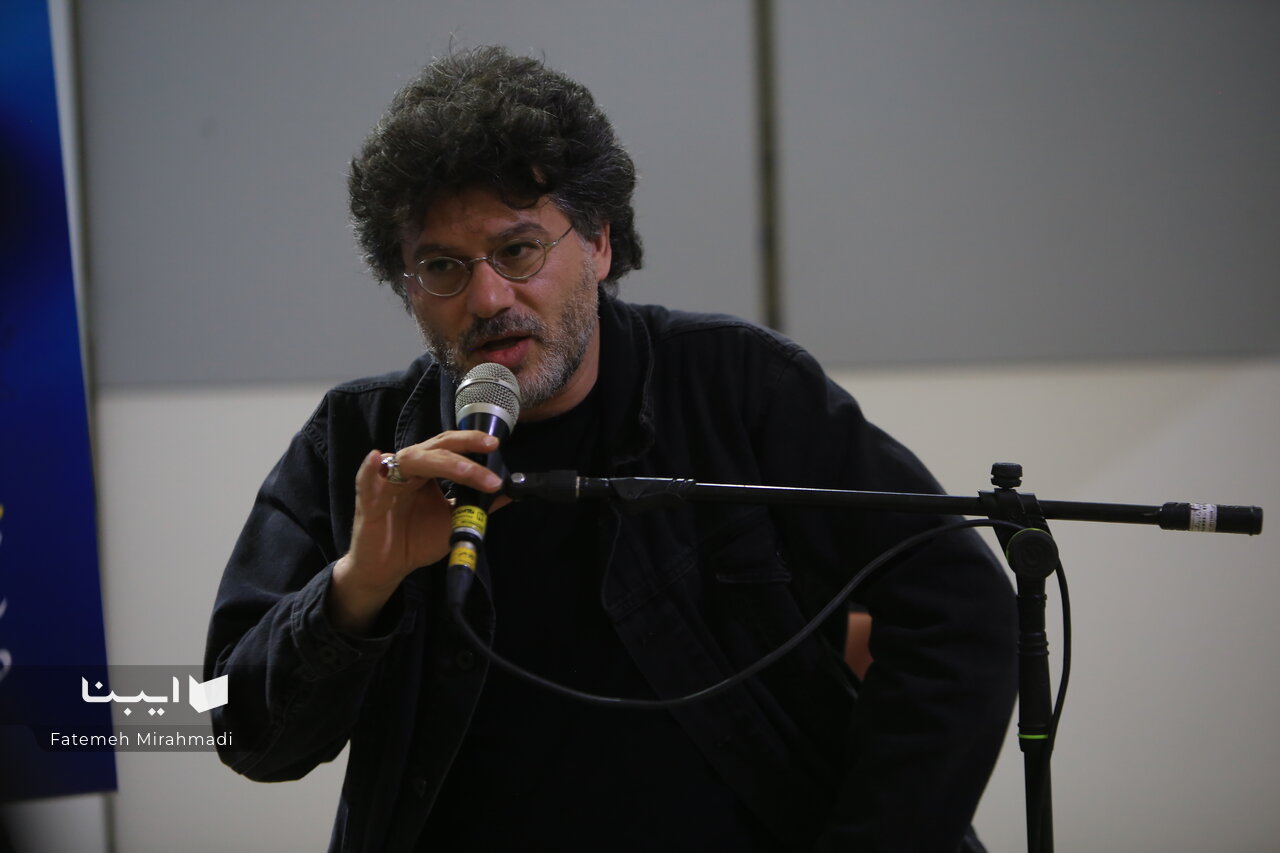
According to the correspondent of Iran Book News Agency (IBNA), Sobhan Kiani: The ‘Oral History and Story: Strengthening or Weakening War Literature’ session, part of a series on the problematization of fictional literature, was held by the Office of Fictional Literature of the Art Bureau at Somayeh Book Cafe. Mohammadreza Sharafi Khaboushan, a writer, and Ahmad Shakeri, a critic, were the guests of this program.
Mohammad Hadi Abdulvahab said at the beginning of the session: Oral history is a type of research known as oral history. Its method involves collecting information from individuals present at an event, and naturally, a research method cannot be referred to as a work of art, although it has equivalents. This will be an introduction to the discussion.
Mohammad Ghaemkhani, referring to the narration of war events in the form of a novel, said: Our issue, as activists involved in producing texts about the war, is whether we have been able or can narrate in such a way that the Iranian audience sees themselves in these narratives, just as they experienced the war? Do they see and feel that it is what they lived through? Such a big question certainly doesn’t have one answer and is full of assumptions and issues. A large number of writers believe that we are at a critical point and have shortcomings. The topic I arrived at in previous discussions was the style and type of writing. It was from this perspective that we decided to address this gap in today’s session. Is the apparent crisis in the narration of the eight-year war, which we believe has not been narrated as it should, one on which there is consensus? One theory suggests the crisis stems from the novel’s inability to express other aspects of contemporary Iran, while another believes this crisis is not inherent to literature but rather a matter of cultural management.
What is the Issue?
Ahmad Shakeri, as the next speaker, said: The first thing that is very interesting and attractive to me is the scholarly choice of the title ‘Problematology’. After several decades, we are looking for issues in war literature, but in reality, that is not the issue; some of us are looking for difficulties in practical realms that have not yet become issues. What you have done is not problematology and research; it is below that, meaning we state problems and answer them. I have several studies on this, one of which is a problem-based study on war fiction literature that attempts to explain and describe the problem ecosystem or system of problems in the field of war. Another area related to your discussion is trend analysis, which is very important. We have two studies in this regard, the first of which is literary trends. You cannot examine issues on a case-by-case basis because individual cases only become issues when they turn into a general attraction and trend. Unfortunately, the title of your sessions has not been chosen precisely because it has no relation to problematology.
He further added: If we are looking for problematology, we must see what problematology is and what some of its axioms are. Your general title encompasses hundreds of issues. I will name a few points that are the framework for understanding an issue to help us find answers: 1. What is an issue? Are we facing a question or an issue? 2. In what domain is an issue recognized? 3. When has it been an issue? 4. The next topic is the multiplicity of issues. 5. Is the issue mono-disciplinary or interdisciplinary? 6. Classification of issues based on their type? 7. What system governs the structure and geometry of issues? 8. What is the logic of issues? 9. What prioritization system do issues follow? 10. What is the distinction and difference between real issues and perceived issues? 11. The difference between issues in the realm of action and theory? 12. Understanding the evolution of an issue over time? 13. The standard for evaluating an issue? 14. Which issues are authentic and which are secondary? 15. Who are the problem-holders? 16. Who is qualified to answer? Reflection on these topics can lead us into problematology.
This literary critic stated: One of the things we must do is adopt a research-oriented approach to our narrative of issues. It seems we are facing and dealing with a whole. I am someone who has addressed the fictional literature of the Sacred Defense and tried to systematize it. We cannot reach some concepts unless their status is clarified. The problem we face is a methodological one. If we want to solve the problem, we must adhere to its prerequisites. You are faced with a plethora of unscientific common beliefs that lack proper data and method. We should not minimize our expectations from problem formulation and its solution. Dialogue is not a suitable method for obtaining data. The novel creates a world, and realistic novels are reproducible. Conceptualizing keywords is necessary. The difference between oral history and memoir is that memoir is a narrative by oneself, about oneself, and for oneself, while oral history is not a narrative by one individual about one individual.
Let’s Expect Nothing from Literature Except Literature
Mohammadreza Sharafi Khaboushan said: For me, dialogue itself is valuable because the speaker can express their thoughts and speak for or against what they believe. I have written in the field of authorship, specifically in fiction and memoir writing; books have been published by me where I have interviewed and recorded memoirs of those who went to war, or elsewhere, I have written stories about the war to show their mutual impact. One of the things I have also done is historical activities, where, due to a lack of books, I referred to documents and writings from the Qajar era. In my mind, I was comparing the writings of the Qajar era with the fictional literature that emerged after the revolution.
He further stated: I realized how much a writer can utilize memoirs and written sources in creating their stories. This utilization differs in every era. Our perspective on recording memoirs and oral literature should be literary, not historical. When we have this perspective, our expectations will also be different. We can have a special view on oral literature and the creation of memoir-writing. We should consider it a distinct movement that has no precedent in our country’s literary history, and we are facing a new phenomenon after the revolution. We tried to use micro-narratives and detailed descriptions for the benefit of influencing the audience in narration. We knew that in the new era, given advancements, history records events in its own way; we should not worry about confusing history because it is busy performing its duty in its own sector. Therefore, these two should not be compared, and their mutual influence should not be raised as an issue or concern. Let’s leave the historical part to the science of history and distinguish these two. In my opinion, it is better to categorize anything in oral history that aims to influence the general audience as literature.
This writer stated: The ultimate goal of these kinds of works is impact, and writers exert all their efforts to use literary devices that create this impact. I do not believe in a crisis. What should be the national understanding of war? Every country believes that every audience, when reading works, should know what heroes it has had and what deeds it has performed. Every literary text presents its own point of view regarding the war, and the audience does not approach literature expecting to see historical reality. When history is properly recorded, even if literature uses distortion or imagination, no harm is done to historical truth; because each has its independent function. When new narratives emerge in a country’s literary flow, the novel should indeed benefit from them, not think of them as rivals. The reason for the novel’s survival is that it uses every narrative because we do not have a definitive genre for the novel. I consider the flow of oral literature and this diversity of narratives as a blossoming, a phenomenon, and a new achievement. This amount of attention paid to popular readings of war is unparalleled. The more diverse the discourses and readings, the more it enhances the writer’s creativity.
Khaboushan concluded by saying: We must ask what our expectation is from a novel or fictional literature. If we answer our questions about what we expect from literature, we realize that I don’t go for a novel just to read a genre of literature, but also to enjoy the process of a story and consider different interpretations. If we set aside assumptions, many issues become clear. There is a contract between me and the text I approach. What we have after the revolution in expressing the history of the Sacred Defense is the author’s intervention in oral history. I do not consider this detrimental to literature, provided we view this issue from a literary perspective. We are rushing to judge the position of Sacred Defense fictional literature. We are writers who find ourselves in a new event every day. We didn’t ask ourselves whether perhaps this kind of literature can narrate this nation. Why are we seeking comparison? These events require different narrators. I believe there is a magnificent outlook before our novel writing.





