Illustrated Story ‘K-Pop Hunters’ by Netflix
According to the Iran Book News Agency (IBNA), quoting from Briokarten, Netflix has provided an opportunity for fans of the successful film “K-Pop Hunters” to delve into the creative heart of this work and see the behind-the-scenes formation of its world in very complete detail. In a joint collaboration with Nucleus Publishing, a printed and illustrated version of the book will be released to the book market in America and Europe starting in the new year.
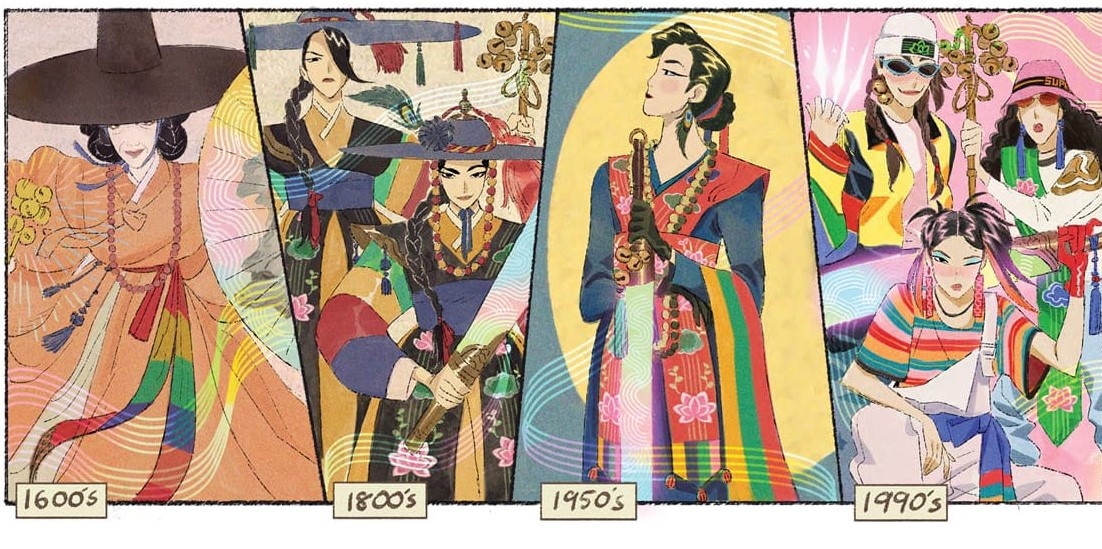
This 142-page book is a compact and multimedia collection; a combination of a pictorial encyclopedia, a guide to Korean culture, production notes, and narratives on the formation process of the characters and the film’s world. The illustrated book offers something more complete and complex than what could fit into the film’s 95-minute runtime, including research on mythical demons, initial character designs, directors’ narratives, and even analyses of K-Pop dance compositions.
The film’s co-director, Maggie Kang, explains in the book that the roots of the work began with a personal desire: an honest and joyful portrayal of Korean identity in Western animation.
She says: “Since childhood, I watched films about other Asian cultures, but there was less representation of Korean culture in animation. I don’t know why, but mythology was the first thing that came to my mind. Jeoseung Saja (death angels in Korean mythology) were always a lasting image from my childhood, and thinking about demons quickly led me to demon hunters. I wanted to create superhero girls who were more real; girls whose eating and acting silly were also part of their personality… not just beautiful and cool, but with real insecurities.”
This combination of honesty and mischief, mythology and the vibrant energy of a K-Pop music video, is seen throughout the book. The production team emphasizes that they did not create the film as a humorous imitation of celebrity culture but rather as a tribute to the cultural power of K-Pop; a local yet global phenomenon.
Chris Appelhans, the other director of the film, says: “What’s amazing about K-Pop in today’s world is that it unites people; with great kindness and empathy. It transcends all borders. To be able to create a myth that connects with the truth of what this music does was very powerful for us.”
The character analysis section also goes beyond what is seen in the film. Appelhans writes about the main character, Rumi: “There are parts within you that you might not like, or thoughts you might wish had never crossed your mind. These things can consume you and turn you into a worse version… or they can make you stronger.” This focus on vulnerability behind appearances reinforces one of the film’s central messages: behind the makeup, behind the fame, behind the on-stage personas, these girls are still discovering themselves and the powers they want or don’t want to use.
Another section of the book is dedicated to the design of the character Jino, the charming anti-hero of the film; where character designer Scott Watanabe explains how he tried to recreate the “definition of charm” in an accessible format while remaining faithful to K-Pop aesthetics. According to him, the main challenge was designing a bad boy who still retained the “puppy sweetness” of K-Pop. “Jino had to live in two worlds — how bad could he be, and how much of that innocence and cute charm still needed to be preserved.”
Throughout the book, from production notes and space design keys to costume portfolios, traditional weapons, mythology diagrams, and research on K-Pop dance, a significant volume of research and cultural understanding is displayed. Almost every frame of the film is the product of careful examination of elements of Korean culture, Seoul street style, and mythological traditions.