Sarhangi’s Account: Haj Qasem’s Life from a Different Perspective
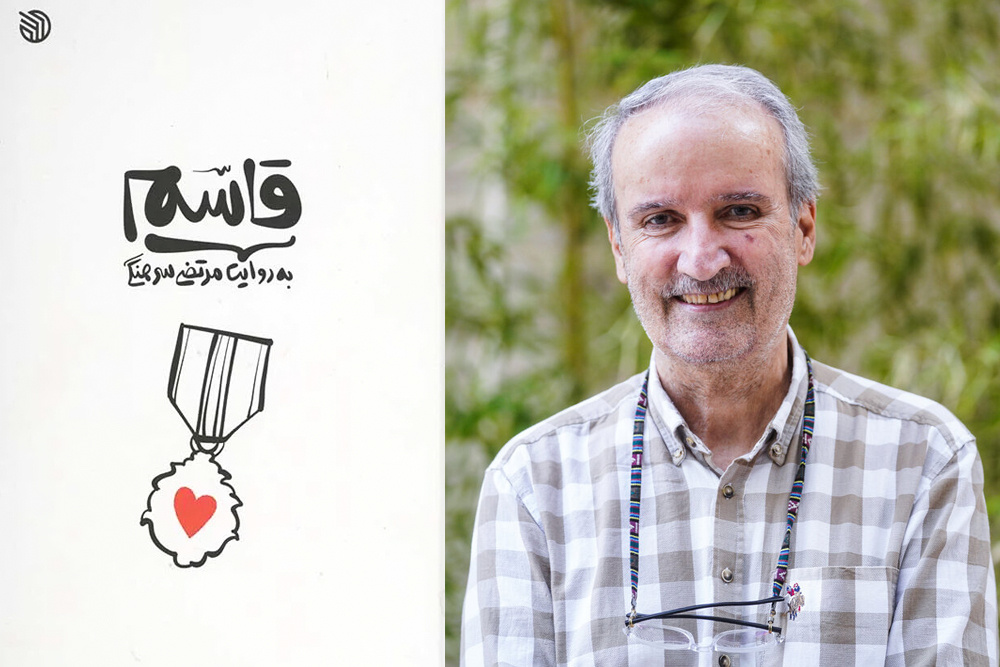
According to the reporter of the Iran Book News Agency (IBNA), “I was supposed to go to India. I had completed my tasks. The ticket was also purchased for Saturday, January 4, 2020. In the dimly lit morning of Friday, a message arrived from my colleague. It said Haj Qasem Soleimani had been martyred. Without taking the news seriously, I replied, ‘Please be careful with such news; it might not be true.’ At the same time, I turned on the television and muted it. The household was asleep. I switched it to Channel 6. A subtitle flashed: Breaking News! Haj Qasem Soleimani, commander of the Quds Force, was martyred at Baghdad Airport.
The news was true. When I believed it, I couldn’t get up from the sofa. Right then, I said, ‘I can’t go to India!'” These sentences are from the introduction of the book “Qasem,” written by Mortaza Sarhangi, a work in the field of resistance literature and oral history, which narrates the life, personality, and field experiences of Sardar Qasem Soleimani. Sarhangi, who has been active for years in documenting the Iran-Iraq War memoirs and recording the narratives of combatants, has continued his special approach in this book: focusing on human narratives, tangible details, and moments that present a close and believable image of Haj Qasem’s personality.
Sarhangi, during the 368th “Night of Memoirs,” says about the details of writing this biography: “The writing of this book has taken more than five years, and during this time, efforts have been made to provide an accurate, multidimensional, and human image of Martyr Haj Qasem Soleimani, in a way that distances itself from purely propagandistic views. To prepare the book’s content, dozens of interviews were conducted with close individuals, comrades, witnesses, and family members to illuminate his life story and personality from various angles. In addition, many details of the book have been compiled based on the study of documents, writings, and Haj Qasem’s personal memoirs. This research method has ensured that the presented image is not only documented and accurate but also accurately reflects his human and moral dimension.”
In various sections of the book, the importance of recording oral history has been emphasized. The author stresses that martyrdom is not merely an “end,” but the beginning of narrating and documenting historical experiences that can familiarize future generations with the realities and values of his life. Recording memoirs and conversations with close associates and comrades has provided a basis for the reader to become acquainted with the diverse aspects of Haj Qasem’s personality and for a complete picture of his life, thoughts, and actions to form in the reader’s mind. Ultimately, this book is more than a historical narrative; it is an effort to preserve the human and moral legacy of Martyr Soleimani.
The book “Qasem” is neither a classic, official biography nor a political analysis. Rather, it is a collection of narratives, memoirs, scenes, and conversations compiled from various sources, which together present an image of the period of Soleimani’s character formation and struggles. The book’s structure is mostly episodic and designed based on short chapters; each section focuses on a memory or event, ultimately leading the reader to a gradual understanding of the main character.
Chapter One: Childhood and Roots
This chapter deals with Qasem Soleimani’s childhood and adolescence in Rabor, Kerman. The rural life, family hardships, work and effort at a young age, and the formation of a responsible spirit are key points of this section. Sarhangi tries to show the hero’s character development within the context of the simple and tough life in southeastern Iran.
Chapter Two: Entry into the IRGC and the Beginning of the Path
This chapter narrates the young Soleimani’s entry into the Islamic Revolutionary Guard Corps in the early years of the revolution. The author provides a clear picture of his initial experiences, training, and responsibilities he undertook early in his journey. The working environment of the IRGC in those years, the enthusiasm of the youth, and the complex conditions of the country are the main themes of this section.
Chapter Three: Deployment to the Front and First Missions
In this chapter, Sarhangi explains Soleimani’s entry into the western and southern fronts. The narratives are mainly quoted from comrades or close associates; the focus is on understanding his first field experiences, the difficulties of operations, and how the trust of forces in him was formed on the battlefield.
Chapter Four: Command and the Formation of Field Management Style
This chapter is dedicated to the years when Soleimani took on more important responsibilities and accepted higher-level command. Sarhangi, by citing behavioral examples, tries to show his command style, force management, communication with combatants, and battlefield ethics. This section is one of the most important and prominent chapters of the book.
Chapter Five: Operations and Decisive Moments of the War
In this chapter, several important operations in which Soleimani played an effective role are narrated. Instead of precise military analysis, the author focuses more on the feelings of the combatants, critical moments, quick decisions, and Qasem Soleimani’s personal characteristics in difficult situations. The energy and tension of the battlefield are felt in this chapter.
Chapter Six: Human Relations and Daily Life at the Front
This chapter moves away from the most formal parts of the book and delves into the human aspects of a commander’s life in war: how he treated his forces, his humor, concerns, care for young forces, moments of solitude and prayer, and his interaction with people in war-affected areas. Sarhangi demonstrates his greatest narrative skill in this section.
Chapter Seven: End of the War and Post-War Responsibilities
This chapter refers to Soleimani’s view of the end of the war, the changing conditions of the country, and his new responsibilities after the war. Although the book does not delve into political details or macro-analyses, it shows how the war years shaped his character and future path.
Chapter Eight: Legacy, Memories, and Narratives of Close Associates
The final chapter of the book focuses on the importance of preserving memories. Narratives from companions, friends, and close associates are quoted, providing a more emotional and human image of Soleimani. The main goal of this chapter is to summarize the image that the book has tried to build of him: a commander with a human spirit, simple living, and a sense of responsibility.
Among the main themes of the book, Soleimani’s youth and entry into the IRGC hold a special place. Sarhangi has tried to show that Soleimani’s rise to the position of Quds Force commander or his prominent roles in later years were the result of a gradual process shaped by the hardships, responsibilities, and experiences of the war era. In many sections, the author, by addressing simple but decisive moments—such as human interactions, daily behaviors, or moral encounters—has tried to reveal lesser-known layers of his character.
One of the book’s features is its soft, emotional, and intimate language. Unlike formal and dry narratives of military figures, Sarhangi seeks to create a more human image; an image in which Soleimani is not just a military commander, but a human being with concerns, emotions, and social relationships. This narrative style has made the book engaging and followable for general readers as well.
Furthermore, the book has tried to recount parts of Soleimani’s role in the Iran-Iraq War; including his presence on the southern and western fronts, his interaction with his forces, and his command style in operations. Sarhangi describes these sections not in dry, military language, but by using narratives from close associates, comrades, and witnesses; therefore, the book’s atmosphere is closer to Sacred Defense literature than a military research book.
On the other hand, the book often avoids direct entry into sensitive political discussions or regional analyses. Although there are references to Soleimani’s role in the post-war years, the main focus remains on the war period and the early years; because the author specifically wants to show the formation of his character and spirit in the context of the war.
Sarhangi, like his other works, pays special attention to the emotional atmosphere of the war, sacrifices, the simple life of the combatants, and battlefield ethics. He does not try to portray Soleimani as a superhuman individual, but he also does not delve into a multi-faceted critique or examination of his actions. Therefore, the book “Qasem” is, more than anything, a work for those interested in heroic and human narratives, not an analytical biography.
In summary, “Qasem” is a book that, rather than pursuing broad political or historical debates, seeks to provide a human-narrative portrait of Qasem Soleimani. This approach has made the work readable for audiences interested in Sacred Defense literature; while for researchers in contemporary history or security studies, it may not provide sufficient in-depth information and analytical documentation.
In a part of this book, we read: “That night, however, I had rested my chin on my hand on the chair and was watching the children play. I thought to myself, if I have any attachment to the world, it is these two granddaughters and two grandsons.
Early in the evening, when I saw the children, I was surprised. I don’t know why I didn’t want to see them that night; I was afraid my attachment to them would weaken my resolve and make me not go. I watched the grandchildren play and felt like someone who is silently saying, ‘How much I love you; but I have to say goodbye to you.’ When I saw them, it was as if God gave me another spirit and vitality. Sometimes when I came out of a meeting and was sad, the children would call Hossein and ask him to call my youngest daughter, Asal, to talk to me so I would calm down. That night, as I was leaving, Fatemeh hugged me. She wanted to say goodbye and go home. She told me, ‘I wish I could hold your legs like when I was a child and not let me go.'”





