Writers Are a Little More Ordinary Than Others
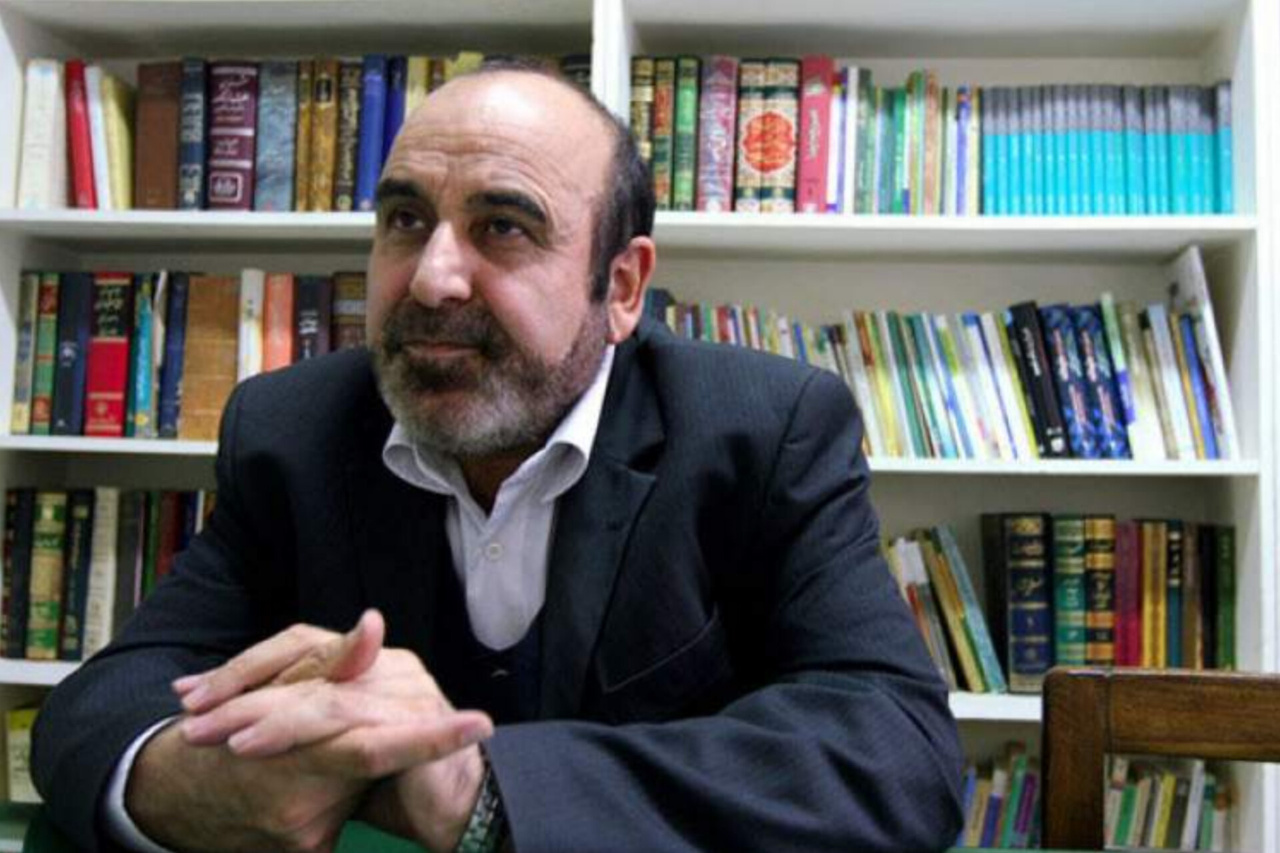
According to the correspondent of the Iran Book News Agency (IBNA), “Behind the Scenes of Writing,” a book by Ebrahim Hasanbeigi, one of the country’s prolific and veteran writers, has recently been published by Tadai Book Publishing. In this book, Hasanbeigi answers the question of how stories are born from everyday events, memories, and travels. “Behind the Scenes of Writing” is the result of his lived experience and the experience of writing over 140 fictional works.
On the occasion of the publication of this work, we had an interview with Hasanbeigi, which you can read below:
What was your goal in writing the book “Behind the Scenes of Writing”?
I never had a predetermined goal for writing this work and didn’t think I would turn the behind-the-scenes memories of my stories into a book. Of course, these memories, which have become a book, were fully presented as examples in story writing workshops, and I asked the students to carefully understand how a writer combines reality and imagination and progresses from a paragraph of text to a storybook. The students’ reception of these memories encouraged me to collect them in a book at an opportune time.
If you wanted to state the difference between ordinary people and writers in one sentence, what comes to your mind?
Writers are ordinary people, and perhaps a little more ordinary.
What is the most difficult stage for a writer in composing a story?
Writing a story has many difficult and easy stages, and when I want to write, part of the difficulty is finding the first paragraph, the introduction; this beginning is difficult. The next difficulties for me are not related to the writing itself, but sometimes I am forced to abandon a story for a trip, illness, or a long party, and returning to the same language and prose with which I started is difficult.
Which of your works do you like the most and why?
This is a difficult question. When the number of children becomes very large, it’s hard to say which are more beloved, but among my works, those I have lived with the most include “Roots in the Depths,” “Ashkaneh,” and “The Saint.”
In the book “Behind the Scenes of Writing,” you mentioned the novel “Shab-e Nasour” as your most distinct novel. Please explain about this novel. Why was your soul’s sweat greater in this work?
The reason for this was that I chose a subject where a group of Savak agents and a group of revolutionaries stood face to face, and naturally, this work was a narrative of pursuits and escapes, but the hardest part of the story was when I had to portray the confrontation between Savak torturers and captive revolutionaries; to advance the story, I had to simultaneously embody the role of a cruel and violent Savak torturer and an imprisoned and oppressed revolutionary, and based on real documents, show how the horrific events of the Savak prison occurred. I became very nervous, and even my family noticed my strange mood. Sometimes my daughter would jokingly ask, “Are you a Savak agent today or a revolutionary?”
An important discussion in the book “Behind the Scenes of Writing” is memories and lived experience, and how a story is born from life experiences. Do you, in addition to lived experience and memories, use stories you have read and information from books as sources for writing your stories?
This use is unconscious, and I do not use reading a story as a source. My being is full of experience, and my way of life is such that, knowingly or unknowingly, these experiences have been created. I have never been sedentary and have not lived in one house for more than eight or nine years. I have traveled extensively and have often advised story writing students to travel a lot and change their place of residence. Also, if you are an employee, do not stay in one office for many years to increase your lived experience.
One of the novels you mentioned in “Behind the Scenes of Writing” is “Muhammad.” To what extent do you think a writer of religious novels can intervene in historical narratives and use imagination?
This is an unfinished discussion. When I started writing religious novels after the revolution, no one talked to me about red lines, and as a religious person with a family religious background, I recognized the sacred boundaries myself. Later, I realized that some strictures and limitations were cumbersome, and not observing them did not harm the novel at all, so I decided to overlook some limitations while maintaining authenticity and accuracy. Sometimes I am criticized for quoting certain words from the Prophet (PBUH) or an Imam, to which I reply that these words and advice are stated based on their character.
One of your novels is “Signs of Dawn.” How important is it for a war literature writer to be present on the battlefields?
The intention to write this work formed in my mind in 1983 before leaving Gorgan for Kurdistan, with the intention of being in the battleground and gaining lived information. One of my motivations for going to Kurdistan was to be in the Paveh area and write a novel about the fall and subsequent liberation of this city. I thought I would write this novel in Kurdistan, but it was written after the war, initially as a screenplay which I submitted to the Art Bureau but it was lost. Later, I wrote it as a novel. For writing this work, I conducted many interviews with individuals present during the events in Paveh, especially at the hospital and gendarmerie building.
Which of your novels do you think has the most potential to be made into a film?
Many of my novels, because they are based on events and not characters, can be turned into films. I wanted the novel “Muhammad” to be made into a film, but Majid Majidi stated that his film focused on the childhood of the Prophet (PBUH). I believe that if the novel “Signs of Dawn” had reached Hollywood producers, it would have been well received because I tried to portray the fall and liberation of a city in a story full of events. Unfortunately, when I proposed this book for adaptation to IRIB, they told me that due to the end of security issues in Kurdistan, such films would no longer be addressed, but then we saw investment in the film “Che.” The books “Purple Years” and “Shab-e Nasour” are also good options for adaptation, but unfortunately, my follow-up for adapting “Shab-e Nasour” into a film was ignored. Several of my works in the children’s and young adult literature, including “Golden Fish and Silver Fish,” and also the collections “Soufi and the Magic Lamp,” “Amirhossein and the Magic Lamp,” and “Gisoo and the Magic Lamp” can be turned into animated series. Although I have published 140 fictional works, mostly in the field of religion and Sacred Defense, IRIB only once used a children’s book about prayer without my permission.
You mentioned the book “Soufi and the Magic Lamp.” How successful has this work been in attracting an audience?
This work and two other books named “Amirhossein and the Magic Lamp” and “Gisoo and the Magic Lamp,” which were planned to be a five-volume series, if published in Japan, would have served as inspiration for creating animations. In these books, which utilize the global mythological belief of the genie in a lamp, this time the genie is a baby genie who cannot come out of the lamp and only his voice is heard. This little genie goes to teenagers who have big dreams but do not know the path to achieving them.