Unveiling of the Poetry Collection ‘From Olive Grove to Deer Plain’
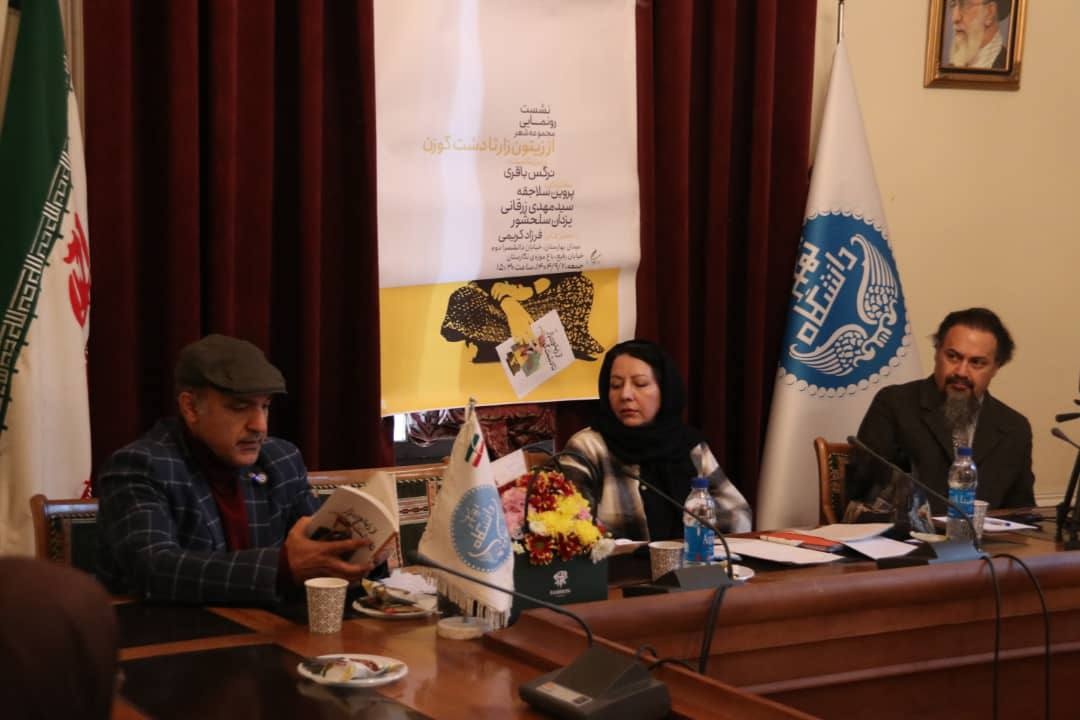
According to the literary correspondent of the Iran Book News Agency (IBNA), the unveiling ceremony of the poetry collection ‘From Olive Grove to Deer Plain,’ penned by Farzad Karimi, was held on November 28, 2025, at Master Moin Hall of Negarestan Garden Museum in Tehran. Dr. Seyyed Mehdi Zarghani, Professor of Persian Language and Literature at Ferdowsi University of Mashhad, was the first speaker at this session. In a talk titled ‘Organized Assault on Language,’ he reviewed and analyzed the poems in this collection. Zarghani introduced this title as a definition of poetry by formalists, viewing it as a controlled assault to create prominence in artistic language.
He stated: “In this approach, one must see how the poet has managed to transform language into poetry. With this in mind, the poems in this collection can be considered modern. The language of these poems is such that it maintains its potential for expansion; therefore, there is no need to worry that the poet will suffer from a lack of technique for the continuation of his poetic journey. Employing such a technique is very difficult, and consequently, explaining this technique is also a difficult task for a poetry analyst, which is a characteristic of such poetry.”
This literary researcher considered the essence of Farzad Karimi’s poems in the discussed collection to be love for a modern human, and likened the presence of social contexts in these poems to Nizar Qabbani’s love poems, where social issues are scattered in the background of his poetry.
According to Zarghani, some weaker poems also exist in the collection, and the poet himself is astute enough to know which poems are weak and need to be removed in subsequent editions.
He considered the two phrases ‘ambiguous dreams’ and ‘distant memories,’ taken from the poems of this very collection, to be very illuminating and key to understanding Farzad Karimi’s poetry.
Dr. Parvin Salajegheh, university lecturer and poet, was the second speaker at this session, presenting a talk titled ‘Language and Axes of Deviance’ from a general linguistics perspective. This literary critic considered Farzad Karimi’s poetry modern due to its departure from the norms of traditional rhetoric.
Salajegheh explained: “This departure from the norm has occurred beyond merely violating rhyme or some other traditional rhetorical devices. The primary factor that has taken the language of these poems out of the norms of standard language is the element of emotion. The result of this deviation has guided the poetry towards chronotopia, topotopia, anthropotopia, and similar instances. Such an approach, by drawing upon historical references, mythological references, and a small amount of symbolic references, has moved beyond classical rhetoric, to the extent that sometimes we encounter poetic delirium in this collection.”
Salajegheh considered linguistic anomaly in these poems to be the product of imagination, not of the type of simile, but of creating specific delusional spaces. Chronotopias that evoke heroic myths of Iran or other regions, as well as history, have opened another path for linguistic anomaly in poetry. Furthermore, the archaic mindset of the poet, without excessive use of archaic language and by subtly blending sophisticated language with standard language, has marked another aspect of the poetry’s linguistic anomaly.
The session secretary, Dr. Narges Bagheri, poet and faculty member of Qazvin International University, was the third speaker. She delivered her talk titled ‘Aesthetics of Distance.’ Bagheri considered the presence of myth in literary text as a sedative that transforms the world into a safer place to live and helps us create meaning for our lives in this meaningless world. From this perspective, the poetry collection ‘From Olive Grove to Deer Plain’ is a fusion of demythologization and myth-making.
According to this literary researcher, wherever a woman’s role is encountered in the poems of this collection, the poet has engaged in myth-creation or myth-invocation.
She explained this point, saying: “For example, one can refer to the myth of Anahita, who, when she places her foot in the Zayandeh-Rood, water flows; she is a symbol of fertility, a supporter, an embodiment of love and life. Such an encounter leads us to face the absence of women in the text. In this worldview, the goddess is the central signifier whose absence empties the world of meaning. In contrast, wherever a man is mentioned, we encounter demythologization, like the line: ‘A man busy dying himself’ from the first poem of the collection. The critique of myth and the creation of space for new meaning and new myth is a sign of the text’s and society’s dynamism. If we reduce a woman to an object, even if it is not a sexual object but a spiritual one, she will become a deity for men, seen and expressed through the male gaze. From a feminist perspective, this beauty and spirituality are products of a patriarchal gaze.”
The fourth speaker of the session was Dr. Ghodratollah Taheri, Professor of Persian Language and Literature at Shahid Beheshti University. He began his speech titled ‘Pause,’ by referencing the fast pace of life in the modern world. In his opinion, one must know where to pause because the result of pausing is perception. Pause-inducing phenomena can be pleasant or unpleasant, but the result of both is beauty. Many things in human life create pause. Linguistic phenomena are among those that can create pause in a literary text.
Taheri added: “The language of these poems is more direct and aims to reduce ambiguity compared to Farzad Karimi’s previous collections. The poet has poured fewer myths into the text than in previous works to establish better communication with the audience.” This literary researcher then examined the state of pause in the collection by reading an example: “The woman was more deer-like than beautiful.” According to Taheri, forming a comparative adjective from a noun, contrary to Persian grammar rules, creates a pause in the text. This is an unconventional linguistic phenomenon, but its unconventionality is not so extreme as to prevent understanding. Another example: “And my migration was to me.” Considering the meaning of migration, being a subject while also being an object creates a pause, which is the product of the poet’s linguistic discoveries.
He said: “There are many such linguistic discoveries in this collection. As the reader gets accustomed to unusual and unexpected linguistic discoveries, they also get accustomed to unusual and unexpected meanings; for example, in the theme ‘a man who was busy dying himself / a man who was busy dying himself,’ subject and object are intertwined again.”
Dr. Reza Ternian, university lecturer, poet, and literary researcher, was the last speaker of the session, providing explanations about the myth of the deer in Iranian culture. Ternian introduced the deer as one of Iran’s myths which, although less regarded in later times, had a prominent presence in the cultural background of Iranians. According to this literary researcher, the type of deer emphasized in Farzad Karimi’s poetry belongs to the northern American lands and is therefore not part of Iranian culture, which leads to considering the deer in these poems as imaginary.
At the end of this session, Farzad Karimi briefly referred to the cover designs of his seven published poetry collections and, emphasizing the importance of cover design in completing, introducing, and displaying a book, appreciated Naser Nasiri, the designer of the covers of his seven poetry collections.
The poetry collection ‘From Olive Grove to Deer Plain,’ comprising 76 poems and 124 pages, has recently been released to the book market by Ney Publishing.





