“Kohanboom”: A Poetic Narrative of the Ancient Land of Iran
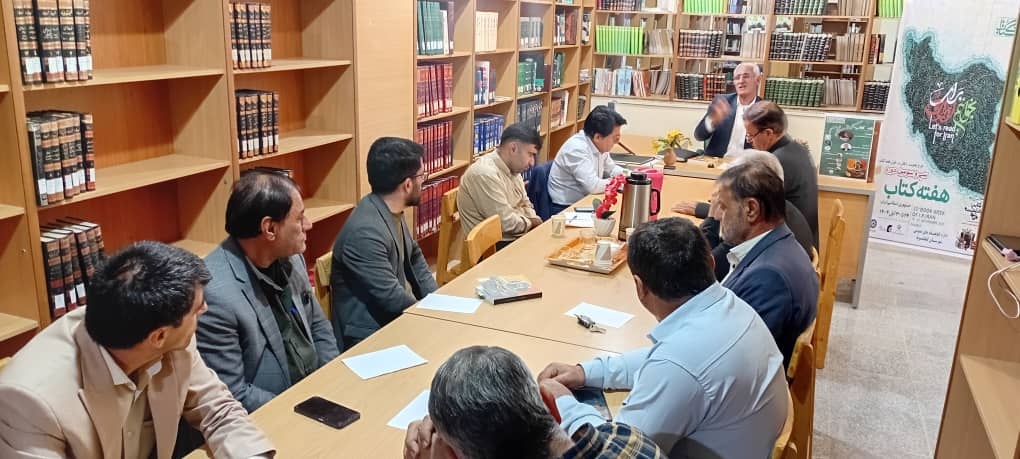
According to the Iran Book News Agency (IBNA) in Dehdasht, a review and discussion session for the book “Kohanboom” was held with the presence of the author, poets, researchers, and officials from the public libraries of Kohgiluyeh county.
In this session, various aspects of the book, including its language and vocabulary, literary devices, historical narrative, and characterizations, were analyzed, and the necessity of revising certain sections and complementing historical sources in subsequent editions was emphasized.
Seyed Nabiollah Taghavipour, head of the Public Libraries Department of Kohgiluyeh county, stated: “Holding book review sessions is one of the central programs in the county, and within this framework, Seyed Ahmadreza Fazilatmanesh’s book ‘Kohanboom’ was reviewed by critics.”
He added that review sessions help identify the strengths and weaknesses of works: “The aim of holding this session is to provide a specialized analysis of the book and facilitate dialogue between the author and critics to offer a more precise evaluation of the work.”
Seyed Rahman Saeidi-Sogh, poet, literary critic, and secretary of the session, said: “After studying the work, he examined points in three domains: linguistic, literary, and intellectual. In the linguistic and vocabulary domain, the poet pointed to the frequent use of the letter ‘Vav’ at the beginning and end of verses and enumerated examples.”
Saeidi considered the appropriate syntactic connection of the verses and the prose-like nature of the work’s language as factors contributing to text comprehensibility, adding: “Although the linguistic techniques used in the poetry are numerous and noteworthy, in some sections they have led to linguistic deficiencies.”
He referred to examples such as the concise reading of the word “روی” (on/face) in the phrase “his shadow on his head” and the ambiguity of some expressions.
He also addressed typographical and spelling errors in the book and listed the poet’s coinages, such as “Vezaratkadeh” (ministry-house), “Mard-a-Mard” (man-to-man), “Mah-ben-Mah” (moon-by-moon), and “Nang-aghin” (shame-laden), as linguistic features of the work.
The veteran poet further focused on the literary domain of the book and stated: “Literary devices in this work have been used with precision and creativity.”
He listed examples of pun, allusion, irony, and metaphor in various parts of the work and considered the book’s symbolisms as thought-provoking aspects; he mentioned symbols such as the bear for the Soviet Union, the fox for England, the wolf for Rome, and the shark for the Portuguese in the Persian Gulf.
Saeidi identified the third domain of the book as intellectual and said: “The author’s fidelity in historical narration and avoidance of one-sided judgments are prominent features of the work.”
According to this critic, narratives related to the Qajar and Pahlavi eras are presented without bias and by avoiding extremism.
He also referred to the author’s devotion to Imam Ali (AS) and the prominent poetic quality of the seventh chapter of the book, considering the choice of a non-epic meter and the ‘charpareh’ (quatrain) format as a sign of the poet’s innovative thinking.
Saeidi, referring to the humor used in the work, recalled examples of these humorous elements in sections related to the Arab invasion of Iran and the end of the Qajar rule.
Seyed Ghaffar Ganji, a poet and literary critic, stated in this session, referring to the poet’s creativity in choosing a less frequently used meter and form in long poems: “The narrative in parts of the book, especially at the end of the second and beginning of the third chapters, is engaging and poetic.”
He added: “This type of narration continues in many chapters, but in some sections, the text is limited to short and fleeting reports.”
Ganji, by reading examples from the Achaemenid chapter, emphasized the need to strengthen the narrative in other chapters and said: “The poet’s entry into the narrative text and the expression of personal views requires establishing a clear boundary between historical narration and poetic expression.”
He mentioned editorial rereading, correction of typographical errors, inclusion of more sources, and the use of illustrations and footnotes as points that could be considered in subsequent editions.
Alisina Barghak, a teacher and history researcher and head of the Kohgiluyeh and Boyer-Ahmad History Association, noted, referring to the fact that the historical section of Shahnameh covers from the Parthians to the advent of Islam: “‘Kohanboom’ purely deals with historical narrative and has not entered the realm of myth.”
He considered the book’s attention to the history of ancient Elam noteworthy and added: “Lesser-known dynasties are mentioned in the work with correct chronological order, alongside Babylonian and Akkadian dynasties.”
This critic, referring to the limited sources regarding the Anshan dynasty, suggested that this section be completed in the next edition.
Barghak also referred to the narration of Elamite dynasties such as Awan, Peli-awan, Shimashki, Sukkalmah, Kidinuids, and Igehalkids in the book and said that the author has managed to blend these narratives with poetic language.
Seyed Kheyrullah Elahidoust, poet, university lecturer, and head of the Kohgiluyeh Poetry Association, continued the session by stating: “Strengths of the book include its poetic music, fluent language, beautiful compositions, and a coherent narrative from both linguistic and storytelling perspectives.”
He considered the dramatic scenes in the narration of wars and romances, as well as the work’s characterizations, as prominent parts of the book, citing examples such as the lives of Nader Shah and Agha Mohammad Khan.
Elahidoust noted the connection of these characterizations to the poet’s education in psychology and, in outlining weaknesses, mentioned the high pace of narration and the reporting style of some text sections.
He emphasized: “Although the proximity of poetic language to prose has made understanding the work easier, in some cases it has affected the music of the poetry, and it is necessary for the characters in the overall work to become closer to poetic characters.”
Sadra Salahi, another critic at this session, also proposed suggestions regarding the book’s layout and said: “Using appropriate columnization and placing prose text alongside the poem in an alternating manner could help improve the visual quality of the work in its second edition.”
Finally, Seyed Ahmadreza Fazilatmanesh, the author of “Kohanboom,” referring to the critiques, said: “He accepts a large part of the critics’ points and does not deny potential errors in rhyme, meter, and spelling or punctuation, attributing them to the lack of a precise final edit, which will be corrected in subsequent editions.”
Regarding Seyed Rahman Saeidi’s linguistic and content critiques, he explained that his stance in the narratives is based on Iran, and he has tried to avoid common dichotomies and maintain neutrality when narrating sensitive periods such as the Qajar, Pahlavi, and early Islamic eras.
He noted: “Even in narrating figures like Alexander and Genghis, although the author’s position was focused on Iran, he tried to accompany the narration with fairness.”
Fazilatmanesh continued, in response to Seyed Ghaffar Ganji’s critiques, saying: “Narrative deficiencies in parts of the book stem from historical gaps; points about which sources have not said much. These are instances where the author had more freedom to write extensively.”
He emphasized: “These gaps can create opportunities for literary creativity, but a clear boundary must be maintained between historical narration and mythical elements.”
He also attributed the omission of numerous historical sources to the author’s freedom in narration, stating: “The only source explicitly mentioned is ‘Ruzegaran’ by Zarrinkoub.”
The author further explained regarding the points raised by Alisina Barghak that the absence of the Anshan dynasty was due to a scarcity of sources, adding: “The narration of Elamite dynasties in the work was strengthened with the suggestion of the book’s historical editor.”
Regarding Seyed Kheyrullah Elahidoust’s points, Fazilatmanesh said: “I could have delved more into some historical events like the Ashura incident, the Battle of Ariobarzanes, and the uprising of Ya’qub ibn al-Layth, and expanded them poetically, which I will consider for future editions.”





