Where did the Aryan Marriage Ceremony come from?
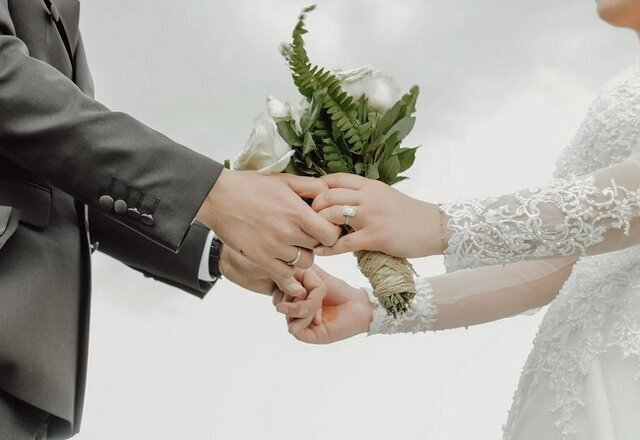
According to Khabar Online, for several years, a ceremony known as “Aryan Marriage” has become popular in some wedding ceremonies and is mostly seen in virtual spaces and celebrity gatherings; a ritual that many attribute to ancient Iran and perform as a symbolic alternative to official or religious marriage. However, the main question remains: Does this emerging ceremony have historical support and authenticity in ancient Iranian texts, and what do historical documents say about it? An interview by ISNA with Alireza Hasanzadeh, Associate Professor at the Research Institute of Anthropology of the Cultural Heritage and Tourism Research Institute, based on his research and studies, indicates that what is known today as “Aryan Marriage” has no roots in the legal and religious sources examined from the Sasanian period, nor is there any trace of it in classical Iranian literature and rituals. It appears to be a contemporary phenomenon, mostly a product of cultural developments and virtual space representations rather than a historical legacy from Iran’s past.
ISNA wrote: Below is the detailed interview with Alireza Hasanzadeh, Associate Professor at the Research Institute of Anthropology of the Cultural Heritage:
Is “Aryan Marriage” historically supported and authentic?
Most of our information about family, marriage, and related elements pertains to jurisprudential, legal, and religious texts from the Sasanian period. These texts include collections such as Matikan Hazar Datastan (a legal and judicial collection from the Sasanian era), Avesta (with a very ancient oral tradition; parts of it likely organized during the Achaemenid-Arsacid periods, but its final compilation and stabilization occurred in the Sasanian era), Dinkard (the great encyclopedia of post-Sasanian Mobads, compiled in the early Islamic centuries), Shayest Na Shayest (a Zoroastrian jurisprudential text, probably 9th to 11th centuries AD), and Ardavirafname (the story of a Zoroastrian Mobad’s journey to heaven and hell, with the existing narrative belonging to the Islamic era). These texts describe the normative aspects of a couple’s behavior; the duties of husband and wife, penalties for breaking commands, the nature of legitimate marriage, purity and impurity, sin and reward. These are Zoroastrian law books and religious texts that explain the religious and ethical principles of marriage.
It should be noted that in Zoroastrianism, marriage is a religious act and an action against Ahriman (evil spirit). In the Vendidad of the Avesta, the duties of husband and wife, rules of adultery, contamination, purity, and chastity are explained. In Dinkard, the rights of husband and wife and the role of children are discussed. Matikan Hazar Datastan speaks about dowry, divorce, inheritance, and types of marriage. Shayest Na Shayest also addresses the rules of “Dashtan” (menstruation), purity, dowry, and the moral dimensions of marriage. Ardavirafname also depicts the rewards and punishments for the behavior of men and women, such as obedience or disobedience to the spouse, bodily purity, adultery, and infidelity. In 2002, a book titled “Woman and Culture,” edited by me, was published to commemorate the centenary of the birth of the famous anthropologist Lady Margaret Mead, in which researchers such as Katayoun Mazdapour, Nahid Tavassoli, Shervin Goodarzi, and others discussed this extensively, and I refer you to that book published by Ney Publishing.
Therefore, in none of this written heritage, is there any instance that can be called “Aryan Marriage.” This matter is important because these sources are jurisprudential and legal sources from Iran’s historical periods, and if something were to exist, it should have been in these sources. It must be noted that a contract (aqd) is a jurisprudential and legal text and should have a written record.
Is the Aryan Marriage Ceremony also mentioned in ancient literary texts?
In classical Iranian literature, what we have is a poetic representation of marriage, not a legal contract. Most marriages described in epic literature are the unions of Iranians with Turanian and Iranian women (Tahmineh, Rudabeh, Farangis, Manizheh, etc.). In these texts, the focus is on the beauty and chastity of women, the splendor, wisdom, and power of heroes, rituals of celebration, feasts, minstrelsy, gifts, and sometimes the role of fathers and elders in courtship. In none of these descriptions is there a contract titled “Aryan Marriage,” nor is it mentioned.
What references are made to this in the historical Islamic period and philosophical texts of the early and middle Islamic centuries?
In the works of philosophers such as Farabi (10th century) and Avicenna (10th–11th century), the ethical and philosophical tradition of pre-Islamic Iran is combined with Islamic teachings and Greek philosophy. In Islam, too, marriage, like in Zoroastrianism, is a divine duty that completes a person’s faith and religion.
The most important concept regarding family in Islamic period philosophy is “household management” (Tadbir Manzil). Farabi has a relatively egalitarian view of men and women; he considers women as partners to men in building the ideal city (Madinah Fadilah). Avicenna defines the role of women more in the domestic sphere but bases the relationship between husband and wife on affection, not obedience.
The movement of philosophical-ethical discourse from Farabi and Avicenna towards Abu Hamid Muhammad Ghazali (11th–12th century) gradually diminished the status of women. Ghazali, in Kimiya-ye Sa’adat and Ihya’ ‘Ulum al-Din, adopts a jurisprudential and authoritarian view of women: obedience to the husband, restriction from leaving the home, control of speech, veiling, and a fear of the body. This discourse led to and bequeathed a connection between misogyny and somatophobia in medieval Islamic-Iranian culture. Woman became a symbol of male impurity and downfall and, for this reason, had to be strictly controlled. This view was remarkably distant from Farabi’s perspective.
Following this tradition, Nasir al-Din Tusi in Akhlaq-i Nasiri (13th century), Qabusnama (Unsuralma’ali, 11th century), Nameh-ye Tansar (rewritten by Ibn Isfandiyar, 6th Hijri century; original related to the Sasanian period), Siyasatnama by Nezam ol-Molk (11th century), Javidan Kherad (attributed to Ibn al-Muqaffa, though its attribution is not certain and it was compiled later), all present an image of gender roles in which theoretical and practical reason are mostly attributed to men, and women are defined within the domestic sphere for preserving offspring and childbearing.
In Islamic mysticism (Irfan), man is also the symbol of the outward and divine intellect; woman is the symbol of the inward, light, and hidden truth. For this reason, “outward guardianship” (velayat-e zaheri) is considered to belong to men, and women are deprived of higher levels of power.
How are marriage rituals and celebrations described in ancient Persian literature and texts; is there any sign of the Aryan Marriage Ceremony in them?
Based on Ferdowsi’s Shahnameh, the works of Nezami Ganjavi, and Vis and Ramin by Fakhruddin As’ad Gorgāni, one can speak of the representation of marriage. In Shahnameh, marriages like Zal and Rudabeh, Siyavash and Farangis, etc., are described with night gatherings, feasts, minstrels, celebrations with music, drums, and flutes, gift-giving by the groom’s family, and the presence of elders and Mobads (in some sections), but no specific legal or ritual contract is mentioned. What exists is a descriptive representation of a “celebration,” not a “contract.”
In the works of Nezami Ganjavi, such as Khosrow and Shirin, Layli and Majnun, Eskandarnameh, there are descriptions of feasts, gifts, bride’s adornment, and ceremonial celebrations. But again, there is no text named “Aryan Marriage.” In Vis and Ramin, which is one of the oldest Iranian romantic tales, the courtship ritual, wedding ceremony, family’s role, gifts, and the presence of Mobads are described. But there is no independent ceremony called Aryan Marriage.
So, where did the “Aryan Marriage” ceremony, in its current popular form, come from?
Ignoring pre-Islamic culture led to the formation of an alternative and liminal culture in informal society, which has two sources of inspiration:
1. Ancient Iran
2. Western cultures (Valentine’s Day, Halloween, etc.)
In an article in 2002 in the “Social Sciences Journal” of Tehran University, regarding Chaharshanbe Suri and national football, I showed that policies of formalizing post-Islamic events and restrictions imposed on national rituals like Chaharshanbe Suri (especially in the 1980s) caused popular culture to move towards reconstructing ancient identity with carnivalistic dimensions. From the mid-1990s, this trend strengthened, and Iranian national football became carnivalistic/polyphonic with the simultaneous presence of men and women. From the 2000s, rituals like Valentine’s Day and Halloween also appeared, and even rituals like Christmas linked with Yalda, meaning our national culture.
In this same trend, “Aryan Marriage” or “Aryan Mourning” also emerged in the last decade, and was represented in celebrity wedding celebrations. But this form, what you call Aryan Marriage and White or Aryan Mourning – not based on any historical text or reference, but as a cultural reaction against the formalization of culture and the lack of inherited justice in attention to ancient Iranian history.
Iranian identity, while maintaining national unity, is polyphonic and based on cultural diversity. This diversity is interconnected and essential under the umbrella of “Iranian national identity”; a rainbow identity with a deep connection. Ignoring any part of this diversity provokes a critical reaction from popular culture and manifests itself in informal culture.
Therefore, “Aryan Marriage” is a cultural response to the denial or lack of attention to parts of Iran’s historical identity, especially pre-Islamic Iran, and has occurred in a spontaneous and popular process as a critical action against cultural policymaking.





